

Somos
What we’ll be talking about at Somos
Power up the rumor mill – it’s not just election results.
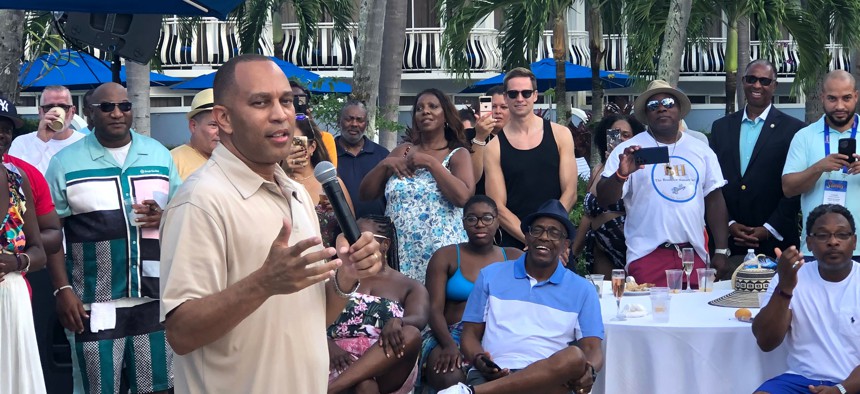
Rep. Hakeem Jeffries speaks to a poolside crowd at the Somos conference in 2022. Jeff Coltin


Election Day is nearly upon us – which means that the Somos Puerto Rico conference is also nearly upon us. The gathering is a way to promote collaboration between New York state and Puerto Rico, and for New York politicos to schmooze, sit poolside and learn from their colleagues in San Juan, Puerto Rico. But with the island experiencing an ongoing water shortage, the vibe at Somos may be a bit different this year and some are choosing to not attend altogether. As always, there will be plenty to talk about right after Election Day. Here’s what people will be talking about at Somos.
AOC’s big choice
Rep. Alexandria Ocasio-Cortez’s future plans will be the talk of the town during Somos. Will she run for president in 2028? Or will she challenge U.S. Senate Minority Leader Chuck Schumer? She’s said she’ll reassess things after the midterms – a period of time that will begin with Somos (though she typically has not attended the conference). Ocasio-Cortez’s decision could open the door for many other scenarios to play out. If she doesn’t run for Senate, who will? And who would replace those people? “2027 is going to be that great reconfiguration,” Democratic consultant Ryan Adams said. “Not just for 2028 – there will be people who are thinking about 2029 (who) will be positioning themselves in 2028.” And all of that, of course, could kick off at Somos this year.
Hochul’s election takeaways
As Democratic consultant Yvette Buckner put it, the results of this year’s elections are going to be an indicator of whether New York is truly blue or actually more purple. But just as telling will be – should she win reelection – Gov. Kathy Hochul’s margin of victory, where she struggled and where she did well, plus how she fared compared to downballot candidates and her own lackluster 2022 performance. All of that will inform important conversations at Somos, more than one insider said. How will her electoral performance influence her policy goals for next year and beyond? And how will that influence the working relationship between Hochul and New York City Mayor Zohran Mamdani? “I assume that he’s going to go (to Somos) and do a celebratory presence with the governor – a united front kind of thing, and that they’re working together,” said journalist and political commentator Gerson Borrero.
Jeffries as speaker?
With House Minority Leader Hakeem Jeffries potentially on the precipice of becoming the nation’s first Black House speaker, there will be buzz about the Brooklynite and what he’ll do if Democrats emerge with the majority on election night. But there may also be discussions about whether soon-to-be members of Congress in the party’s left wing, like Darializa Avila Chevalier and Claire Valdez, will vote for Jeffries for speaker, or what concessions they might seek. Also an open question, as Buckner pointed out, is what role Mamdani will play in influencing that process, seeing as he backed both of them over more establishment candidates and actively lobbied against New York City Council Member Chi Ossé challenging Jeffries. Could Jeffries end up negotiating with Avila Chevalier and Valdez in exchange for “yes” votes at Somos or in the weeks to come? “If they have him by his political testicles, he will follow,” Borrero said. “It depends on the numbers (in the House). If it’s really tight, he will have to lobby them, and that’s a good place to talk.”
Musical chairs in the Legislature
With a significant number of high-profile departures from the state Legislature and numerous chair positions up for grabs, this is likely to be a hot topic. Of course, there are the big questions of who will replace Mike Gianaris as state Senate deputy majority leader and Crystal Peoples-Stokes as Assembly majority leader. Also, expect to hear about lawmakers putting their names forward to lead key committees in both chambers, including the Housing, Finance and Labor committees in the state Senate and Transportation and Environmental Conservation in the Assembly.
Refocusing on Puerto Rico
Given the water shortage in Puerto Rico, some people are opting not to attend this year’s conference, or at least have mixed feelings about going, not wanting to further tax the island’s resources. But Camille Rivera, partner at New Deal Strategies and president of La Brega y Fuerza, tried to put those concerns to rest. “People should not feel reluctant to go to Puerto Rico,” she said. “There is nothing wrong with going to the island to support the infrastructure, to support the tourism. These are people who have jobs that very much rely on that.” Not to mention, addressing issues like water access, infrastructure woes and the like on the island are part of the original purpose of the conference. “There’s a reason that we go there – and yes, there’s definitely some kind of, like, ‘Oh, it’s a junket.” Rivera said. “I’m going to be going to Somos in my capacity as the president of La Brega y Fuerza to be able to kind of highlight these issues … it’s really actually a good opportunity for us to take issue with what’s actually happening on the island.” Expect energy around supporting Puerto Rico to go beyond panels and a day of service this year.
Other whispers
The never-ending saga that is the legal battle for control of the Brooklyn Democratic Party likely will continue into 2027, but there’s no shortage of immediate hot takes on the drama. As much as people might want to talk about other things, it’s hard to escape the all-encompassing chaos of this fight. It’s also possible we’ll see potential candidates positioning themselves for 2029 runs for borough president in Brooklyn, the Bronx, Staten Island and Queens. Plus, it’s never too early to discuss the 2029 New York City mayoral race, public advocate’s race and more. Those aren’t the only career moves that could be rumored at Somos – might we hear whispers of any shakeups in the Hochul administration, should she win reelection? But with no elections in 2027, perhaps it’s finally the year that policy issues dominate the conference – and maybe that means figuring out what lawmakers will take on next year in Albany other than taxing the rich, regulating artificial intelligence and determining the long-term future of data center development.