

Opinion
Opinion: Affordability begins with food and New York must act now
The state needs a modern food system that can absorb federal uncertainties and withstand market shocks.
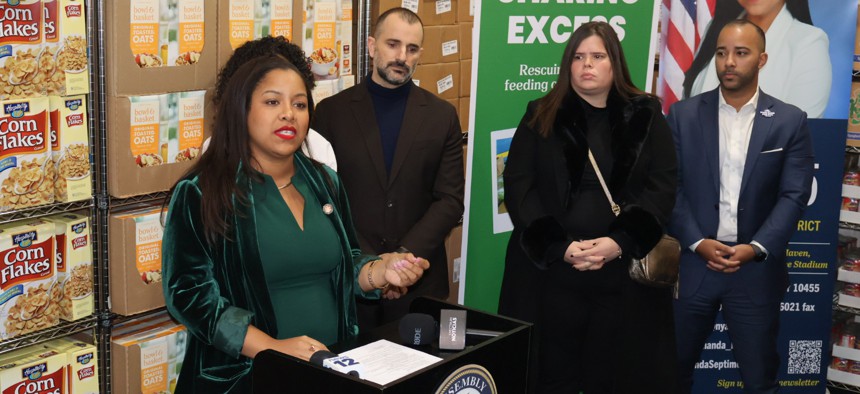
Assembly Member Amanda Septimo has proposed a tax credit to help solve food insecurity. Malvin Sanabia, district director, Assembly Member Amanda Septimo’s office


Food is the most universal part of our lives. It connects us. It cuts across language, geography and political identity. It is the common denominator of the American experience and one of the most immediate indicators of whether a community is truly doing well. In the Bronx, across New York state and the nation, nothing affects families more directly than the ability to afford groceries and medicine, pay rent and keep the lights on. These are the pillars of real affordability, and far too many New Yorkers are finding their expenses are more than their incomes.
Grocery prices have climbed to levels that families simply cannot absorb. Rent continues to rise amid housing scarcity and lack of deep investment in the New York City Housing Authority. Utility bills show no signs of easing. For many households, the budget no longer stretches to the end of the month. And while we often talk about the economy in abstract terms, families experience it in four simple categories: rent, utilities, medicine and food. When those falter, everything else does too.
Food is the one essential where abundance already exists. New York produces, distributes and imports more than enough food to feed every child, every senior and every working family. Yet the systems responsible for moving that food into communities are outdated, fragmented and deeply vulnerable to shocks. The recent federal shutdown and disruptions to the Supplemental Nutrition Assistance Program made that painfully clear, overwhelming food pantries and leaving families stranded long before Washington, D.C., resolved its gridlock. As documented in recent analyses, New York’s charitable food network is overburdened, its logistical capacity is insufficient and millions of pounds of high-quality food are wasted each year because it is cheaper for businesses to discard food than donate it.
This contradiction – waste on one side, hunger on the other – is not just a policy failure. It is a moral failure. It is not a partisan issue. Hunger does not vote blue or red. As national food security leaders have noted, America produces far more food than it consumes; the challenge is not supply, but waste, broken logistics and the politicization of essential programs like SNAP and WIC. When government dysfunction threatens a family’s ability to put food on the table, it undermines both stability and trust.
In the Bronx, the consequences are deeply personal. Food pantry lines grow longer each week. Seniors ration meals so medication lasts. Parents skip lunch so their children don’t go without dinner. Community organizations, like Afrikana and the Kingsbridge-Riverdale-Van Cortlandt Development Corp., hustle, with limited staff and fewer resources, to respond to surges they can no longer predict. All the while, food that could nourish these families spoils in warehouses, gets dumped in landfills or is left unharvested because the transportation and storage costs are too high.
We can fix this because the solutions already exist. Innovative bootstrap organizations have developed solutions before the government could mobilize to do so. Across the state, partnerships are proving what is possible when we modernize our food rescue infrastructure and invest in upstream and downstream collaboration. Most recently, Sharing Excess, one of the nation’s largest food rescue organizations, and Catholic Charities, one of New York’s oldest human services organizations, have built a high-volume rescue program that uses data tracking, cold chain logistics and coordinated dispatch systems to move surplus food efficiently and predictably into communities. This partnership builds on Sharing Excess’ nationwide model and creates meaningful impact where food abundance goes to communities that need food the most.
Their model shows that when we invest in logistics, not just goodwill and charity, we can reduce waste, stabilize supply and give families reliable access to quality, nutritious food.
But modern logistics require modern incentives. New York’s proposed Food Rescue Tax Credit, which I recently introduced, would finally make it economically sensible for farmers, distributors, retailers and wholesalers to donate high-quality food instead of throwing it away. By covering 65% of the value of quality donated goods, as well as the transportation and storage costs, the credit would level the playing field and ensure that doing the right thing is also the financially rational thing. For prepared meals, similar concepts, like the Chef to Community Tax Credit, building off the Sharing Excess model in Pennsylvania and being led by Rethink Food here in New York, have the potential to demonstrate how restaurant-driven meal production can improve health outcomes, stabilize small businesses and deliver millions of hot meals in high-need areas at relatively low cost.
All of these approaches point toward a larger truth: Food access should never be threatened by political dysfunction or bureaucratic delay. New York needs a modern food system that can absorb federal uncertainties, withstand market shocks and ensure that every family has dependable access to affordable, nutritious food. The Bronx deserves that. Every community deserves that.
Food is not political. It is essential. And building a food system that reflects our values – equity, dignity and resilience – is not just good policy; it is the foundation of a stronger New York. It is also the kind of forward-looking work our communities expect from leaders who understand that the most important issues aren’t ideological, they are everyday realities that put food on the table and roofs over our heads. Families deserve a food system as strong as they are. And New York has everything it needs to build one.
Let’s put party and politics aside and build it together.
Amanda Septimo is an Assembly member representing District 84 in the South Bronx.
NEXT STORY: Opinion: Jewish CUNY students still need support