

Opinion
Opinion: City leaders must continue the work to protect and strengthen NYC’s nonprofits
For years, nonprofits have suffered from a complex municipal contracting and payment system that has made their work unnecessarily difficult.
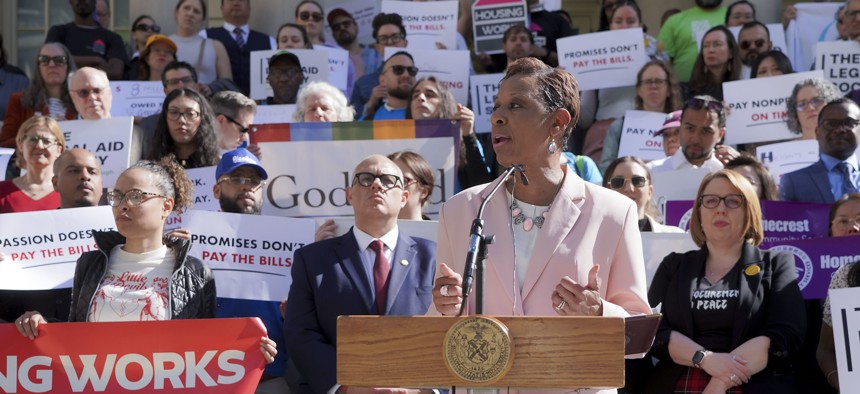
New York City Council Speaker Adrienne Adams, center, and Human Services Council Executive Director Michelle Jackson, attend a press conference outside City Hall to push for legislation to reduce the city’s payment delays to nonprofits, on April 30, 2025. Gerardo Romo / NYC Council Media Unit


New York City’s nonprofit human services organizations form the frontline workforce that helps millions of families and residents survive in our city. They provide shelter and food assistance, care for older adults, assist immigrants, develop young people and deliver mental health services in our neighborhoods, but their stability has been undermined by city bureaucracy and the Trump administration’s attacks.
As continued federal budget cuts further threaten the ability of these nonprofits to deliver for our city and all New Yorkers, it’s critical that the next mayoral administration and City Council prioritize continued efforts to solve the problems that city government has created for them.
For years, these organizations have suffered from a complex municipal contracting and payment system that has made their work unnecessarily difficult. Delayed payments, retroactive contracts and limited staff capacity at city agencies have strained both budgets and staff, forcing nonprofits to waste their time navigating the bureaucracy of our city’s contracting system, rather than focusing on delivering essential services to our communities.
Now, nonprofits are also facing existential threats from the Trump administration, which continues to advance devastating funding cuts to health care, food assistance, services for children and youth and other essential programming.
Delays and interruptions in services can be life-threatening, resulting in New Yorkers going hungry or without housing and other critical care, as we have already begun to witness. Federal funding represents a significant portion of nonprofit budgets, and with a growing demand for services amidst an affordability crisis, our city government must ease the challenges within our control to ensure our nonprofits can continue and flourish.
Over the past several years, with the severity of difficulties and challenges of our contracting and payment processes only intensifying, providers and advocates – led by the Human Services Council – have repeatedly sounded the alarm about delayed payments, strained staff and other obstacles faced by the sector. Their persistence in pushing for solutions made clear the urgency of this crisis, and the City Council has partnered with them to pursue meaningful improvements.
In this year’s State of the City address, the Council announced a package of contracting reforms to help advance these shared goals. Several new laws have now been enacted, including a 50% advance-payment requirement for a majority of the city’s nonprofit contracts upon registration, the codification of the Mayor’s Office of Contract Services (which has been provided with increased citywide procurement powers) and new transparency and corrective-action requirements for agencies with chronic contract and payment delays.
In addition, the Council recently passed legislation establishing quarterly advance payments for key Mayor’s Office of Criminal Justice and Department of Homeless Services contracts, positioning additional agencies for the broader, citywide adoption of this model in the years ahead. This next step will bring greater predictability to providers and support more stable year-round planning.
Together, these reforms will move the city away from a dependence on delayed reimbursements and towards a more reliable, accountable and responsive system for the organizations that deliver essential services across the five boroughs.
In another step forward, the city also launched a new Discretionary Grant Pilot through close collaboration between the City Council and mayoral administration. This pilot replaces the current contracting process for Council discretionary allocations under $25,000 and streamlines the pathway for organizations to receive their Council-allocated funds, recognizing that smaller awards should not be trapped in a process built for larger, more complex contracts.
These changes represent meaningful progress. Yet, these improvements must be deepened and paired with additional breakthroughs that protect our nonprofit sector and ensure its sustainability.
Mayor-elect Zohran Mamdani and the next City Council will now inherit stronger tools, clearer rules and a more coordinated partnership than what existed just a few years ago. Their success will depend on continuing this momentum and focusing on the fundamentals: hiring and retaining the contracting and fiscal staff that city agencies need to process contracts on time, reducing backlogs and fully implementing the reforms already in place.
Nonprofits show up every day for New Yorkers. Strengthening our city’s systems is critical to building a more stable and equitable future for working families across the city.
The progress we achieved in the last four years has created a stronger foundation for the nonprofit sector. The next set of city leaders have an opportunity – and a responsibility – to build on it.
Adrienne Adams is the speaker of the New York City Council. Michelle Jackson is the executive director of the Human Services Council.
NEXT STORY: Opinion: What’s next for Mamdani’s criminal justice agenda?