

Opinion
Opinion: How Black and Jewish Brooklynites teamed up against a controversial housing bill
A broad coalition helped block the Community Opportunity to Purchase Act from winning a veto-proof majority.
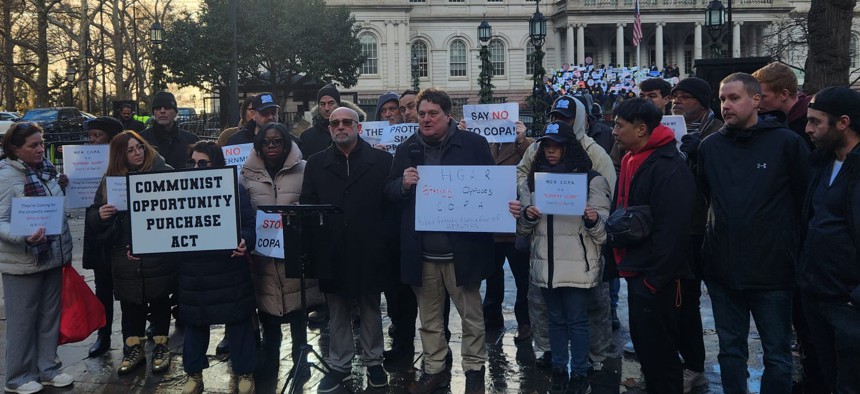
Opponents of the Community Opportunity to Purchase Act rally outside City Hall on Dec. 18, 2025. Office of Council Member Darlene Mealy


From well before the Community Opportunity to Purchase Act (COPA) came up for a vote in the City Council, I had serious concerns about what it would mean for my district and for working-class New Yorkers across the city. I represent a district in which the ability to freely purchase and sell small multifamily property, especially for Black small property owners, is a key part of our American Dream, and this bill clearly would be a major infringement on that ability.
I decided that I would not only vote against the bill, but that I would do everything in my power to stop it, despite the risk that can come with speaking up in opposition. As an elected official, taking a strong stand on an issue means that your opponents may target you for being vocal against their agenda. But the reward for taking a stand is finding allies who feel the same way that you do and are willing to fight alongside you. And that’s exactly what happened when I learned about state Sen. Sam Sutton’s public statement opposing COPA. I found a friend who would support me in our shared fight.
It is rare, almost unheard of, for a state senator to issue a public statement weighing in on a New York City Council bill. Sutton did so because COPA posed a real and immediate threat to housing stability, investment and affordability citywide. His statement reinforced to me that this bill was not just another housing proposal, but rather a radical and ideologically driven effort that would cause real harm.
Shortly after that statement was released, Sutton and I spoke directly. That phone call marked the beginning of a coordinated effort to stop COPA from becoming law. We shared the same concerns: that the bill would stall property sales, drive investment out of New York City, reduce housing supply and ultimately raise rents. We also shared a deep worry about how COPA would affect Black small property owners, many of whom rely on the ability to sell their buildings on their own terms as a path to financial stability.
From that point forward, we began making calls one by one to City Council colleagues and others with influence in the Council. We talked about the long delays the bill would impose on sales, the uncertainty it would inject into the housing market and the chilling effect it would have on reinvestment in aging multifamily buildings. We made clear that this was not a pro-tenant bill, but a socialist policy that would ultimately hurt tenants the most by reducing supply and accelerating disinvestment.
Those conversations mattered. Together, we were able to flip multiple votes. In the end, COPA only passed the Council by a vote of 31-10, with seven members abstaining. Those flipped votes were the difference between COPA passing with a veto-proof supermajority (which would have required 34 votes) and COPA passing without one – a critical distinction given the strong likelihood that Mayor Eric Adams will veto this bill before leaving office.
Equally important was what grew out of this effort. At the direction of Sutton and myself, Black and Jewish leaders along with small property owner organizations came together to form a coalition that publicly opposed COPA. This coalition organized, spoke out, protested and made noise.
That coalition helped change the narrative. It helped sway additional opinion inside the City Council. And it demonstrated what is possible when communities with a long history of allyship stand together once again.
The ultimate lesson here is powerful and worth stating plainly: a Jewish state senator and a Black City Council member working in partnership were able to stop a socialist bloc from forcing through a deeply harmful policy on New York City. That matters – not just for this vote, but for the future of our city.
This fight is far from over. If Adams vetoes COPA, then incoming City Council Speaker Julie Menin (who abstained from the vote) will need to decide whether to try to override the veto, and we’ll need to convince the eight new council members taking office in January why they should oppose the bill. There’s also the risk that the council would just pass the bill again next year when the new mayor would be happy to sign it.
Sutton and I have made it clear that the Black and Jewish leadership partnership formed during this battle will continue and grow.
Together, we are committed to advancing smart housing policy and pushing back as a whole against the dangerous socialist agenda that threatens New York City’s economic andsocial stability.
New York works best when our communities work together, and this is only the beginning.
Darlene Mealy is a New York City Council member representing the 41st Council District, which includes Brownsville, Bushwick, Crown Heights, East Flatbush and Prospect Lefferts Gardens.
NEXT STORY: Opinion: How Black and Jewish Brooklynites teamed up against a controversial housing bill