

Opinion
Opinion: Task-sharing and the stepped-care solution to youth mental health care
What global mental health innovation can teach New York City about youth support.
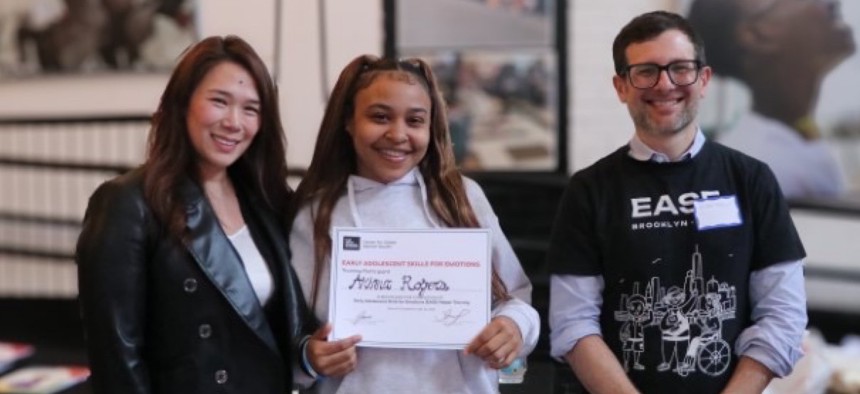
Eva Wong, left, and Adam Brown, right, pose for a photograph with a youth worker who participated in the Early Adolescent Skills in Emotions facilitator training. Mayor’s Office of Community Mental Health

The recent forum on youth mental health in Albany, hosted by the Coalition to Empower Our Future, correctly identified a critical need: We require strong, accessible and community-rooted support systems for young people. In New York City, young people face a myriad of challenges and uncertainties. From digital addiction to interpersonal stresses, academic pressure to food insecurity and homelessness to anxiety over immigration-related matters, our young people are not shielded from these multifaceted stressors. There is now a growing consensus that clinical interventions alone cannot solve this crisis. Instead, as the panelists suggested, we need a broader, community-based approach to complement specialized clinical services that meets young people where they are.
We agree.
And the good news is, despite the many challenges facing youth today, there is a growing knowledge base supporting the use of community-based models to build capacity where there are shortages of providers and overcome barriers such as stigma. This model, known as “task sharing,” trains neighbors, youth workers, teachers and coaches to become the essential first line of defense, because they are trusted and are already responding to the social and emotional realities of these youth.
Task-sharing is not new, but it has only recently gained the attention it deserves as a critical piece to the mental health puzzle in the U.S. Outside of the U.S. – primarily in humanitarian and emergency contexts – task-sharing emerged as a public health strategy to reduce gaps in care in countries where there might be one therapist per 100,000 people. With proper training and supervision, care delivered by non-specialist providers leads to improvements in mental health and wellbeing, and non-specialists trained in such interventions say that they feel that they personally benefit from these skills and feel more connected to their community.
Now, cities outside of humanitarian settings are increasingly looking to task-sharing to help address high rates of mental health concerns and large gaps in care during emergencies but also to address chronic daily challenges. Within New York City, programs like Project Hope offered mental health support and education following Hurricane Sandy through task-sharing strategies embedded in nonprofit organizations and houses of worship. Over the past few years, hundreds of staff at homeless and domestic violence shelters have been trained to provide Psychological First Aid. In the wake of the COVID-19 pandemic, the first U.S.-based clinical trial is nearing completion examining the use of non-specialist provider mental health programs delivered by community organizations across NYC.
Given the alarming rates of mental health concerns among young people, it is imperative that we provide comprehensive funding to support the inclusion of task-sharing strategies for youth as a central component of mental healthcare in NYC. Without it, we will miss critical opportunities to provide strategies that meet the needs and concerns of young people today. In fact, here in New York City, the need for these diverse, community-based solutions is consistently affirmed by young people themselves. The Department of Youth and Community Development (DYCD) recently conducted a series of youth town halls where mental health consistently topped the list of concerns. While this generation is often more open about mental health, this openness is not universal, especially among young men of color who may harbor a mistrust of traditional systems.
As DYCD Commissioner Keith Howard has observed, "Young people want support from those who look like them, speak their language, respect their culture, and have walked in their shoes. Building peer-led capacity is a matter of both trust and equity." One way to do this is by building peer leaders through the SOUL Care program, a multi-agency initiative that pairs young, predominately BIPOC, people in foster care with young leaders with relevant lived experiences. These youth face complex trauma and often struggle to access culturally responsive, long-term care. SOUL Care is showing that when support is provided by trusted peers, the support feels relevant and trusted.
New York City is also the first city in the U.S. to evaluate a new task-sharing intervention developed by the World Health Organization, called Early Adolescent Skills in Emotion (EASE). This brief intervention was designed to be delivered by non-specialist providers to youth and caregivers. EASE was shown to be effective in several trials outside of the U.S. and, over the course of two months, we carefully adapted it through a co-design process with youth in Brooklyn to make strategy reflect the needs and concerns of the community. Now, the Mayor’s Office of Community Mental Health and DYCD have collaborated with the New School Center for Global Mental Health to train after-school staff at 15 programs across Brooklyn, Queens and northern Manhattan. After-school staff are dedicating one day each week to teach young people how to understand their emotions, ask for help when they are overwhelmed and develop problem-solving strategies. Caregivers also participate, building a shared language and strengthening the family environment around the child.
Although this pilot program is still underway, we are already seeing the impact on the ground. After-school staff say this training is giving them concrete skills to support youth who are struggling and a better sense of when a child may need more specialized mental health care. Youth participants say the program helps them regulate their emotions, articulate their feelings and feel safer reaching out to an adult when stress becomes too much.
Evidence for youth-focused task-sharing strategies is growing. But if we are to respond to the needs of youth in our city, we must also ensure that we close the financial gaps needed to sustain this work. We recognize that even in the wealthiest cities, mental health systems are strained. However, the future of care for youth lies not just in more clinicians, but in smarter and more cost-effective systems. Crucially, this requires implementing a stepped-care approach – a comprehensive model that creates clear pathways from scaled community support up to specialist intervention.
While this coordinated system is new, with strategic public investment in training and robust clinical supervision, non-specialists can be empowered to deliver effective strategies. This ground-up approach is the missing link – a return to a true Community Mental Health model, defined by its focus on prevention, integration and building capacity at the most local level with solutions rooted in community. This approach recognizes the therapeutic power of human connection and prioritizes investing in the people who are already on the ground.
What we have learned from global innovation is that healing is not found in a clinic or prescription alone. It emerges from shared language and mutual trust, from someone knowing how to ask the right questions at the right time and the thousands of support networks built within communities. With the right evidence-based training and investment, community members in NYC can become powerful agents of preventative mental health care for the next generation. Investing in them now is how we will transform our public health system from reactive to resilient.
Adam Brown is a professor of psychology at The New School and the director of The New School Center for Global Mental Health. Eva Wong is a seasoned mental health clinician and the Executive Director of the Mayor's Office of Community Mental Health.
NEXT STORY: Opinion: The kids are alright