

Opinion
Opinion: To fight poverty, Mamdani must hire Latinos
When policies, programs and budgets are debated in City Hall, we are rarely at the table where the municipal pie is cut up.
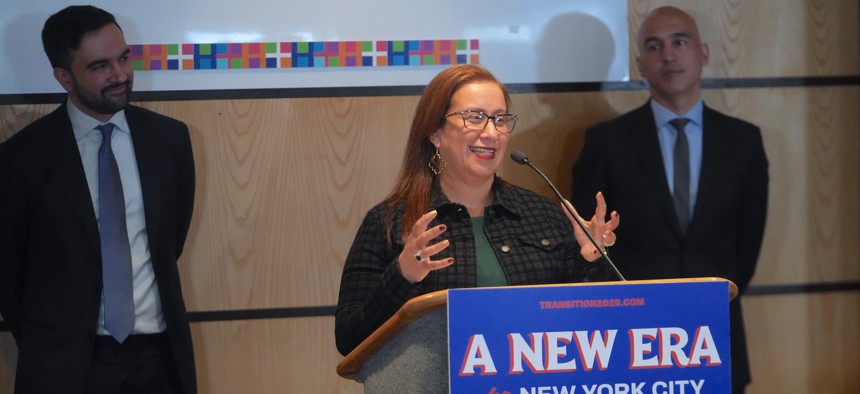
Mayor Zohran Mamdani, left, named Helen Arteaga Andaverde, center, his deputy mayor for health and human services at a press conference on Dec. 30, 2025. Selcuk Acar/Anadolu via Getty Images


If Mayor Zohran Mamdani is serious about reducing poverty, he should hire Latinos.
I didn’t say hire more Latinos, because the core problem is that while we represent the second-largest demographic in New York City, there has long been a systemic bias against hiring Latinos at City Hall.
In the de Blasio administration, we ranked third in hiring. In the Adams’ administration, we fell to fourth – trailing whites, Blacks and Asians – according to the biennial EEO-4 reports submitted by the Department of Citywide Administrative Services to the federal Equal Employment Opportunity Commission, as reported in City & State.
The consequence is simple: when policies, programs and budgets are debated in City Hall, we are rarely at the table where the municipal pie is cut up.
The civil rights and union movements fought for equitable access to employment, healthcare, retirement plans, and mortgages. These are the foundations of stability for any community.
Yet, the continued hiring bias in City Hall has left the Latino community behind. As a result, we and our children remain the poorest New Yorkers.
By “we,” I mean the Puerto Ricans, Dominicans and Mexicans who represent the majority of Latinos in the city and 29% of the total population. Our children represent half of all children in New York City. For comparison, according to the U.S. Census, whites represent 36% of the population, Blacks 23%, and Asians 15%.
But we have hope in Mamdani.
I am writing this now because across more than 20 years, I have covered the periodic EEO-4 filings for The Village Voice, The Daily News and City & State to highlight this persistent bias. This time feels different.
Puerto Rican elected officials were among the first in the city to endorse Mamdani’s candidacy in the Democratic primary. Historically, they have been part of a coalition with Black leadership in mayoral races, but this time they struck out on their own. While the city’s Black political establishment largely supported former Gov. Andrew Cuomo and City Council Speaker Adrienne Adams, the Latino progressive wing went all-in for Mamdani.
Reps. Nydia Velázquez and Alexandria Ocasio-Cortez, state Sens. Gustavo Rivera and Julia Salazar, and New York City Council Members Alexa Avilés and Tiffany Cabán were ubiquitous for Mamdani. During the critical period when Mamdani had virtually no name recognition, they were everywhere – in print, online and on the ground. Brooklyn Borough President Antonio Reynoso further solidified this support as the prominent Dominican voice in the primary.
The gamble paid off. Latinos voted in droves for Mamdani. Whether driven by a historic lean toward democratic socialism or a desire for a new kind of leadership, he was our candidate. Now comes the time for “payback.” Justice, respect and equitable hiring policies within the Mamdani administration would help bring much-needed attention to the persistent, concentrated poverty that has devastated Puerto Ricans since the 1940s, Dominicans since the 1980s, and Mexicans since the 1990s.
By successfully addressing this generational high concentration of poverty, Mamdani would cut the overall poverty that a quarter of all New Yorkers contend with – a reality he was not afraid to highlight at every campaign stop. That was his poetry; now is the time for his prose.
He made a great start by hiring Helen Arteaga Andaverde – a native of Ecuador and the first Hispanic person to serve as executive director of Elmhurst Hospital – as his deputy mayor for health and human services. As a co-founder of a neighborhood health center in Corona, she’s been a firsthand witness to concentrated poverty in one of the city’s poor immigrant neighborhoods.
The late, great newspaper columnist Murray Kempton once suggested that journalism is fueled by the hope that change will happen. The same holds true of elections. Mamdani may well be the change we have been waiting for. But it’s essential that he reverse the longtime failure to bring Latinos into city government in proportion to our representation in the general population.
Eddie Borges is a New Yorker of Puerto Rican/Taíno descent who writes about race and poverty. He has applied for a job in the Mamdani administration.
NEXT STORY: Opinion: It’s time for abundance in specialized high schools