

Opinion
Opinion: New York City Is sitting on billions hiding in plain sight. It’s time to use it for housing and fiscal stability.
Selling the “air rights” above city-owned properties could help finance affordable housing and reinvestment in public institutions.
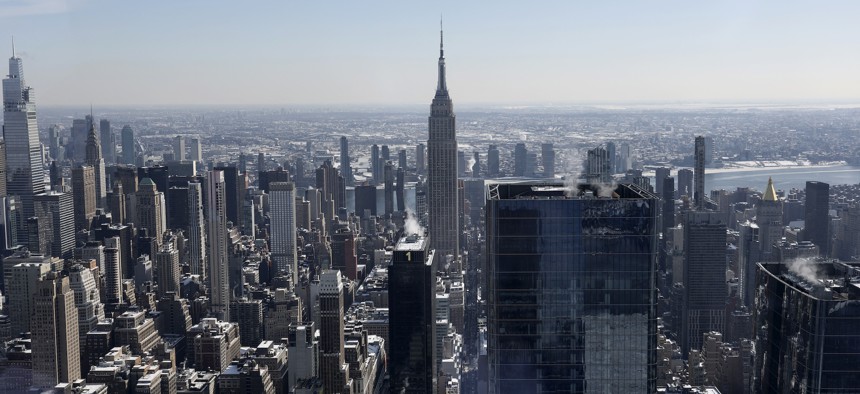
New York City could raise billions of dollars by creating a program to pool and sell the unused development rights, or “air rights,” above city-owned property. ANGELA WEISS / AFP via Getty Images


New York City is facing a compounded crisis: a major, multi-year budget gap that is already forcing hard choices about services and an affordable housing emergency that is hitting low-income New Yorkers the hardest. These two pressures reinforce each other. When the budget is tight, the city has less flexibility to invest in housing and the supports that keep people stable. And when housing costs rise, more families need public assistance – putting even more strain on the budget. What we need now are tools that do three things at once: generate meaningful, durable revenue; accelerate the production of affordable housing, including deeply affordable units; and avoid cutting the core services New Yorkers rely on every day.
Too often, the public debate treats these challenges as separate problems to be solved sequentially – close the budget gap first and then focus on housing, or build more housing and hope the fiscal picture improves. That framing is wrong. New York does not have the luxury of addressing these crises one at a time. The city needs solutions that work on both fronts simultaneously.
One such solution is hiding in plain sight: the unused development rights above city-owned property.
New York is a vertical city governed by zoning rules that determine how much floor area may be built on each parcel. Many buildings – particularly older ones – are built far below what zoning allows. The unused portion can, under certain circumstances, be transferred to another site so that a project elsewhere can build more. This is the basic logic behind what New Yorkers commonly call “air rights.”
Traditionally, those transfers are tightly constrained. In much of the city, air rights can be sold only to an adjacent parcel, limiting both their usefulness and their value. But New York City has already shown that this rule is not immutable – and that, when the public interest is at stake, it can design more flexible systems.
In the early 1990s, Broadway theaters were under growing financial pressure. Rising real estate values created strong incentives to redevelop theater sites, threatening the long-term survival of a cultural district central to the city’s identity and economy. Rather than allowing the market to hollow out Broadway, the city took a more creative approach.
It created – and later expanded – the Theater Subdistrict, a zoning framework that allowed designated theaters to sell their unused development rights not just to adjacent parcels, but to eligible sites across a defined receiving area in Midtown. This innovation accomplished three things at once. It preserved cultural institutions. It directed growth to locations the city deemed appropriate. And it generated real economic value within a regulated, public-purpose framework.
That precedent matters today. It demonstrates that New York City can decouple development rights from strict adjacency and design a development-rights marketplace that aligns private development with clearly defined public goals.
The city should now apply that same logic to its own assets.
Across the five boroughs, New York owns hundreds of buildings: schools, libraries, sanitation and public safety facilities, community centers and other municipal sites. Many of these are built far below their allowable zoning capacity. These buildings are not “underused” in any meaningful sense; they are essential civic infrastructure. But the unused development rights above them represent latent value – value that currently sits idle while the city struggles to fund housing and protect core services.
Here is a practical idea: create a civic air rights program that pools unused development rights above city-owned properties and uses their value to finance affordable housing and reinvestment in public institutions.
Under such a program, the city would first identify eligible city-owned properties with unused floor area. Those development rights would be pooled into a city-managed inventory – effectively a civic air-rights bank. The city would then designate appropriate receiving areas: transit-rich corridors and other locations where additional density aligns with long-term planning goals, infrastructure capacity and neighborhood context. Developers seeking additional floor area in those areas would purchase rights from the civic pool under transparent rules, with proceeds dedicated to affordable housing and civic reinvestment.
There are at least two viable ways to structure this approach. One model would limit purchases to affordable-housing or mixed-income projects that meet defined affordability thresholds, directly tying added density to the creation of below-market units. Another model would allow broader participation by qualifying developers, while dedicating proceeds by formula – funding deeply affordable housing citywide and providing a stable revenue stream for schools, libraries and capital maintenance associated with the sending sites.
Either approach would require strong guardrails. Receiving areas should be chosen carefully, with clear limits and meaningful community engagement. Governance would need to be transparent, with regular public reporting on development rights sold, revenues generated, housing delivered and funds reinvested, so New Yorkers can see what the policy is producing.
The fiscal case for this approach is not speculative. Even a modest pilot – drawing from a limited number of city-owned sites – could generate revenue in the hundreds of millions of dollars, depending on market conditions and location. A program that scales responsibly over time could generate far more. Those dollars could help unlock deeply affordable housing that would otherwise be financially infeasible, while also reducing deferred maintenance and capital backlogs in the very institutions New Yorkers rely on every day.
There is also a political case, if City Hall is willing to make it clearly and honestly. This is not a giveaway to developers. It is the city converting the value of a public asset into public benefit – housing for families being priced out and predictable reinvestment in schools and libraries that have long been asked to do more with less.
New York has used zoning and development rights creatively before, when the stakes were high and the alternatives were worse. The stakes are high again. The budget is tight. Housing is scarce. And New Yorkers are demanding solutions that are both bold and practical.
The air above our public buildings may not look like an answer to the city’s biggest challenges. But it is hiding in plain sight. With disciplined design and a careful pilot, it could become one of the most powerful tools New York has to build a more affordable city and a more stable fiscal future – without raising taxes or cutting the services that define the city and on which millions of its citizens rely.
Andrew Rasiej is the founder of Civic Hall at Union Square.
NEXT STORY: Opinion: New York families deserve more than survival. A guaranteed income will help.