

Opinion
Opinion: A racial equity plan must guide Mamdani’s budget process
Voters approved a New York City Commission On Racial Equity, but mayors haven’t listened.
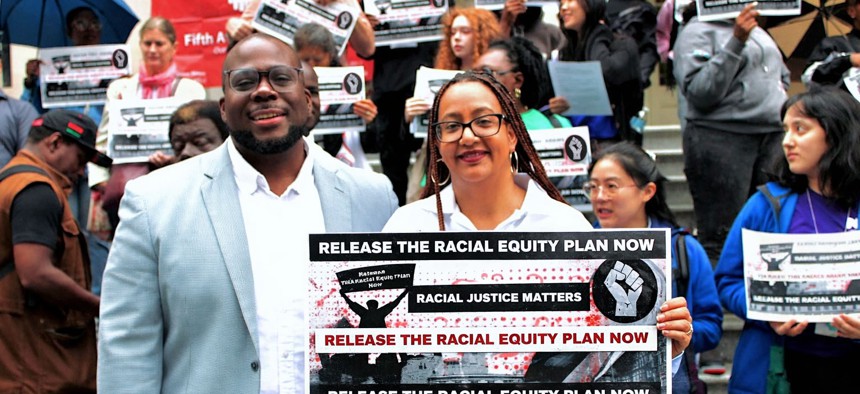
Tyrik Washington, a consultant with the New York City Commission on Racial Equity, and Linda Tigani, the commission’s executive director, attend a demonstration on the steps of City Hall. NYC CORE


A city’s budget is more than a spreadsheet. It is a moral document. Every line item reveals what, and who, a city values. When budgets are crafted without an explicit racial equity plan, they reinforce the very disparities leaders claim they want to fix. If New York City is serious about racial equity, opportunity and shared prosperity, a racial equity plan must guide how public dollars are raised, allocated and elevated. Racial equity is not a cute sound bite; it’s the law of the land in New York City.
Let’s do a little time traveling back to when those in power were forced to hear the cries of so many New Yorkers after the brutal murders of George Floyd, Ahmaud Arbery and Breonna Taylor. New Yorkers of all ages took to the streets and declared Black lives matter and economic justice matters. New Yorkers not only protested but also stormed the ballot boxes in 2022 and overwhelmingly approved charter amendments that require the city to develop and publish racial equity plans and establish a dedicated office and separate independent commission to hold city government accountable to that work – birthing the New York City Commission on Racial Equity, or CORE, spearheaded by Linda Tigani. For so many naysayers who thought protesting was just a vocal exercise, they had to accept permanent transformative change to the city’s charter, creating a legal obligation for city agencies and leaders to plan, act, budget and report with a racial equity lens.
CORE’s actions to uphold the law sometimes require difficult and uncomfortable steps, including pursuing legal actions in 2025 against Eric Adams, the second Black mayor in New York City’s history, for failing to release the mandated racial equity plan. Delaying or refusing to release the preliminary racial equity plan fails the voters, breaks the law and ensures that inequity will continue through government services. This decision is not about politics or personality, but about ensuring that legal obligations are met and that commitments to transparency and accountability are honored. The charter obligations remain clear and legally binding for every mayor, including current New York City Mayor Zohran Mamdani, requiring that the preliminary budget must be released with the preliminary racial equity plan, and a final plan must align with the executive budget. (The Mamdani administration has promised to release a preliminary racial equity plan within his first 100 days in office.)
The New York City racial equity plan is designed to guide the citywide budget by redirecting investments from crisis to prevention and intervention. Communities harmed by racism and social injustice continue to experience chronic disinvestment, resulting in higher rates of emergency room use, incarceration, abuse and killing by law enforcement, evictions and unemployment – not because of personal failures, but because of intentional systemic neglect. Targeted investments reduce long-term public cost while improving quality of life.
Racism is a daily reality, and universal programs are often treated as inherently equitable, with little attention paid to how they are implemented. But universal policies administered through biased systems reproduce inequalities. Ignoring race does not eliminate racial bias – it allows it to operate unchecked. Racial equity is not just a moral imperative; it is a fiscally responsible strategy.
When racial equity guides the budget, goals and metrics are clearly defined. Agencies are expected to explain how their spending decisions advance – or fail to advance – racial equity outcomes. This allows residents, advocates and policy makers to track progress and identify which changes are needed. Budgeting becomes less opaque and more democratic, strengthening the people’s voice in government decision-making.
A city’s budget with a racial equity plan strengthens fiscal responsibility, builds trust with the public and addresses the root causes of inequity. Racial equity and efficiency are not opposites; they are partners. A racial equity plan brings clarity and intentionality to budgeting. It asks basic but powerful questions: Who benefits from the spending? Who bears the burden? Who was left out of past investments, and how can today’s budget begin to close those gaps?
At a time when cities face overlapping challenges – such as economic uncertainty, housing shortages, climate change impacts and public health crises – every dollar matters. The question is not whether the cities can afford to center racial equity in their budgets; the question is whether they can afford not to. Funding systems that continue to produce unequal outcomes is both unjust and unsustainable.
A racial equity plan does not promise instant transformation, but it offers a direction: a commitment to align values with spending and to invest in a future where prosperity is shared rather than stratified. It sends a clear message: racial equity is not an afterthought – it is a governing principle. This is why a racial equity plan must guide Mamdani’s budget process.
Linda Tigani is the chair and executive director of the NYC Commission on Racial Equity (CORE). Tyrik Washington is a community and political engagement consultant with NYC CORE.
NEXT STORY: Opinion: Finish what we started – and stop making Long Islanders pay the price