

Opinion
Opinion: Why NYC needs a Department of Community Safety
For decades, the city has defaulted to police, courts and incarceration to contain and supervise crises.
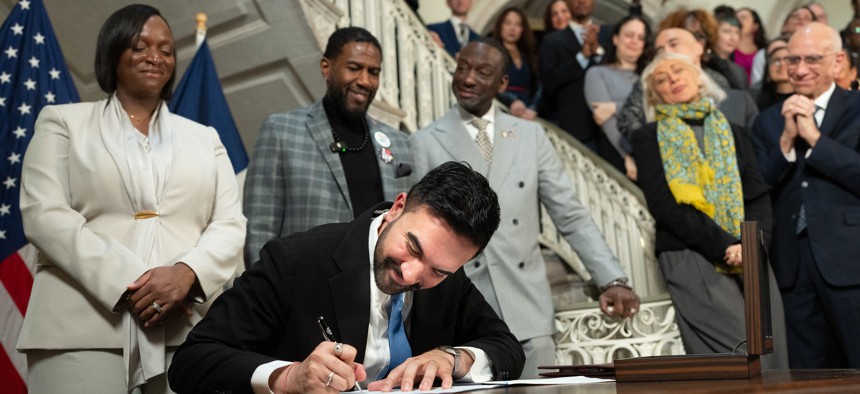
New York City Mayor Zohran Mamdani signs an executive order to create the Mayor’s Office of Community Safety on March 19, 2026. Michael Appleton/Mayoral Photography Office


On Thursday, New York City Mayor Zohran Mamdani announced the creation of the Mayor’s Office of Community Safety to begin the process of transitioning people from crisis to stability outside of the criminal justice system. This is an important step in fulfilling his campaign promise to ultimately create a fully funded Department of Community Safety.
Renita François, the new deputy mayor for community safety, brings both the institutional expertise and on-the-ground understanding needed to advance a new paradigm for public safety. Her track record reflects a deep commitment to community-centered strategies grounded in data and lived experience, as well as a clear determination to align city agencies, operating procedures, policies and budgets toward an effective, community-driven approach to safety.
With this announcement, Mamdani is starting to build what New York City has never fully realized: a 24-hour civilian crisis response system integrated into 911 and 311 that routes behavioral health, homelessness, substance use and domestic calls to trained responders who are equipped to stabilize people in real time by phone or in person and have the resources, capacity and agency to do so.
For decades, the city has defaulted to police, courts and incarceration to contain and supervise crises in part because it lacks infrastructure for prevention and coordinated alternatives, creating an expensive cycle through jails, shelters and hospitalizations that rarely resolves the underlying instability. The Department of Community Safety has the potential to reframe public safety as crisis stabilization, governing outcome-driven, cross-agency coordination that secures housing, treatment, identification and ongoing support before someone spirals into emergency systems, repeatedly.
Unfortunately, the crisis response system inherited by the mayor has continued to cost lives and safety. Police responses to mental health calls resulted in the death of Michael Lynch and the injury and prosecution of Jabez Chakraborty, while more than a dozen others have died on the streets amid a system incapable of moving people into care before crises escalate. These outcomes are predictable because we treat behavioral and social emergencies as law-enforcement problems. Calls to 911 for mental health crises have doubled over the past decade to nearly 200,000 annually, nearly all answered by police and routed to psychiatric emergency rooms where many are quickly discharged or briefly admitted, only to return to the same instability, at best.
Meanwhile, NYPD’s heavily touted “quality of life” initiatives signal a return to “broken windows” policing, a strategy long credited with filling Rikers and destabilizing Black and Brown communities in the name of order while actually manufacturing crisis at scale. We’re seeing the churn again as over-policing ticks up and more than 300 people at a time have cycled through central bookings, with arraignments delayed up to 72 hours. If only 7% of 911 calls involve crimes in progress, then defining “quality of life” primarily through arrest and summons isn't a public safety strategy. It’s a high-volume processing model that confuses visible enforcement with actual safety.
At the same time, the last administration underfunded community responders from mental health teams to violence interrupters and peer specialists, while requiring them to operate in silos without real-time information, clear authority or direct access to housing, behavioral health, medical care and social services. Stabilization depends too often on personal relationships rather than guaranteed pathways. Responders are left to manage acute crises within a rigid punishment-centered system instead of a coordinated civic infrastructure. Programs like the Crisis Management System have reduced shootings and strengthened neighborhoods but remain structurally disempowered and unable to fully integrate with health, housing and social service systems.
The current B-HEARD model, which pairs EMTs and social workers, was intended as an alternative to sending police and taking people to hospital emergency rooms. Unfortunately, these teams currently act mostly to support a police response and have relied primarily on hospitalization. Part of the problem lies in the NYPD’s sole control of the 911 dispatch system that has been unwilling to send many of these calls to civilian teams. The DCS proposal calls for teams that act independently of the police and can rely on an array of community based service providers as an alternative to emergency rooms. This would be in keeping with best practices in dozens of other cities.
If this sounds theoretical or lacks need for urgency, consider Matthew and David.
Now 21 and 19, the brothers grew up in a household shaped by untreated schizophrenia and poverty. Their mother cycled through repeated encounters with public systems that identified risk but never delivered sustained care. While pregnant, she assaulted their father and members of the public, a manifestation of destabilization. No coordinated plan prepared the household for the children in it. The state’s final intervention was a life sentence for her and the family she left behind.
David was born while his mother was incarcerated and removed from her at birth. He was placed with his father, who was raising Matthew in public housing while coping with untreated trauma, substance misuse and the sudden demands of single parenthood. Responsibility of this family fractured across punitive agencies, each supervising a narrow slice of the crisis while no one addressed the crisis.
David struggled to access school and basic services. Multiple institutions encountered him over the years, but none responded in a sustained, coordinated way. At 16, he was arrested for weapon possession – another intervention through a punitive system, leading to more supervision, not stability.
A community leader eventually referred him to We Build the Block, a community safety organization. It took weeks just to locate him. Once he was found, staff discovered he had not attended school in at least three years and did not know where he was officially enrolled. Re-enrolling him required months of advocacy, including appeals to senior officials within the Department of Education and the City Council. Staff spent years reconstructing records that already existed somewhere in city government.
Matthew’s trajectory diverged but was equally fragile. He graduated high school against the odds, but housing instability and emerging mental health challenges left him without the basic documents needed to secure work or stability. He did not know his county of birth, a prerequisite for obtaining a birth certificate from the city’s third-party vendor. Without a birth certificate, he could not obtain a state ID. Without an ID, he could not access employment, housing or stabilizing services. The barriers were bureaucratic, but the consequences were existential.
In December 2024, Matthew was shot while walking. Months later, he was hospitalized following a mental health crisis. Despite relentless advocacy, he was discharged, unable to access a youth mental health shelter bed because he declined medication even though he was willing to participate in therapy and community-based care. The system processed him. It did not stabilize him. In January 2026, he was arrested for charging his phone in the subway.
Today, after four years of advocacy, both brothers have identification documents, benefits and are connected to community support including shelter. That progress required extraordinary effort from We Build the Block. It required miracles within systems not designed to produce them.
David is now experiencing mental health episodes. To obtain the psychiatric evaluation needed to unlock services, providers have advised that the fastest route is to “911 him.” In other words, to access care, the entry point must again be the emergency response system, risking trauma, loss of shelter and potentially worse. While David continues to navigate the mental health puzzle palace, he will also have to answer to the court for a shoplifting charge from late 2025, while We Build the Block was navigating the Human Resources Administration system for months to get his food benefits assigned to him while he was living in a shelter.
Matthew and David are not outliers. They are the logical product of a public safety framework that confuses contact with care and intervention with resolution. Their story exposes the central flaw in the status quo: New York has built systems that undermine our collective safety and keep people trapped inside them. A Department of Community Safety has the potential to change that by doing what the city currently does not: aligning funding, information and interventions across agencies and treating crisis not as an isolated or criminal incident but as a predictable outcome of unmet needs. This requires the political will to architect a new era safety framework.
Dana Rachlin and Alex S. Vitale served on the Community Safety Subcommittee of Mayor Zohran Mamdani’s transition team. Rachlin is the executive director of We Build the Block and the associate director of community and precinct-based initiatives at John Jay College. Vitale is professor of sociology at Brooklyn College and the CUNY Graduate Center.
NEXT STORY: Opinion: Lowering energy bills starts with getting New York off fossil fuels