

Opinion
Opinion: Corporate America needs to come clean about AI’s impact on jobs
Investors need better information to judge whether AI-driven workforce changes reflect thoughtful strategy or short-term cost cutting.
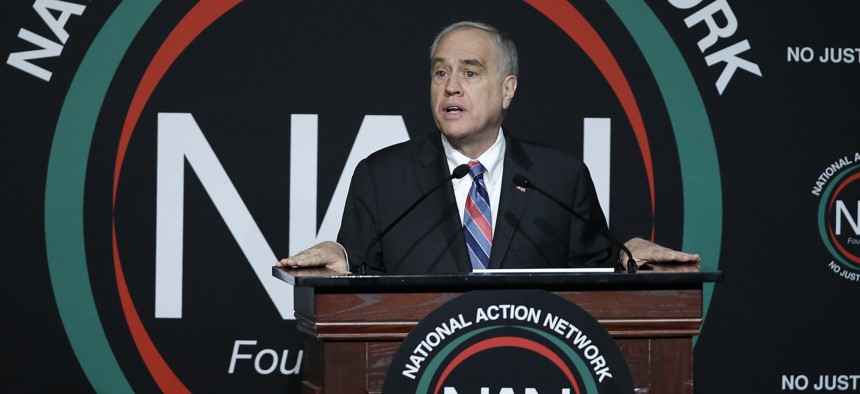
New York State Comptroller Thomas DiNapoli speaks at the National Action Network on April 11, 2024. John Lamparski/Getty Images


Artificial intelligence is rapidly reshaping how companies operate, compete and profit. From software development to logistics to customer service, AI promises major gains in productivity. It is increasingly driving hiring decisions, workforce size and layoffs. Yet companies consistently fail to give investors clear, comparable information on how their AI strategies are affecting employees and long-term business growth. They’re eager to highlight productivity gains, but rarely provide transparency on AI’s consequences.
That’s why, as trustee of the New York State Common Retirement Fund, I’m calling on corporations in our portfolio to increase transparency around AI’s impacts on their operations, especially when innovation has significant implications for a company’s workforce.
This lack of corporate transparency matters. Our state pension fund supports innovation that strengthens long-term growth and shareholder value, but durable growth requires more than technological ambition. Yet the SEC’s Investor Advisory Committee found in December 2025 that AI disclosures across public companies remain “uneven and inconsistent,” making it difficult for investors to assess and compare risk.
Research suggests that when AI is used exclusively to automate tasks and eliminate roles rather than augment human judgment, it can undermine institutional knowledge. It also disproportionately erodes employment opportunities for early-career and entry-level workers, a group that National University data shows accounts for nearly 50 million U.S. jobs at risk.
Anthropic’s CEO has warned that AI could eliminate half of all entry-level white-collar jobs and spike unemployment 10% to 20% within five years. Federal Reserve Bank of St. Louis research corroborates this concern, finding that occupations with higher AI exposure experienced larger unemployment rate increases between 2022 and 2025. Poorly managed workforce transitions can expose companies to reputational, legal and regulatory risks that ultimately impact shareholder value.
Economists have long argued that labor-saving technology creates new demand for work over time. The concern is the massive speed of a shift that creates enormous risks. Unlike earlier waves of innovation that spread gradually across sectors allowing for measured adaptation, AI is being deployed simultaneously across industries, compressing into a few years disruptions that once unfolded over decades. The World Economic Forum’s 2025 Future of Jobs Report finds that 41% of employers worldwide plan to reduce their workforce over the next five years due to AI. This speed may damage the quality and productivity of a company’s workforce and, more broadly, add to the large-scale instability of the economy.
Workforce disruption on a grand scale can have broad economic consequences by affecting consumer demand and economic stability and creating a more uncertain operating environment for businesses. Investors need better information to judge whether AI-driven workforce changes reflect thoughtful strategy or short-term cost cutting that undermines long-term future performance.
Investors should be able to understand how companies are managing AI’s impacts on employees, including job reductions and investments in retraining or redeploying workers, and what governance structures are in place to oversee their AI strategy.
I have reached out to the largest publicly traded companies in our state pension fund’s portfolio, including many like Amazon, Salesforce, Meta and Pinterest that have pursued layoffs in the name of AI efficiencies. I’ve asked them to disclose information on layoffs and other workforce impacts of AI, because without it, it’s much harder for investors to evaluate whether the changes are sustainable and in the company’s long-term interests.
There’s a reason AI’s labor impacts have drawn rare bipartisan attention and legislation in Congress. The SEC’s own Investor Advisory Committee voted in December 2025 to formally recommend that the Commission require companies to disclose AI’s impact on workforce management, including workforce reductions and upskilling, precisely because current disclosures are inadequate. The underlying message is clear: policymakers, regulators and investors alike lack reliable information about how AI is changing jobs, skills demand and workforce stability.
Transparency is not an impediment to innovation; it is a hallmark of sound corporate governance.
Greater transparency benefits companies. Firms that clearly explain how AI fits into their workforce strategy are better positioned to retain talent, demonstrate sound governance and manage growing regulatory scrutiny. Already, 72% of S&P 500 companies cite AI as a material risk in their annual filings. Consistent disclosure improves comparability, reduces uncertainty and helps companies allocate capital more efficiently.
Clear disclosure also helps investors judge whether AI investments are strengthening businesses or weakening them over time. As the person in charge of pension fund assets for more than 1.2 million public employees, retirees and beneficiaries, I believe that increased daylight on how companies are managing their workforce in the AI era is essential to assessing risk, resilience and value creation.
Investors need to see risks just as clearly as rewards if markets are going to function well. A clear view of how AI will affect a company’s workforce is a material necessity in the current age, and corporations need to embrace it.
Thomas DiNapoli is the New York state comptroller.
NEXT STORY: Editor’s note: Will Waymo go the way of the Segway?