

Opinion
Opinion: Our laws must make clear that intoxication is not consent
April is Sexual Assault Awareness Month, a time to confront the gaps that continue to leave survivors without justice.
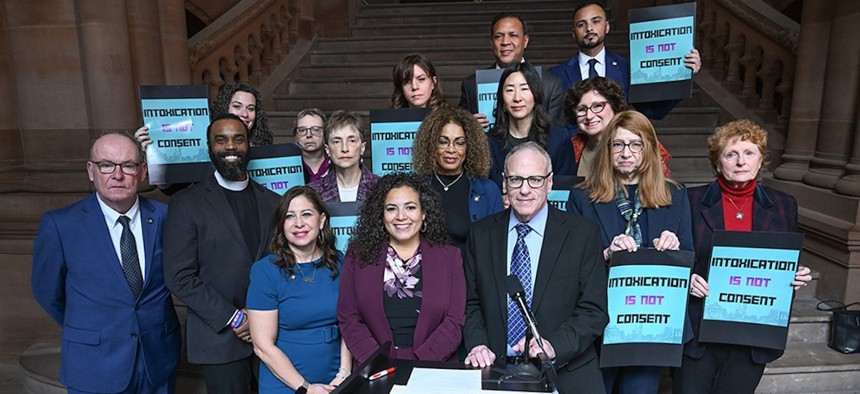
Surrounded by fellow lawmakers and advocates at the Capitol, state Sen. Nathalia Fernandez and Assembly Member Jeffrey Dinowitz call for passage of legislation making clear that intoxication is not consent. Office of Assembly Member Jeffrey Dinowitz


Recent allegations involving Eric Swalwell, as reported in the press, have once again brought forward a pattern that lawmakers hear far too often. Someone goes out for a night with friends or colleagues and wakes up the next morning with only fragments of memory, left to piece together what happened and whether they were violated.
In many of these cases, survivors describe their last clear memory as something ordinary: a drink, a conversation, a moment that should have been safe. What follows is confusion and a legal framework that does not allow for justice.
As it stands, New York law allows for prosecution when a person is incapacitated due to involuntary intoxication. But it draws a distinction when that intoxication was voluntary. In practice, that distinction can leave survivors without protection simply because they chose to have a drink.
That is a failure in how our laws account for reality.
To address this, we introduced A.101-A / S.54-A to ensure that individuals are protected from sexual assault regardless of how their intoxication occurred. The focus should remain where it belongs: on the actions of the perpetrator, not the decisions of the survivor.
Survivors already face immense barriers to coming forward. Many question their own experiences, blame themselves or fear professional and personal consequences. Some convince themselves that what happened was mutual, even when it was not. Others remain silent altogether. When the law does not clearly protect them, it reinforces that silence.
Closing this gap is about aligning our laws with this basic truth: intoxication is not consent. This legislation ensures that survivors are not excluded from protection because of a technical distinction, and that those who exploit vulnerability are held accountable.
This is not theoretical. It is happening in our communities, in workplaces and in spaces where people should feel safe. New York has an obligation to lead. That means making clear that consent cannot exist where capacity does not, and ensuring our laws reflect that reality.
Jeffrey Dinowitz is an Assembly member representing the 81st Assembly District in the Bronx. He is the chair of the Assembly Codes Committee. Nathalia Fernandez is a state senator representing the 34th Senate District in the Bronx and Westchester. She is the chair of the Senate Alcoholism and Substance Use Disorders Committee.
NEXT STORY: Opinion: To help the outer boroughs, keep World Cup tourists in hotels