

Opinion
Opinion: Why your electric bill is so high – and how the state comptroller can lower it
If we lower the profit margin that utility monopolies are guaranteed to earn, we lower electricity bills.
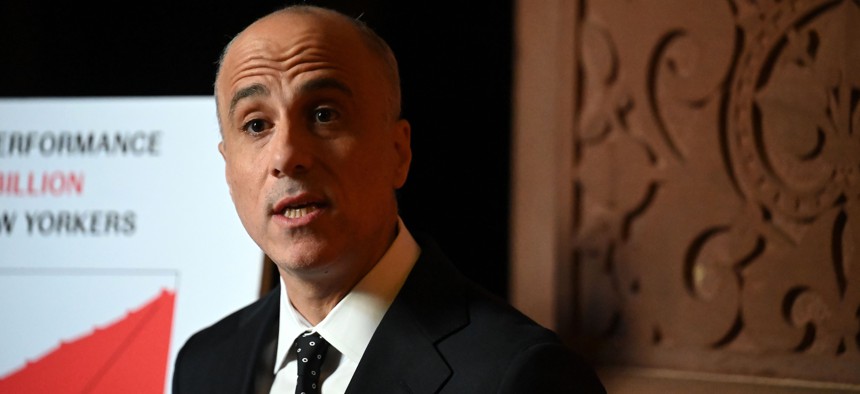
State comptroller candidate Drew Warshaw holds a news conference on Dec. 22, 2025. Will Waldron/Albany Times Union via Getty Images


Your electricity bill is too high. It doesn’t have to be.
Across New York, families pay more and more each month just to keep the lights on – another rising bill competing with rent, groceries and child care.
You’ve heard the usual explanations: fuel costs, aging infrastructure, weather. Those are real. But they’re not the whole story.
There’s another driver built directly into every electric bill – one most people never see: the profit margin guaranteed to utility investors. That’s right: guaranteed.
When regulators set electricity rates, the rates they approve don’t just cover the cost of power lines, maintenance and operations. They also guarantee a profit margin – known as a “return on equity” – to the investors who own these utility monopolies. The higher that return, the higher your bill. It’s that simple.
Right now, those returns are set at levels that are higher than they need to be. We can change that.
Utilities are among the safest businesses in the country. They are monopolies with a captive customer base and revenue set by the government. But even with that low risk, New York’s state regulator allows returns of around 9.5% – meaning ratepayers are paying billions of dollars over time to support investor profits that are higher than necessary.
Here’s the key point: if we lower the profit margin these monopolies are able to earn, we lower electricity bills. And New York has a clear, practical way to do it.
As comptroller, I would bring the New York state pension fund – along with other long-term institutional investors – in as partners to help finance utility infrastructure at a lower cost of capital than the Public Service Commission currently guarantees utilities can make.
These investors are different from Wall Street firms chasing short-term gains. They are long-term, patient investors. They are willing to accept solid, stable returns that match the low-risk nature of utilities – without demanding the overpriced premium that drives up your utility bills today. Consider that New York’s state and local pension fund target return is just 5.9%, significantly lower than the 9.5% guaranteed rate of return for New York’s utility monopolies.
That matters because when utilities can raise money at a lower cost, regulators are required to pass those savings on to customers.
Same grid. Same service. Lower bills.
Think of it like refinancing a mortgage: nothing about your house changes – but your monthly payment goes down.
This plan does not reduce returns below what is needed to attract investment. It replaces a portion of higher-cost, short-term capital with lower-cost, long-term capital that specifically seeks lower-risk returns. That makes the system more stable – not less – and reduces financing costs over time and, in turn, your utility bill.
Importantly, New York’s pension fund would still earn returns higher than its target return. This is not a subsidy. It is investing 101: matching stable liabilities with stable, income-generating businesses.
Lowering the cost of capital by just a couple of percentage points over time would put real money back into people’s pockets – not once, but month after month, and year after year. Even a modest reduction to the return on equity could reduce New Yorkers’ electricity and gas bills by an estimated $2.3 billion per year, or about $300 in the pocket of a typical New York household – real money returning to families who have been overcharged for decades.
Why aren’t utilities tapping lower-cost sources of capital right now? Because the system doesn’t reward utilities for finding the absolute cheapest capital. Instead, it rewards them for deploying capital even when that capital may not be efficiently used. And all the while approved by state regulators with little to no oversight.
Given this lack of oversight, I would pair investing lower-cost capital with a second step: accountability. The comptroller has the authority to audit the agencies that regulate utilities. I would use that power to examine top-to-bottom the entire broken business model of our utility monopolies and all of the ways in which ratepayers are getting squeezed – for example, by having to pay the lobbying costs for these utilities to lobby the state to increase our own utility bills.
Electricity pricing has long been treated as a technical issue – something only “experts” can understand. But the bottom line is simple: when investor returns are set too high, working families pay the price.
We can change that. The state comptroller has the power and the capital to make a difference – even though the current officeholder, Thomas DiNapoli, has chosen not to.
Across the country, analysts, academics and consumer advocates have documented that the models used to set utility returns tend to produce profit margins well in excess of an appropriate risk-adjusted rate of return, which over years has artificially increased our electricity bills. We don’t need fancy models to set utility returns; we can open up the process to investors like public pension funds to find out the actual cost of equity.
I spent eight years building a clean energy company that financed and constructed over $1 billion in clean energy infrastructure and served thousands of households, fighting utilities every step of the way. I know how these systems work – and I know that small changes in financing costs and utility incentives can have big impacts on what people pay every month.
Let’s lower utilities’ higher-than-needed profit margin. We do that and we lower your bill and we remove the incentive for the wasteful, gold-plating of our grid. And we can do all of that without reducing reliability, without deterring necessary investment, and without compromising the pension fund’s fiduciary duty.
We hear calls for “freezing” the rate. Under this plan, we can “lower” the rate.
This is a concrete, actionable way to do it.
Drew Warshaw is a candidate for New York state comptroller.
NEXT STORY: Opinion: Don’t let AI chatbots pretend to be doctors and lawyers