

Opinion
Opinion: All media needs help
New York state’s local journalism sustainability program should include nonprofit newsrooms, too.
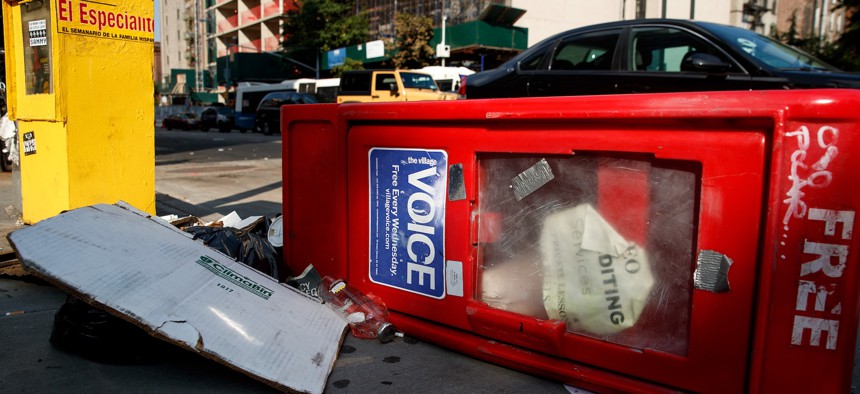
Once worth $55 million, The Village Voice ended its print edition in 2017. Drew Angerer/Getty Images


I’ve been in New York’s media world long enough to lament all the roadkill we’ve suffered in the last four decades. When I was growing up on the West Side of Manhattan, I’d often go to a newsstand on Wednesday mornings to pick up a thick copy of The Village Voice, as much for the classified section as the searing left-wing political reporting and commentary. At its peak, the Voice (which was owned by Rupert Murdoch from 1977 to 1985) fetched a $55 million purchase price from the wealthy scion of the Hartz Mountain pet food company.
The Voice looked unconquerable until 1995 when a West Coast man named Craig innocently launched a website called Craig’s List that let people exchange goods. His modest site grew and grew, all while newspapers’ classified sections, including The Village Voice’s, shrunk and shrunk. Many newspapers folded over the next two decades. In the aughts, I co-owned four Manhattan weekly community newspapers, and I watched up-close a $1 million revenue classified section shrink until there was only less than $100,000 left annually.
I quickly pivoted to add live events revenue to our stream of funding, and I’m proud to say those weekly newspapers are still alive and thriving under new management. But I was the exception to the rule, because most papers that relied on classifieds to support their advertising-only revenue bit the dust, just like the once-mighty Village Voice.
In an act of true “guilt philanthropy,” Craig Newmark – the founder of Craigslist – donated $30 million to CUNY’s Graduate School of Journalism, which renamed itself The Craig Newmark School of Journalism. I actually think that Craig Newmark is a nice and well-intentioned man who didn’t start out trying to kill newspapers. Nonetheless, I always found this to be a bit ironic because of the deleterious effect Craigslist had on newspapers. Maybe next we’ll have a “Mark Zuckerberg School of ADHD and Social Media Studies at NYU”?
Similarly, one of most beloved newspapers in the city, The New York Observer, started deteriorating in 2009, after Arthur Carter, a lover of great journalism, sold the pink-papered broadsheet to a 25-year-old neophyte named Jared Kushner. Although it was a perennial money loser for Carter (someone once called it Arthur Carter’s Gift to NY), he was a careful steward of the paper. The same could not be said for Kushner, who through a series of naive, ill-timed and badly executed initiatives drove the beloved newspaper to the graveyard in November 2016 – not coincidently, the same month his father-in-law was elected to the White House.
It became clear that a wealthy scion who was schooled in the real estate development business was unable to transfer those skills to journalism and media ownership. The Observer still lives in a pale form on the internet, but there are tens of thousands of influential New Yorkers who miss its witty headlines and probing journalism, which contributed to the city’s heyday of media in the 1990s and the early aughts.
And there’s another lesser known but equally sophisticated publication, 7 Days, which soared like a meteor across the media landscape from 1988 to 1990, when it shockingly shut down after winning numerous magazine awards.
These are three of the dozens of publications in New York state that have shut down due to the punishing business model of print media in our modern, web-based era. Some of them folded due to the owner’s lack of interest or skill in adopting the modern tools necessary for a publication to thrive: digital media (websites and/or email newsletters) and live events (award ceremonies, conferences and other innovative ideas).
Sensing that local media needed a lifeline, Gov. Kathy Hochul and both houses of the Legislature passed a bill last year known as the Local Journalism Sustainability Act. It will award tax credits up to $300,000 per year to bonafide and qualified for-profit media companies for three years (2025 to 2028). As a long-time media publisher, I applaud the governor and the legislature for passing this bill – its $30 million budget will help save many media companies at least through 2029 and hopefully for much longer when the bill is renewed in 2028.
But there is one tweak to the original bill that I feel would be beneficial to make it a truly sustainable aid program for those producing great journalism. There are 20 nonprofit newsrooms in the city – and 60 statewide – that deserve to be part of this program.
In New York City, there are The City (which produces good investigative journalism, but should really change its name to avoid being confused with City & State), City Limits (known for its comprehensive reporting on housing issues and much more) and Documented (which covers overlooked immigration issues), among others that deserve funding help.
In other parts of the state, many nonprofit newsrooms are operating in virtual news deserts – including the Peekskill Herald, Rochester Beacon and The Yonkers Ledger, to name just a few.
They are all part of New York state’s growing media landscape, and perhaps amending the bill to include nonprofits will even encourage others living in areas that are thinly covered to start their own nonprofit newsrooms.
It’s time for the Legislature and the governor to double down on the valuable Local Journalism Sustainability Act and extend it to all kinds of media entities.