

Opinion
Opinion: The debate over buffer zone bills ignores that New York has a war crimes problem
A CUNY Law professor’s case that Israeli real estate events in NYC violate international law – and potentially federal and state law, too.
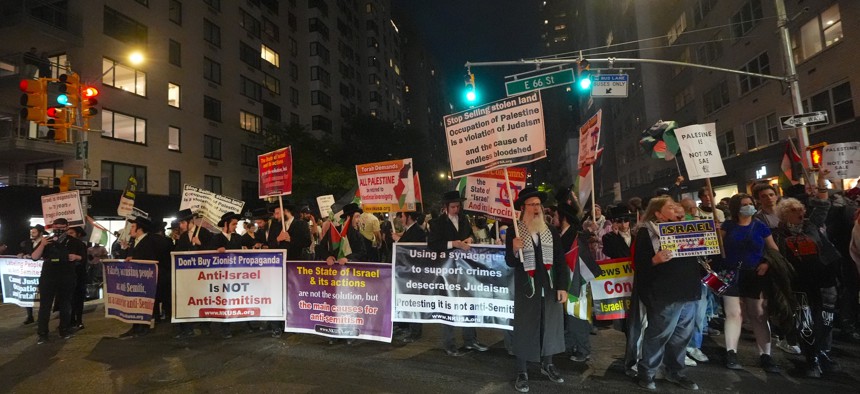
Pro-Palestinian demonstrators protest the “Great Israel Real Estate” event at Park East Synagogue in Manhattan on May 5, 2026. Selcuk Acar/Anadolu via Getty Images


The legislative debates in City Hall and the state Capitol on protecting houses of worship and educational sites from protests has pitted the First Amendment’s protections of religious freedom against its protections of protest. But this debate has obscured the more fundamental question of what these protests are responding to: active facilitation of what international courts and human rights bodies have classified as criminality representing the worst threats to humanity.
Real estate companies operating in Israel and the New York metropolitan region have been hosting expos to sell unlawfully seized land in the occupied West Bank: ancestral land that Palestinian families have lived on and cultivated across generations. The people demonstrating outside these expos are attempting to make visible, by constitutionally protected means, grossly illegal conduct that would otherwise proceed without public notice or scrutiny. Understanding that is the necessary starting point for any honest civic conversation about how our city should respond.
Mayor Zohran Mamdani has repeatedly asserted that these events violate international law and should have no place in New York City. And as a professor of international and constitutional law at the CUNY School of Law, I can say he is entirely correct.
The illegality of Israeli settlement activity, which these real estate expos contribute to, has been called “one of the most settled issues in modern international law.” They constitute war crimes subject to prosecution by any country in the world. More fundamentally, as the International Court of Justice concluded in 2024, they contribute to Israeli apartheid and Israel’s unlawful annexation of the West Bank, or in other words, the old-fashioned colonization of Palestine. The court was unambiguous about what this means for the international community: All countries bear a legal obligation to refrain from providing any support to settlement activity and to take active steps to prevent their nationals from investing in that activity. (While the U.S. withdrew from the International Court of Justice’s compulsory jurisdiction, that is irrelevant here. The court’s opinion simply articulates all countries’ existing obligations under the most fundamental norms of international law.)
The real estate expos do not simply vaguely undermine these legal obligations. As federal courts in this district have held, a person who provides practical assistance which has a substantial effect on the perpetration of an international crime, with the purpose of facilitating its commission, bears accomplice liability for that crime. The settlement real estate expos appear likely to satisfy that standard.
Investigations by media outlets and advocacy groups reveal acts taking place within and around these expos that can constitute practical assistance which has a substantial effect on Israeli settlement activity. The expos sell settlement properties that benefit from a range of Israeli subsidies. The target of these expos are U.S. citizens, who are “overrepresented” in the West Bank compared to Israel, to the point that settler violence has been described as an “American problem” by Ibrahim Fraihat, a professor of international conflict resolution at the Doha Institute for Graduate Studies. These expos further use a screening process to verify the religious identity (and even religious commitment) of prospective buyers and offer packages that include discounted mortgages from Israeli banks with U.S. offices, logistical support for the purchase, and assistance for buyers looking to sell American properties to finance the purchase.
These targeted sales pitches also appear to be made with the purpose of facilitating Israel’s settlement activity; the other key element of accomplice liability. Investigations show that real estate firms have explicitly appealed to wartime nationalism in Israel, taking on a heightened frenzy post-October 7. Indeed, 2024 witnessed the largest Israeli land seizures in the West Bank since the 1993 Oslo Accords, with Israel's finance minister openly stating that the purpose of these plans was to prevent the establishment of an independent Palestinian state.
In an analogous scenario, Human Rights Watch and Amnesty found that online tourism companies like Airbnb and Booking.com that list settler properties make settlements more financially attractive to investors, contributing to their maintenance and expansion. Leading human rights experts have concluded that these actions could amount to aiding and abetting war crimes. The New York real estate expos do even more. They are forums that actively seek buyers of unlawfully seized Palestinian land.
By violating the highest norms of international law, these real estate expos are also violating U.S. federal law. Federal law incorporates serious international law prohibitions and such law is considered “supreme over State law.” They also run afoul of federal and local laws in other ways. By screening attendees on the basis of their religious identity, these expos likely violate federal and New York state and City anti-discrimination in housing laws. What’s more, by targeting sales to only those who are Jewish, these expos discriminate in ways that further what the International Court of Justice, Human Rights Watch, and Amnesty have all found to constitute Israeli apartheid: concentrating land ownership and associated privileges among Jewish settlers to the exclusion of Palestinians.
And pitching sales of properties to which the seller does not hold valid (i.e. lawful) title potentially violates various city consumer protection and advertising laws. Settlers are per se prohibited under the Geneva Conventions from owning any land in occupied territory. Even ostensibly consensual sales of Palestinian lands to settlers are invalid since, as Human Rights Watch has noted, Palestinian land owners are often compelled to sign contracts to sell their land due to the apartheid nature of Israel’s occupation. Israel imposes various travel restrictions and other burdens on Palestinians that prevent them from freely accessing and being able to live on their lands, causing the value of Palestinian-held land to plummet and forcing Palestinians to leave.
The anti-discrimination and consumer protection violations these expos implicate are real – but the graver truth is that war crimes, apartheid, and colonization are being facilitated on New York soil, and we are not reckoning with what that means. Some are even taking place in institutions (like houses of worship) that benefit from New York tax exemptions. Their participants are using financial infrastructure that runs through this city. Yet rather than stop them and move New York towards compliance with our international law obligations by enacting legislation like the “Not on our dime!” Bill, elected officials are instead trying to deploy public resources to prevent impactful protests against these crimes.
What is being discussed here is not an abstraction. Palestinian families are being actively dispossessed – of not just their homes and livelihoods, but more broadly the possibility of political existence. Israel's settlements force Palestinians to live in segregated enclaves reminiscent of apartheid South Africa's bantustans: a systematic project to make Palestinian self-determination physically impossible and subjugate the Palestinian people even further.
As home to the United Nations, New York has long been a capital of the postwar international order – the very order that classifies settlements as war crimes, and apartheid and colonization as patently illegal, and imposes on all states an obligation to stop facilitating them. The norms enshrined in Midtown Manhattan were built so that the world would never again have to reckon with what happens when they are abandoned. Defending them – actively, visibly, here – is what our city owes to that history and to the protection of vulnerable peoples everywhere.
Jeena Shah is a professor of law, focused on international law and constitutional law, at the CUNY School of Law.
NEXT STORY: Opinion: More Asian New Yorkers should consider joining the government workforce