

Opinion
Opinion: For the first time ever, “all leases, no increases”
The Rent Guidelines Board should side with tenants and approve an unprecedented rent freeze on both one- and two-year leases.
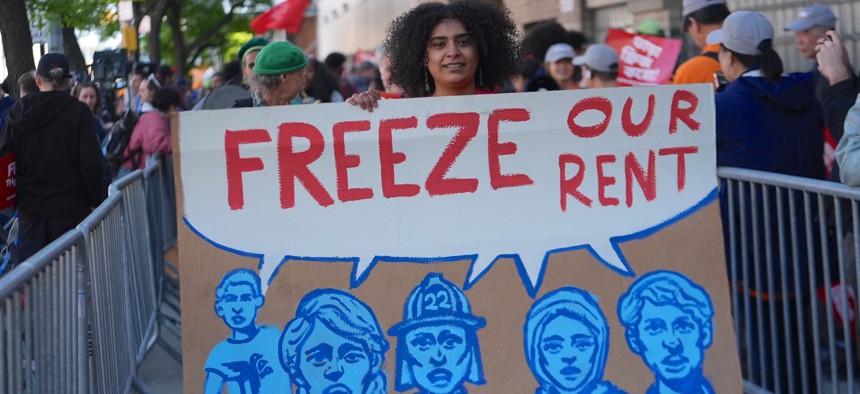
Tenant advocates call for a rent freeze outside a preliminary Rent Guidelines Board meeting at LaGuardia Community College in Long Island City on May 7, 2026. Selcuk Acar/Anadolu via Getty Images


New Yorkers are in trouble right now. They’re facing stagnant wages and rising costs for food, transportation and childcare. Then there’s rent. The fact is the New Yorkers who make this city work are being priced out of their own homes.
This year, when the Rent Guidelines Board sets rents on stabilized leases for the next two years, it has the opportunity to side with millions of tenants who urgently need financial relief by approving the first-ever rent freeze on both one- and two-year leases. (The RGB approved rent freezes on one-year leases in 2015, 2016 and 2020, but has never approved a rent freeze on two-year leases.)
Rent is the largest monthly expense for roughly 70% of New Yorkers who rent their homes. Half of the 2.4 million rent-stabilized tenants report struggling to make ends meet, and most lack emergency savings. Even a small increase can push a household into crisis. A two-year rent freeze would keep money in people’s pockets. It would collectively save tenants billions of dollars and provide each of them an average of hundreds of dollars in monthly relief. That money would go toward groceries, childcare, transportation and local businesses across the city.
Landlords and their advocates argue that rising costs make rent increases necessary. But the data tells a different story. Landlord profits have increased in recent years, and net operating income has grown significantly over a short period of time. At the same time, tenants often see little to no improvement in their living conditions. Most report that rent hikes have not led to better maintenance or upgrades.
Stability matters just as much as affordability. Rent stabilization has long been one of the most effective tools for preventing displacement. More than a third of very low income New Yorkers in rent-stabilized housing depend on these protections to remain in their homes. Without strong safeguards, the city risks losing the very people who keep it running. Between 2020 and 2023, more than half a million people left New York City, many in search of lower housing costs. A rent freeze would help slow that trend and keep communities intact.
So where is the money going? Too often, it is going to cover the costs of ownership rather than the costs of providing safe, well-maintained housing. Debt is a major factor. Many landlords took on large mortgages based on inflated property values and the expectation of steadily rising rents. Now those bets are coming due, and tenants are being asked to close the gap. At the same time, insurance costs have surged, driven by industry consolidation, climate risk and pricing practices that landlords themselves do not control. These are real expenses, but they are not the result of tenants using more services, or buildings undergoing meaningful improvements or becoming more costly to operate on a day-to-day basis. They are the byproduct of financial and insurance systems that treat housing as a commodity.
It is also important to put the so-called distress in rent-stabilized housing in perspective. Only a small share of buildings face serious financial trouble, and that share is declining. A blanket rent increase is not a targeted solution. It places the burden on every tenant, including those already struggling, while doing little to address specific buildings where support may be needed. The city can provide targeted assistance, reduce costs such as insurance through public programs and invest in long term solutions that take housing out of the speculative market.
At its core, this debate is about priorities. Do we believe that housing is a basic necessity, or do we treat it as a vehicle for profit above all else? A city where working people cannot afford to live is not sustainable. It weakens neighborhoods, strains the workforce, undermines community safety and erodes the character of New York itself. Every New Yorker who wants to continue calling this city home should support a two-year rent freeze.
Ahead of the final RGB vote on June 25, it is important to remind ourselves that a two-year rent freeze is a direct and practical step we can take right now to deliver immediate relief to working people. Our city is better off when we protect our neighbors from displacement and offer millions of tenants the stability they deserve. As our friends in the tenant movement say: “All leases, no increases.”
Tiffany Cabán is a New York City Council member representing western Queens. Gustavo Rivera is a New York state senator representing the Bronx.
NEXT STORY: Opinion: Why does New York shackle women during labor?