

Opinion
Opinion: Kingston rent stabilization lawsuit shows why we need the REST Act
Burdensome requirements and legal challenges have blocked upstate cities from adopting rent stabilization, but the REST Act would fix that.
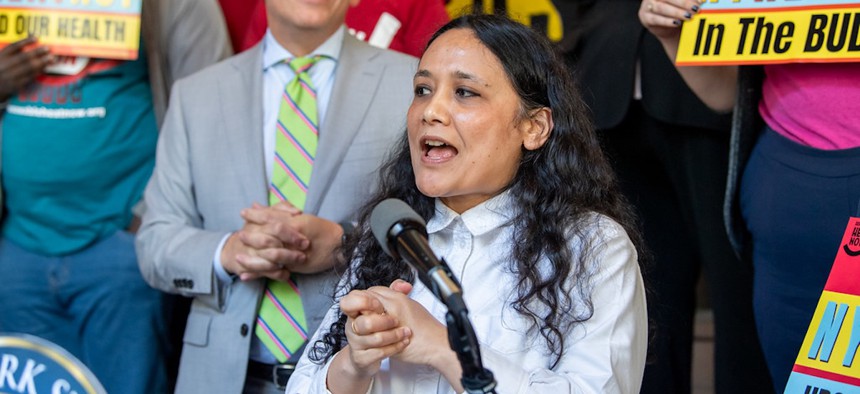
Assembly Member Sarahana Shrestha is the sponsor of the Rent Emergency Stabilization for Tenants Act. NYS Assembly Majority


The housing crisis in Kingston, like many parts of the state, is destabilizing our community. A lack of alternatives is pressuring tenants to sign leases with huge rent increases; state employees are having to live in cars because they can’t afford rent and utilities; and cancer patients undergoing treatment are forced to worry about rent instead of focusing on getting better.
These stories are not exceptions in the majority-renter city we represent – a city where rents have nearly doubled since 2019, and 57% of tenants are rent-burdened, meaning they spend more than 30% of their income on rent and utilities. It’s why, in 2022, local lawmakers opted into rent stabilization, making Kingston the only locality north of Westchester County to adopt the policy successfully. Since then, the city has been mired in lawsuits: first, the city had to conduct multiple costly vacancy studies, then it had to defend the study in court against landlords. These same landlords, aided by New York City’s real estate industry, are once again suing the city, with a vacancy study once more at the center of the lawsuit – and they will continue to do so until the state passes the Rent Emergency Stabilization for Tenants (REST) Act.
The Housing Stability and Tenant Protection Act, the 2019 law that allowed upstate localities to opt into rent stabilization for the first time, should have been transformative. On the contrary, it has essentially served as an obstacle for smaller localities for three reasons.
First, local governments must declare a housing emergency based on the results of a vacancy study, which is not only time-consuming and expensive, but also easy for landlords to manipulate and challenge in court. It’s worth noting that New York is the only state to require such a study. Second, buildings are only eligible for stabilization if they have six units or more, a requirement that makes little sense for housing stock across the state. Third, rent stabilization only applies to buildings built in or before 1974, the year that the rent stabilization law was first passed. It is now 2026, and we have a housing crisis to solve – not just in New York City, where pre-1974 buildings exist in large numbers, but across the state.
The REST Act would fix all three things. Instead of requiring a vacancy study, it would give localities the option of using publicly available data such as eviction rate and rent burden to declare a housing emergency – which would serve as an added legal protection because, while suing over methodology of a vacancy study is too easy, challenging publicly available data is infinitely harder. Second, the REST Act would give localities the option to apply rent stabilization to buildings with four or five units, not just those with at least six units. And third, it would cover all eligible buildings built or substantially renovated prior to the last 15 years on a rolling basis (just as the recently enacted Good Cause Eviction law does), not just those built before 1974.
Tenants make up half the state, and New York’s housing stock isn’t one-size-fits-all. The law shouldn’t be either. As an Assembly member and a local Common Council member, we come at this issue from different perspectives but a shared reality. What’s happening in Kingston – and the failed attempts at stabilizing rents in cities like Poughkeepsie, Newburgh and Albany – make it clear: New York’s rent stabilization laws are outdated, unnecessarily rigid and too vulnerable to legal obstruction.
Upstate cities have the legal right to opt into rent stabilization so they can prevent massive rent hikes and homelessness, but current law makes it all but impossible to do so. We need to change that and pass the REST Act now.
Sarahana Shrestha is an Assembly member representing Assembly District 103, which includes Kingston. Michele Hirsch is an alderwoman and majority leader of the City of Kingston Common Council.
NEXT STORY: Opinion: The debate over buffer zone bills ignores that New York has a war crimes problem