

Opinion
Opinion: More Asian New Yorkers should consider joining the government workforce
Though some roles in government employ few Asian workers, there’s no better time to serve your community from within government.
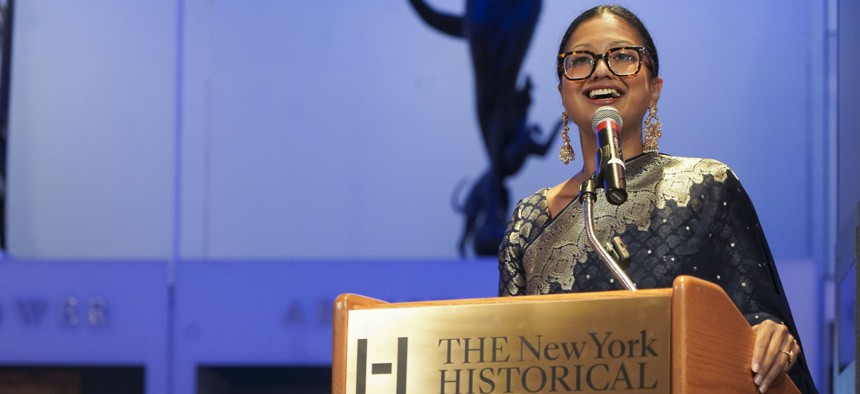
New York City Council Member Shahana Hanif, the first Bangladeshi and Muslim woman elected to the City Council, attends the opening of “The New York Sari” exhibition at The New York Historical. Gerardo Romo / NYC Council Media Unit


In May, we celebrate the heritage and contributions of Asian Americans, Native Hawaiians and Pacific Islanders in New York City. For the first time in NYC’s history, an Asian mayor renewed the hopes of the Asian community, inspiring record levels of voting. Our communities form a cornerstone of the city’s vibrancy and allure. Yet, our communities have not joined the local government workforce at high rates. We write to encourage Asian New Yorkers to go one step further and join the government’s workforce and leadership.
Government service can open a path into the middle class, with often-decent salaries and benefits, even though workers of all stripes have lost power and economic security over the last fifty years. You can earn a living while improving your community. And when a government’s workforce underrepresents the Asian community, government policies won’t address that community’s truest needs. More importantly, when government can’t provide high service for all communities, it won’t be the best government for any community.
Although Asian workers account for 15% of NYC’s adult workforce, only 10% of government workers identify as Asian. While that’s up from 7% in 2015, perhaps many still haven’t seen their peers pursue government careers. Maybe they don’t feel government is the place for them. But government has room for all types: as Asian government leaders, we’re proof that you can exercise influence without fitting every mold or having the loudest voice in the room.
We’re not alone. Around 40,000 Asian New Yorkers serve in city government. Asian workers disproportionately hold roles as science professionals, health professionals and roles related to management. These professions all pay relatively well for the public sector. Of the roles where Asian workers earn the most, they tend to be in information technology.
On the other hand, Asians only make up 10% of the “Administrators” group, the highest-ranking public servants in city government. These roles innovate, problem solve and re-engineer government systems to work better for everyone. We encourage Asian New Yorkers, alongside all other underrepresented communities, to apply for these high-ranking roles.
Let’s not forget the most common government professions for Asian workers in City government. Over 6,300 work as teachers. More than 5,000 work as police and detectives or police supervisors, making up nearly 1 of every 5 Asian public servants outside of the school system. These agencies, due to sheer size, represent the Asian government worker experience more than any other.
The workforce also has many positions with low numbers of Asian workers, including many high-paying roles. Firefighters and fire supervisors, sanitation workers and transportation roles employ comparatively few Asian workers. In particular, Asians comprise only 1% of fire supervisors, per our data.
We have to ensure Asian workers can access less-salaried positions too, since many Asian communities experience high poverty. Broadly speaking, jobs in building services, farming, laborers and craft fields have between 1% and 5% Asian representation. Many specific titles employ virtually no Asian workers. Given the broad socioeconomic diversity of Asian New Yorkers, we’ll fight to ensure they can get city jobs across different levels, that all city jobs have high job quality and that we get more precise data on the sub-communities of city workers.
Data shows that Asian workers in government have clear pathways for growth and promotion. However, their salary growth slows down before the highest levels: career salaries initially increase at roughly the same rate as for white workers, but they increase much more slowly after 15 years. Surprisingly, salaries for Asian workers are spread fairly evenly across all income quartiles of city government salaries. Government employment may help equalize the otherwise high income inequality among Asian workers in New York City.
And while salary is important, the best part of public service comes from working alongside others fighting for New York City. It takes all types of strengths to build a city that stands strong, and agencies like the NYC Equal Employment Practices Commission work for you to remove barriers to inclusion. Asian government workers serve shoulder-to-shoulder with New Yorkers of all backgrounds in probably the most diverse municipal workforce in the world.
We’ve fought for workers and will fight for inclusion and good jobs in government. Whether you want to diversify the workforce by joining it or by working on complex workforce systems, we welcome you. Happy AANHPI heritage month!
Shahana Hanif is a New York City Council member representing the 39th Council District in Brooklyn. She is the first Bangladeshi and Muslim woman elected to the City Council. Jimmy Pan serves as the first Asian executive director of the NYC Equal Employment Practices Commission.
NEXT STORY: Opinion: As we expand childcare, let’s ensure children with allergies are protected