

Opinion
Opinion: New York must set the standard for responsible data center development
By signing a data center moratorium into law, the governor will give the state time to develop meaningful safeguards before this industry expands beyond our limits.
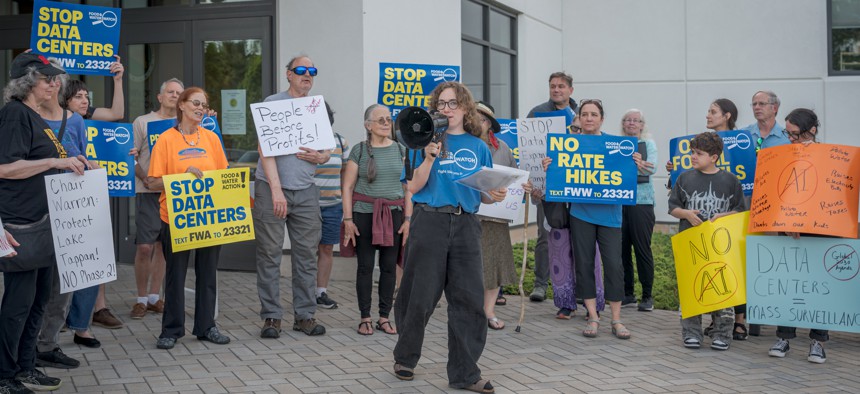
Rockland County residents and activists protest the development of a new data center in Orangeburg. Erik McGregor/LightRocket via Getty Images


The explosive growth of artificial intelligence is fueling an unprecedented rush to build data centers across the country. As developers increasingly target New York for new projects, we face an urgent question: Will we establish the rules needed to manage this industry's growth before its impacts outpace our ability to respond?
If data centers are going to become a major part of New York's economy, they must operate under rules that protect New Yorkers from higher utility bills, encourage efficient energy use and ensure the regions hosting data centers don't absorb the burdens. Last week, the state Legislature took action by passing my bill, the Responsible Data Centers Act, which includes a one-year moratorium on new hyperscale data center permits. Gov. Kathy Hochul should now sign it into law, giving the state time to assess the industry's impacts on our grid, water resources, climate goals and local communities before unchecked expansion continues.
Proposals for large-scale data centers have piled up across New York, each one bringing enormous new demands on our energy grid, water supplies and ratepayers. These facilities don’t just use massive amounts of power – they often reshape entire grids, requiring new transmission infrastructure, new power generation and other costly upgrades. As the Regional Plan Association has warned, energy demand for data centers could outpace what current grid infrastructure in New York is prepared to handle.
Data centers also produce relatively few long-term jobs. In Orangeburg, one data center project received roughly $77 million in tax breaks but created only one permanent job in return. At a time when New Yorkers are being asked to absorb higher costs, these projects raise serious questions about who truly benefits from their expansion.
Already, this surge in energy demand is being used to justify energy projects that do not serve everyday New Yorkers, like the groundbreaking of the Northeast Supply Enhancement pipeline and other costly buildouts designed to meet corporate demand rather than public need. This trajectory risks committing New York to decades of reliance on fossil fuels.
Without guardrails, the fallout from data center growth is predictable because we have seen it materialize in other communities. Ratepayers face higher utility bills, industry creates more pressure for fossil fuel buildout, drinking water supplies face massive drawdowns and there is 24/7 noise pollution from cooling systems or on-site energy generation. What’s often marketed as “economic development” risks becoming a long-term liability for the communities these projects claim to benefit.
All of this is happening as New York backs away from its landmark climate law, delaying implementation and weakening key provisions at a time when decisive action is needed most. Meanwhile, the state continues permitting facilities like Greenidge Generation – a major crypto company now pivoting to power AI – despite growing concerns about the facility’s energy and climate impacts. Greenidge already operates a 106-megawatt natural gas-powered plant for cryptomining and has applied to draw an additional 260 megawatts from the grid.
We’re already feeling the consequences. In the Finger Lakes, TeraWulf is advancing a large data center project near Cayuga Lake, which has drawn fierce local opposition. When local officials attempted to slow the project down, TeraWulf responded by threatening legal action against the town board – an aggressive tactic that underscores how quickly these fights can escalate and how much pressure communities are forced to endure.
These cases make one thing clear: local communities should not have to shoulder the responsibility of fighting billion-dollar companies, especially with such little support. That’s why groups like the National Coalition Against Cryptomining have emerged to support communities and push for stronger oversight of this rapidly expanding industry. Hochul must step in, set clear expectations and shield New Yorkers before these conflicts spiral further out of control.
If data centers are going to be part of New York's future, their growth must align with our climate goals, protect ratepayers and deliver real benefits to the communities that host them. By signing a moratorium into law, the governor will give New York the time it needs to develop meaningful safeguards before this industry expands beyond our limits.
Kristen Gonzalez is a state senator representing District 59, which spans western Queens, North Brooklyn, and the East Side of Manhattan. She is the chair of the Senate’s Internet & Technology Committee.
NEXT STORY: Opinion: Why the Mets are the real working-class team of New York City