

Opinion
Opinion: No one’s boosted Latino politics like DSA
Socialist politics has come full circle in the past 80 years.
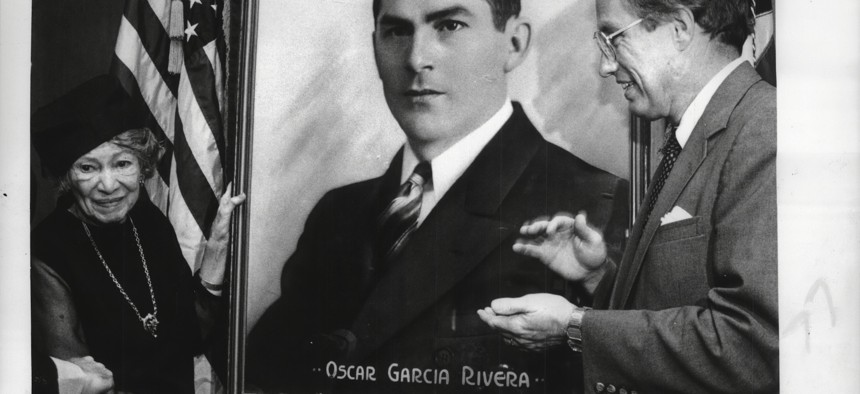
A portrait of the late Assembly Member Oscar Garcia Rivera, a proud socialist and the first Puerto Rican to serve in the state Legislature, is unveiled by his widow Dr. Eloise Rivera and Lieutenant Governor Stan Lundeen on Sept. 14, 1987. John Carl D'Annibale /Albany Times Union via Getty Images Archive


New York City Mayor Zohran Mamdani sent shockwaves through the political establishment two weeks ago with his endorsement of Darializa Avila Chevalier, who is challenging Rep. Adriano Espaillat. The Latino political establishment, especially, viewed the move as another gut punch to Latino leaders, pointing to an earlier snub in January when Mamdani threw his political weight behind the candidacy of Claire Valdez in the race to succeed “La Luchadora,” Rep. Nydia Velázquez, over Velázquez’s preferred candidate, Antonio Reynoso.
“Mamdani is anti-Latino,” went the quip among some of these leaders, despite the fact that both Valdez and Avila Chevalier are Latinas. The ire was also directed at the Democratic Socialists of America, which has been characterized by its detractors as an organization lacking racial diversity. That these battles are unfolding in districts with large Latino populations is particularly fascinating, as it is in these neighborhoods that DSA is experiencing growth and Latino political representation is undergoing significant change.
The relationship between DSA and Latinos is quite fascinating. What began with Rep. Alexandria Ocasio-Cortez’s surprising 2018 victory over then-Rep. Joe Crowley, and continued with state Sen. Julia Salazar’s victory a few months after AOC’s upset, has only grown stronger.
DSA has taken quite a few hits for its lack of diversity, with a substantial number of its membership being white. Yet, of the 13 socialists in elected office in the state Legislature and the New York City Council, half are Latinas. Assembly Member Jessica González-Rojas is also a DSA member, though not formally endorsed by the organization. And of course, AOC is a proud DSA member.
DSA’s penchant for backing Latino/a representatives continues this election cycle, with the socialist organization currently supporting a number of Latino/a candidates for Congress and the state Legislature. Both Valdez and Avila Chevalier – the group’s two congressional candidates – are Latina. Assembly Member Diana Moreno, who recently won the special election to succeed Mamdani in Astoria, is now running for a full term. And Illapa Sairitupac, of Peruvian descent, and Samantha Kattan, of Mexican descent, are running with DSA’s support for the Assembly. In addition to these candidates, there are other candidates who have not formally received a DSA endorsement, but are DSA members, like Brian Romero, who’s running to succeed González-Rojas, his former boss.
It’s clear that over the past few years DSA has done more than other organizations for the advancement of Latino/a representation, including a number of the Democratic county organizations in the city. Consider, for instance, that Moreno and New York City Council Member Tiffany Cabán represent districts that are not even Latino-plurality, never mind Latino-majority. While DSA has supported Latinas beyond districts with a large Latino presence, organizations like the Queens Democratic machine have often bypassed qualified Latino candidates, even in Latino-majority districts.
The link between socialists and some Latino groups has a long and interesting history here in New York. I have previously noted that “the beginnings of Latino politics in New York largely embraced a brand of socialism.” Early Puerto Rican political leaders, like Jesús Colón and Bernardo Vega, were proud socialists. Much like today’s DSA members, they believed socialism responded to economic injustice by providing tools that could balance inequity within a system that often concentrated wealth and power in the hands of a few and left working-class and marginalized communities like Puerto Ricans trapped in cycles of poverty and exclusion.
By 1937, when Oscar Garcia Rivera made history by becoming the first Puerto Rican Latino elected to a state legislature in the U.S., socialism was the preferred economic philosophy of the bulk of the Puerto Rican leaders in New York City, from intellectuals like Colón and Vega to the tabaqueros in the cigar factories.
Garcia Rivera was himself a socialist, and avowed Marxists, labor activists, the American Labor Party and others on the far left boosted his successful run for the Assembly. He represented East Harlem, the “Commie Corridor” of its day that had already helped send progressive leftist Fiorello La Guardia to Gracie Mansion and socialist Vito Marcantonio to Congress.
Garcia Rivera’s first order of business in the Assembly was to introduce an affordable housing bill that aimed to restrict landlords’ ability to raise rents arbitrarily. This was his way of combating an affordability crisis gripping the city, and particularly impoverished groups like Puerto Ricans. And his second focus? Garcia Rivera fought tooth and nail to disrupt the powerful Tammany Hall, seeing them as corrupt political players that did nothing but empower themselves. Interestingly enough, both of these issues championed by Garcia Rivera – grappling against an affordability crisis and fighting against a political establishment content with maintaining or better still gaining even more power, even if it came at the expense of the wider public – are issues that DSA and its Latino representatives have taken on.
After Garcia Rivera’s short tenure in the Assembly, socialism among Puerto Rican leaders began to wane. No other socialist Latino won elected office until AOC’s improbable victory in 2018, 81 years after Garcia Rivera’s first victory. With the rise of AOC and other Latino democratic socialists, a new chapter in Latino politics in New York may be emerging, one that stands on the shoulders of earlier radical traditions embodied by figures such as Colón and more recent activist movements such as the Young Lords of the 1970s.
Some may have qualms with this latest development in the complex nature of our politics and reality, but it cannot be ignored or denied. And what if new Latino socialists win election, some of whom are running in Latino-plurality districts, like Romero in Queens? What will that say about the potential alignment of some of the socialists’ agenda – an agenda of alleviating the current affordability crisis, and battling a system that has not worked for the poor – with many Latinos’ choice of candidate? Rather than critique, as many are wont to do, it seems time to consider the plight of the majority of Latinos and ask why some are preferring Latina/o socialist candidates.
Eli Valentin is an assistant dean at Virginia Union University’s Graduate Center in Harlem and the author of “Politicking in the Barrio: Essays on Latino Politics in New York.”
NEXT STORY: Opinion: New York’s kids are falling through the cracks between our agencies