

Opinion
Opinion: NYC’s proposed horse-carriage ban is driven by emotion and propaganda
“Romanch’s Law” would kill horses and immigrants’ jobs.
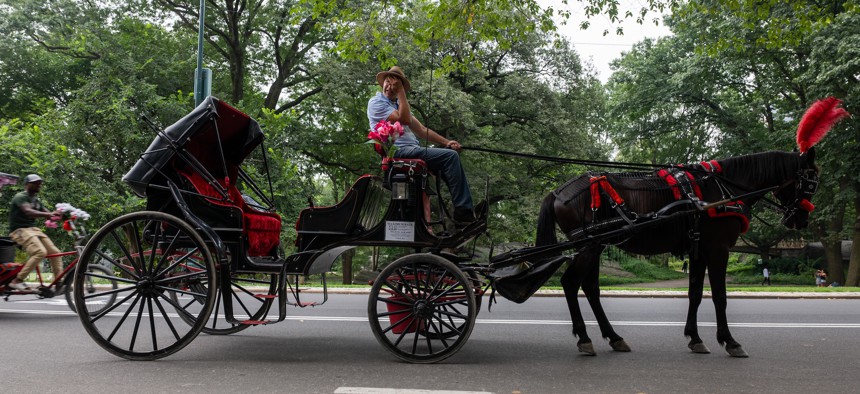
Horse-carriage drivers and their majestic horses have been providing tours of Central Park for 167 years. Spencer Platt/Getty Images


As an equestrian for more than 60 years, and as someone who has spent decades serving New Yorkers both in City Hall and the City Council, I am urging my colleagues to take a step back before making a mistake the city will come to regret.
“Romanch’s Law” (Int. 943), which would ban New York City's iconic carriage horse industry, is misguided legislation driven more by ideology than reality. There is still time for common sense to prevail, and that is exactly what New Yorkers expect from us.
Horse-carriage drivers and their majestic horses have been providing tours of Central Park since the very first day the park opened in the winter of 1858. The purpose was to provide residents and visitors to New York City with a bit of a respite from the hustle and bustle of the burgeoning metropolis. Carriage rides continue to serve that purpose.
The carriage-horse ban would not simply eliminate one of Central Park's most iconic and historic attractions. It would destroy an entire industry built on small, family-owned businesses, cost hundreds of hardworking immigrant New Yorkers their livelihoods and, in the ultimate irony, cost the lives of all 160 horses in the industry.
Thanks to the comprehensive horse-carriage reform law I authored 16 years ago, all carriage horses must, upon reaching age 26, be retired to a horse farm that will provide them with top-flight stables, veterinary care, outdoor exercise, etc. Such accommodations are very difficult to find and cost more than $25,000 per year per horse, which the industry pays for. Most retired horses live about five years in retirement.
But if the industry is closed down and revenue stops, there will be no money to make arrangements to retire 160 horses, some of which are as young as 5 years old, for the rest of their lives. But Int. 943 requires the horses to be retired in the same fashion that NYC carriage horses are retired now. First Class. This is financially impossible.
And Int. 943 does not allow the industry to sell the carriage horses to other carriage industries. These horses are not saddle horses. They are large, muscular “draft” horses, bred and trained to pull a plow), but there is no market for plow horses – and because these horses have never pulled a plow in their lives, that is not even an option. Therefore, many of the horses will likely be sent to slaughter.
It’s not just the horses that will suffer. There are just 68 city-issued carriage medallions, each representing a small business that has often been passed down through generations. Together, these businesses support roughly 200 workers, including carriage drivers, stable hands, farriers, owners and other skilled professionals. The overwhelming majority of them are immigrants who chose this profession, built their lives around it and take immense pride in their work and their horses.
Nothing about this ban makes sense, particularly at a time when New Yorkers are struggling through an affordability crisis. Deliberately wiping out an entire lawful, regulated industry that supports working families is not compassionate public policy – it is economic self-sabotage.
Even more troubling is that this legislation is not responding to a demonstrated pattern of abuse. In the 167-year history of New York City's carriage horse industry, not a single carriage driver has ever been convicted of animal abuse or cruelty. That fact alone should give every City Council member pause.
In November, the City Council's Health Committee rejected a nearly identical proposal known as “Ryder's Law.” After reviewing the evidence, the committee concluded that the horses receive appropriate veterinary care, are housed in stables that consistently pass city inspections and perform work that is suitable for their strength, breeding and temperament. Those facts have not changed.
Last month, our city experienced a heartbreaking tragedy when Romanch Mahajan, a young tourist from India, was killed in a carriage accident. According to reports, the driver had briefly stopped to take a family photograph and still had the horse's reins in his hand when, for reasons that remain unknown, the horse unexpectedly bolted. Multiple investigations into the cause remain ongoing.
Every loss of life is heartbreaking, and this incident deserves a thorough investigation. But good public policy cannot be driven by emotion alone. It must also be guided by facts and perspective. This was the first known passenger fatality involving a New York City carriage ride in 167 years of operation. During just the first six months of this year, by comparison, dozens of people have been killed in crashes involving two-wheeled motorized vehicles on our streets. We do not ban an entire mode of transportation because of a single tragedy. We investigate what happened, learn from it and make targeted improvements where appropriate. The same principle should apply here.
And that’s what the city government should do regarding carriage horses. To the extent there are safety concerns, we should address them. I have introduced a bill that would enhance the safety of an industry I contend is already very safe, with tougher testing of driver applicants, regular refresher training and mandatory enforcement of safety-related rules in the park. Most importantly, the bill also mandates the installation of hitching posts at carriage stands and locations where tourists like to stop for photos. The industry has been asking for years for the installation of this critical safeguard – hitching posts are 100% effective against horses getting loose – but prior mayoral administrations and the Central Park Conservancy have failed to act.
Int. 943 fails everyone. It sentences the horses to death, ignores the wishes of the public, disregards the livelihoods of hardworking immigrant families and seeks to dismantle a safe, highly regulated industry without any compelling justification. New Yorkers deserve leadership that addresses genuine problems – not legislation that creates new ones.
James Gennaro is a New York City Council member representing District 24 in Queens.
NEXT STORY: Opinion: It's time to end horse-drawn carriages in New York City