

New York City Council
The NYC Council passed a $10k bonus for paraprofessionals. Will the mayor sign it?
Even if he doesn’t, the council has the votes needed to override the mayor’s veto.
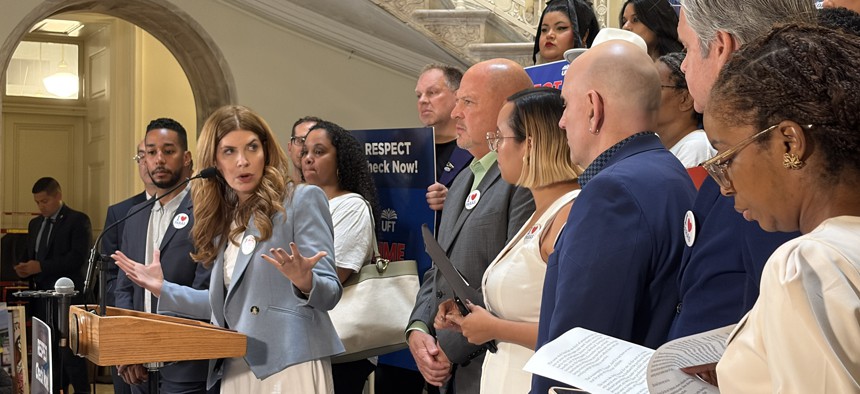
City Council Speaker Julie Menin and United Federation of Teachers President Michael Mulgrew rally ahead of the vote to give paraprofessionals a one-time bonus. Chantal Mann/City & State


You get a raise! And you get a raise! At the New York City Council, everybody gets a raise!
The New York City Council passed legislation Thursday to give paraprofessionals – instructional aides who assist public school students with disabilities and have a starting salary of $32,500 – a $10,000 bonus. The legislation passed by a unanimous vote of 49-0. (Council Members Darlene Mealy and Vickie Paladino weren’t present.)
The city is legally mandated to provide paras to students with disabilities as outlined in their Individualized Education Programs, but the role has 1,600 vacancies across the city, according to the teachers’ union, as low wages dissuade potential workers from pursuing the profession. “You cannot sit idly by as a city knowing that there are thousands of children every day not receiving their services,” United Federation of Teachers President Michael Mulgrew said during a press conference at City Hall prior to the vote. “We’re trying to make sure that our school system is able to pull out of a significant crisis, one it has never faced like this before. And at the same time, to do justice for the people who have been left dealing with the crisis.”
Council Member Carmen De La Rosa, the bill’s prime sponsor, said during the press conference that the bill would save the city money by reducing the frequency of Carter cases, lawsuits in which families of students with disabilities seek reimbursement from the city for the cost of placing their children in private schools because city schools don’t meet their needs.
The UFT has advocated for the bill for more than a year, and the vast majority of council members signed on as cosponsors, but then-Speaker Adrienne Adams refused to move it, citing the legal concerns. Mayor Zohran Mamdani supported the bill on the campaign trail, but has changed his tune since taking office..
“I have been clear that questions of compensation are best resolved through the collective bargaining process that respects workers and their unions. However, the Council's passage of this legislation is in direct violation of the Taylor Law,” the mayor said in a statement following the vote, referring to the state statute mandating that all wages and benefits for public sector workers get decided through collective bargaining. “Our administration is reviewing the final language carefully and working to determine the appropriate next steps.”
Echoing the mayor’s concerns, the fiscal watchdog Citizens Budget Commission released a statement before the vote urging the council not to pass the bill and to instead address the issue through collective bargaining. The UFT, however, won’t begin contract negotiations until 2027.
“Would we have preferred to do this through collective bargaining? Of course. Would we have preferred to do this in the budget? Absolutely,” Council Speaker Julie Menin said Thursday. “But the administration did not want to do either of them. The council is going to use every tool in its toolbox to act.”
Whether or not this specific tool is allowed is a bit more complicated, given concerns about the Taylor Law. The council could potentially face a lawsuit for legislating the bonus outside the bargaining process, but lawmakers and advocates insist that the bill doesn’t violate any laws.
“Let me be clear: we are the United Federation of Teachers. We're the largest local in the entire country. We understand the Taylor Law,” Mulgrew said. “That's why this bill is written specifically the way it is.”
Before any legal challenges can happen, though, the mayor would have to sign the bill – which he hasn’t committed to. And even if the mayor vetoes the bill, it passed with more than enough votes to meet the two-thirds majority threshold needed to override a mayoral veto.
“I really hope it does not come to that,” Menin said during a pre-stated press conference Thursday. “I don't understand how (the bill) could be controversial, or how anyone could disagree with that.”