

Opinion
Hed: Opinion: What ‘9 to 5’ still says about work
New York should honor the late Dolly Parton on this 9/25.
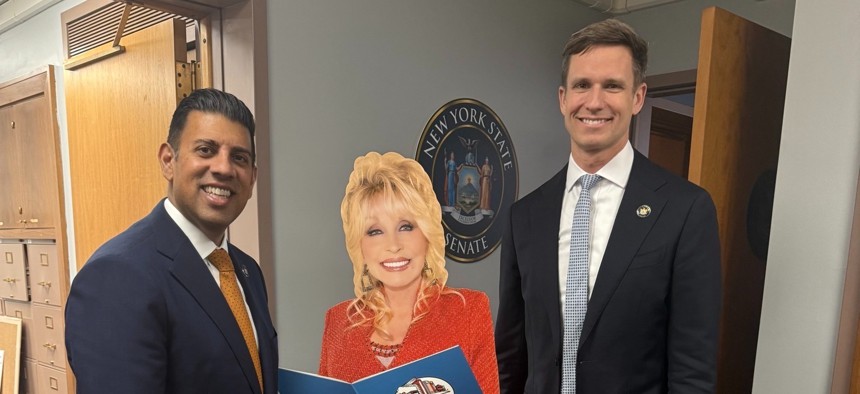
State Sens. Jeremy Cooney and Erik Bottcher pose with a lifesize cut-out of President Parton. Courtesy Erik Bottcher

The American workplace looks very different than it did when Dolly Parton released “9 to 5” in 1980.
The typewriters are gone. Millions of people can work from their kitchen tables. Video calls connect colleagues thousands of miles apart. Artificial intelligence is beginning to change not only where we work, but what work itself looks like.
Yet more than four decades later, the frustrations Dolly put into that song remain remarkably familiar.
Being overworked and underappreciated. Watching someone else take credit for your contributions. Trying to get ahead and wondering why the next opportunity always seems to remain just beyond reach.
That is why “9 to 5” endured. It wasn't simply catchy. It understood something fundamental about work: people want more from a job than a paycheck. They want to know that their effort matters. They want a fair chance to advance. They want dignity and respect.
For working women in particular, the song put words to realities that had too often been dismissed or ignored. The movie that shared its name drew inspiration from a movement of women organizing around unequal pay, discrimination and mistreatment in the workplace. Dolly turned those experiences into a song millions of people could recognize as their own.
The workplace has changed enormously since then. What hasn’t is the basic question: Do people feel valued by the organizations they help build?
That question matters at a time when workers and employers are renegotiating some of the basic assumptions that governed work for generations.
Remote and hybrid work have changed expectations around flexibility. Younger workers are increasingly willing to challenge traditions their parents and grandparents were expected to simply accept. New technology is creating extraordinary possibilities while also producing anxiety about what jobs will exist a year from now. And in what form will the jobs that do endure take.
Those debates can become arguments about productivity, office attendance, technology or generational differences. Underneath them is something simpler.
People want work to work for them, too.
Dolly Parton understood that without ever turning herself into a lecturer. She could deliver a serious message with humor, melody and enough humanity to make people listen.
Her connection to working people also extended far beyond one song. She grew up in poverty in East Tennessee before building one of the most successful careers in American entertainment. She became an entrepreneur and employer herself. And through the Imagination Library, she invested her success in giving children opportunities that many families could never otherwise afford.
Dolly celebrated ambition without looking down on people who were still struggling. Success never seemed to require forgetting where she came from.
Following her death, we introduced legislation that would designate September 25 – or 9/25 – as “9 to 5 Day,” an annual commemoration of her life and legacy. Similar proposals have emerged elsewhere, and Nashville has now established its own annual Dolly Day on September 25.
The idea isn't to celebrate a particular set of office hours. Plenty of Americans have never worked from nine to five in their lives.
The name signifies something larger.
It represents the millions of people who get up every morning and keep families, companies and communities running. It represents the women who fought to be taken seriously in workplaces that depended on them while undervaluing them. And it represents a simple principle that should survive every technological and cultural transformation of work. People deserve to feel that their contribution counts.
Nearly 46 years after Dolly Parton first sang about working life, the world has transformed.
The desire to be respected hasn't.
Erik Bottcher is a state Senator representing parts of Manhattan. Jeremey Cooney is a state Senator representing parts of Monroe County.
NEXT STORY: Opinion: Netanyahu is coming to NYC. How should our elected officials respond?