

20th Anniversary
Opinion: Bill de Blasio’s record in addressing a Tale of Two Cities
Economist James Parrott evaluates the New York City mayor’s progress on closing the inequality gap.
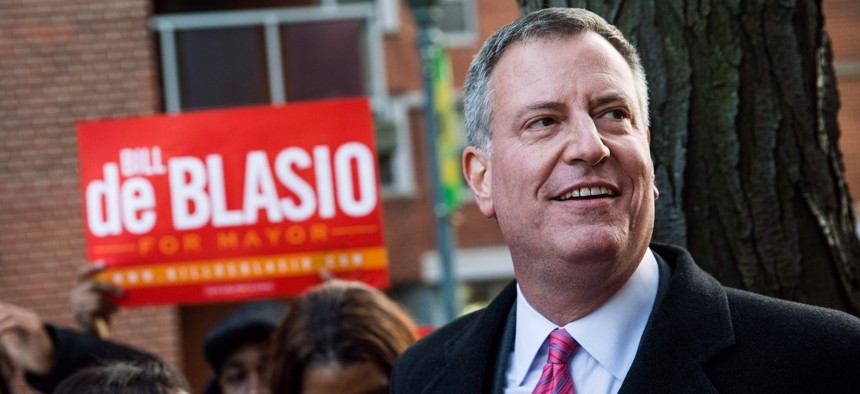
Then-New York City mayoral candidate Bill de Blasio campaigns in Brooklyn in November 2013. Andrew Burton/Getty Images


Bill de Blasio is one of New York’s 20 most influential politicians of the past 20 years. See the full list.
Following 20 years of mayoral rule by Rudy Giuliani and Mike Bloomberg, Bill de Blasio struck a chord with his 2013 campaign promise to deliver policies to address New York City’s “Tale of Two Cities.”
Toward that end, he pursued policies such as universal prekindergarten, several years of rent freezes, housing investments, settling long-overdue municipal labor contracts and raising the minimum wage. He was fortunate to govern during a period of favorable macroeconomic conditions with low inflation and the city’s strongest sustained job growth in decades, but many of his signature policies focused on working-class and middle-income New Yorkers.
In de Blasio’s first six years in office before the COVID-19 pandemic, 2014 to 2019, New York City saw historic wage and income growth for the bottom half of the income distribution, along with declining poverty and a flattening in income inequality. Such economic gains were not borne out nationally, suggesting city policies made a difference.
The doubling of New York City’s minimum wage between 2013 and 2019 was the linchpin to the city’s historic wage and income gains during this period. Under state law enacted in 2013, the city’s minimum wage rose in three steps from the federal $7.25 level to $9 at the end of 2015. But it was de Blasio’s support for the Fight for $15 campaign as early as 2012 and for a citywide $15 minimum wage in 2014 that pushed then-Gov. Andrew Cuomo to support a significant minimum wage increase. Cuomo enacted a $15 fast food minimum wage through a state wage board in 2015 and began phasing in $15 across-the-board statewide in 2016. Cuomo initially scoffed at the idea when de Blasio sought state authority for a New York City $15 minimum wage, but two years later Cuomo was rushing to sign legislation in a race with California Gov. Jerry Brown (as it turned out, both signed $15 legislation on April 4, 2016).
In three $2 increments, the city’s minimum wage went from $9 an hour in 2015 to $15 at the end of 2018 for large employers. Among other wage-lifting measures, de Blasio negotiated long-overdue union contracts with wage increases for over 300,000 city workers following three years when Bloomberg essentially shut down contract negotiations. He also agreed to start pay salary parity for nonprofit sector universal pre-K teachers, and in 2019, put in place the nation’s first minimum pay standard requirement (at $15 an hour for all their working time plus expenses) for 80,000 ride-hailing drivers who Uber and Lyft treated as independent contractor gig workers.
In the immediate pre-pandemic years under de Blasio, the combination of the doubling of the minimum wage, city-supported wage gains and strong employment growth fostered the largest incomes gains for the lowest-earning half of all families in New York City in at least a half century. The city’s wage-driven income gains resulted in a flattening of the income polarization trend that had barreled forward since the late 1970s. Indicative of the income polarization trend that gave rise to the “Tale of Two Cities” narrative, the share of total income going to the richest 1% of New York City families rose from 12% in 1980 to 40% in 2014, a concentration nearly twice the national average. The highest-earning income share then leveled off and dropped to 35% in 2019.
New York’s pro-worker policies tremendously boosted pay for workers in the bottom half of the income distribution, and together with historically low unemployment, enabled 2 million New York City workers and their families to collectively get a bigger slice of the city’s economic pie for the first time in a half-century. Government economic data reveal that workers in the bottom half of the wage distribution had inflation-adjusted wage gains of 20% or more from 2014 to 2019, with the worker at the 10th percentile wage (10% make less, 90% make more) getting a 32% increase, and the worker at the 20th percentile a 25% pay gain.
Higher wages for the lower half of earners were so significant that they translated into a higher share of total wages paid in New York City over that period, according to income tax data. From 2014 to 2019, the share of total wages going to those in the bottom half rose by 1.4 percentage points in the city, while nationally the gain for such workers was less than half that. While the wage share of those at the bottom rose, it fell for the richest 10%. New York’s wage and pro-worker policies made a big part of the difference.
The rising wage share for households in the bottom half lifted their income share as well, with the income gain for those in the bottom half of New York City’s income distribution being far greater than their national counterparts. The sharp income share increase for the bottom half in the city was accompanied by decline in the share of total incomes going to the richest 10%.
Income gains for the city’s nonwealthy also meant 20%+ real median family income gains for the city’s Black, Latino and Asian and other families from 2010 to 2019, according to census data. This is striking in contrast to the two previous decades of stagnant or declining real incomes for families of color. New York City’s poverty rate fell to 17% in 2019, its lowest level since the early 1970s. Child poverty dropped by a quarter over the decade, falling from 31% in 2010 to 23% in 2019 – also the lowest level in nearly 50 years.
Despite the impressive economic gains for the bottom half of the income spectrum, stark inequalities still existed by the time of the onset of the COVID-19 pandemic in early 2020 – and are much starker today. Nonetheless, there’s no mistaking the fact that city policies under de Blasio, including not only higher wages but also the implementation of universal pre-K – saving thousands of families thousands of dollars a year in childcare costs – three years of rent freezes for 1 million rent-stabilized apartments, a sharp curtailment of the New York City Police Department’s stop-and-frisk policing and a significant paid sick leave expansion, all carried out in the spirit of addressing the “Tale of Two Cities,” demonstrated a commitment to improving the lives of working-class and middle-income New Yorkers.
James Parrott is a senior fellow and senior adviser at the Center for New York City Affairs at The New School.
NEXT STORY: Opinion: What ‘9 to 5’ still says about work