

20th Anniversary
Opinion: Jerry Nadler set an example for all studious Manhattan politicians
His successor in Congress, Micah Lasher, writes about Nadler’s lasting impact on New York and the nation.
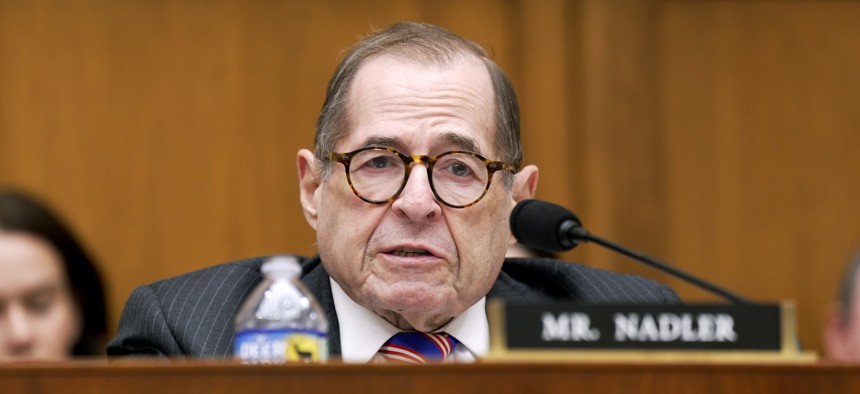
Rep. Jerry Nadler has been part of critical national fights, including as House Judiciary Committee chair during Donald Trump’s first impeachment. Al Drago/Getty Images


Jerry Nadler is one of New York’s 20 most influential politicians of the past 20 years. See the full list.
Stand with Rep. Jerry Nadler on a street corner or at a greenmarket or at the entrance to a subway station – as I did a great deal over the past year while running to succeed him in Congress – and you will meet one New Yorker after another who wants to thank him for his courage.
For enshrining the right to marry in federal law. For speaking out against reckless wars. For protecting the right to vote. For pushing and leading reticent House Democrats to impeach President Donald Trump. For his 25-year battle – finally just won – for the truth about air quality and health risks at ground zero. Because Nadler has been a clarion voice of conscience in Congress for 34 years, and in the Assembly for 16 years before that.
You will meet people Nadler knows personally, or whose parents or grandparents he knew. People he has helped. People with whom he worked on a cause or a campaign at some point over the years, dating back to when he and a group of fellow Stuyvesant High School students first started organizing on the Upper West Side in the ’60s.
In a surprising number of those conversations, he will remember the work they did together, or even the address of the person he’s speaking with; if he has been in their living room – and he has been in many, many living rooms – he will remember a detail. Because no matter the heights to which he rose in Washington, D.C. – chair of the powerful House Judiciary Committee – or the national fights he led, a big part of his big brain has always been devoted to the issues and people of his district.
This being Manhattan, you will – though not as frequently – meet someone who has a bone to pick with their member of Congress, perhaps because of a position or a vote in the House that the passerby didn’t like. And Nadler will explain his reasoning. He will do so neither defensively nor arrogantly, but with an unassuming disposition that should not be confused for lack of passion. Flash, to say the least, is not his thing. His explanation will be rooted in a deep understanding of the legal and policy questions involved. He will wield history, statistics, arcana. He will not look over his interlocutor’s shoulder to seek another, perhaps friendlier, hand to shake. He is unruffled by criticism and never happier than when he is immersed in a substantive exchange.
It is these qualities that have caused his constituents to place in Jerry Nadler total trust, or as near to it as the educated, eclectic and opinionated voters of Manhattan are constitutionally capable of. Those voters happen to be among the highest-propensity, most activist-spirited voters in America. As a result, Nadler has maintained a virtually unique level of influence in elections above and below him on the ballot for most of my lifetime.
He has never been above deploying that influence and getting involved in the hurly-burly of politics. During my primary campaign for Congress, Nadler would call late into the night with questions and ideas about campaign strategy. He sweats the granular details that win elections: where the votes come from – down to the precinct and building – and who can be counted on to get the word out.
And he has seen it as part of his mission, and his obligation, to nurture future generations of political leadership in his district and beyond. I am just the most recent elected official to come from his bench. More broadly, time and again, Nadler’s seal of approval in a tough election was pivotal: Just ask U.S. Sen. Chuck Schumer, Manhattan District Attorney Alvin Bragg or Manhattan Borough President Brad Hoylman-Sigal.
I feel supremely fortunate to have wandered into Jerry Nadler’s political orbit as a teenager 30 years ago, and then to have worked in his congressional office a decade later. As a Nadler staffer, each day was a window into the rare elected leader who was always principled, regularly fearless, and who brought to bear in everything he did an encyclopedic mind.
I remember an effort to persuade Fordham University to allow its security guards to unionize with 32BJ SEIU. I had drafted a lengthy letter to go from Nadler to Fordham’s president, a Jesuit priest. Nadler read the draft in front of me, looked up and asked whether I was familiar with “Rerum novarum.” I was not. The yeshiva-educated son of a chicken farmer explained that it was the 1891 papal encyclical on labor and the working class, and that he wanted to invoke “Rerum novarum,” which is Latin for “of revolutionary change,” in the letter. That is Jerry Nadler.
Through it all, he has left an indelible mark on politics in New York and Washington, D.C., going from strength to strength. He has used his power not for his own benefit, but to advance causes and candidates that embody his belief that progressive, effective government can deliver a more just society.
Jerry Nadler’s influence will carry on long after he leaves Congress, not just because of the laws he has passed but the approach to politics that he has practiced.
Micah Lasher is an Assembly member and the Democratic nominee for the 12th Congressional District.
NEXT STORY: Opinion: What ‘9 to 5’ still says about work