

Opinion
Opinion: Legionella community outbreaks are hard. Politicizing them makes them harder.
When New Yorkers hear competing claims from elected officials, advocates, commentators and public health experts, it becomes harder to know who to trust.
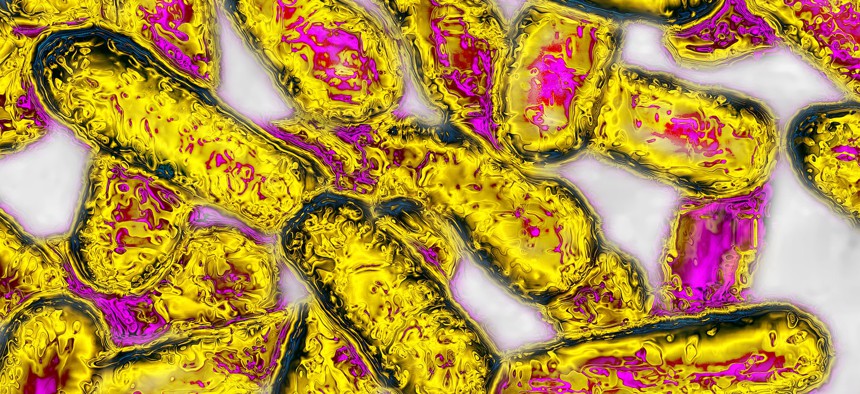
Legionella bacteria BSIP/UIG via Getty Images

Legionella outbreaks are among the most challenging public health events cities like New York face. They move quickly and demand action before answers are known. They require scientists, laboratorians, epidemiologists, clinicians, communications professionals, building owners, elected officials and community members to work together under pressure. I led many of these responses while at the NYC Health Department and supervising the Legionella team at the Centers for Disease Control.
In my experience, when outbreaks become a politicized football, they become even harder.
The recent Upper East Side Legionnaires' disease outbreak was a tragedy. By late July, New York City identified 92 cases, 79 hospitalizations and seven deaths associated with the cluster. Additional deaths confirmed weeks later brought the total to 11. More than 180 cooling towers were tested, dozens were found to be harboring Legionella bacteria and the Health Department mobilized hundreds of staff members in response.
Every death matters. Every hospitalization matters. Every family deserves answers. At the same time, families are not served when response efforts are contradicted, ridiculed and questioned during an emergency for seemingly political reasons.
Legionella investigations are already messy. The public expects a single source, mistake or moment when it all becomes clear. But the reality is complex. Legionella bacteria are naturally occurring in the environment. Finding it is not the same as proving it caused illness. Determining a cause takes weeks, and certainty remains elusive even after it’s controlled. Whichever cooling tower or towers is responsible for this outbreak, public health officials stopped it from causing more infections, severe disease and deaths weeks ago.
That complexity is frustrating. It is also why public health agencies must communicate frequently, honestly and transparently, and not be undermined by politicians. Legionnaires’ disease is treatable. The number one message to impacted communities must be to get to a medical professional immediately if you have flu-like symptoms.
In this case, the NYC Health Department issued repeated public updates, held town halls and press briefings, distributed thousands of educational materials, updated online dashboards, ran advertisements and shared information with clinicians and residents. Overcommunication is critical because the timeline creates confusion. Residents see additional hospitalizations or deaths and wonder whether the outbreak is ongoing when these outcomes often reflect the long clinical course of severe illness rather than ongoing exposure. Public health agencies must explain that distinction clearly, because people deserve information even when it’s evolving.
According to the Health Department, more than 90% of patients developed symptoms before July 7, just days after the investigation began, before many of the final remediation activities and before the full scope of contaminated towers was understood. That means the core public health work that supports stringent regulation and sanitation swiftly cut off the source. The decline may reflect a combination of factors, including rapid early intervention, heightened awareness among clinicians, accelerated testing of cooling towers, immediate precautionary actions and years of infrastructure, surveillance and preparedness work that rarely receive public recognition. Long before outbreaks make headlines, there are disease detectives reviewing reports, laboratorians processing specimens, inspectors enforcing regulations, clinicians recognizing patterns and emergency response teams preparing for the next cluster.
This work is difficult to see because it is measured in events that never happen. The greatest successes are crises averted. But that does not mean there isn’t a story to tell – and no matter how thorough the response, there is always room for improvement. Finding those opportunities requires difficult conversations.
We should ask whether regulations need strengthening and whether inspections happen frequently enough. We should ask whether resources are adequate and whether lessons from the Central Harlem outbreak were fully incorporated. Honest evaluation is not an attack. It is how systems improve.
But there is a time and place for that, and it’s not in the middle of an emergency when clear, consistent communication from everyone is a must. Dehumanizing public health workers as “minions,” claiming they “failed” New Yorkers before the outbreak is over or saying it’s “shameful” that they wouldn’t follow unscientific guidance isn’t just poor choice of words. It distracts from the message that mattered most: to seek care if you feel sick. It weakens trust in that message when following it can be the difference in life or death.
Politicization creates the illusion that every public health event happens because someone failed, hid information or did not care enough. That may generate headlines, but it rarely generates solutions. Most importantly, it confuses New Yorkers.
When residents hear competing claims from elected officials, advocates, commentators and public health experts, it becomes harder to know who to trust. People can mistakenly conclude that basic facts are disputed when they are not. They may start believing health authorities know less, or more, than they actually do or that uncertainty itself is evidence of incompetence. Proposing an unproven course of action during an emergency – like pushing for blanket remediation of every cooling tower in the area while falsely claiming the CDC supports this approach – makes people question who and what information they can trust.
During an outbreak, trust is not a luxury. It is essential.
During my time at CDC, my office was shot at because of the politicization of vaccines. That reinforced something I learned from responding to HIV, mpox and COVID-19: politicization has real-world consequences. One year ago, I resigned from the agency in protest because politicization of public health hurts people’s health – and as a physician I could not stay to see it weaponized by politics.
When public health professionals become targets rather than partners, the damage extends beyond workers. It affects recruitment, retention, morale, and ultimately, the public's health.
Scientists and health officials should be held accountable, questioned and scrutinized. But they should not be demonized for difficult work under uncertain conditions. The people responding to outbreaks are not the enemy. They are the reason outbreaks end.
The Upper East Side outbreak should prompt reflection, improvement and continued investment in prevention. It should motivate us to strengthen surveillance, improve compliance and refine communication strategies. It should inspire thoughtful debate about what worked and what did not. But it should not become another example of public health as political theater.
Legionella outbreaks are hard. But let's not make the work harder by turning them into politics. When we do that, everyone loses, especially the New Yorkers we protect.
Dr. Demetre C. Daskalis, MD, MPH, is the former deputy commissioner of disease control at the New York City Health Department and director emeritus of the National Center for Immunization and Respiratory Diseases at the Centers for Disease Control and Prevention.
NEXT STORY: Editor’s note: A keen sense of timing