

Opinion
Opinion: Central Park as policy lab
A blueprint for mobility safety across the city
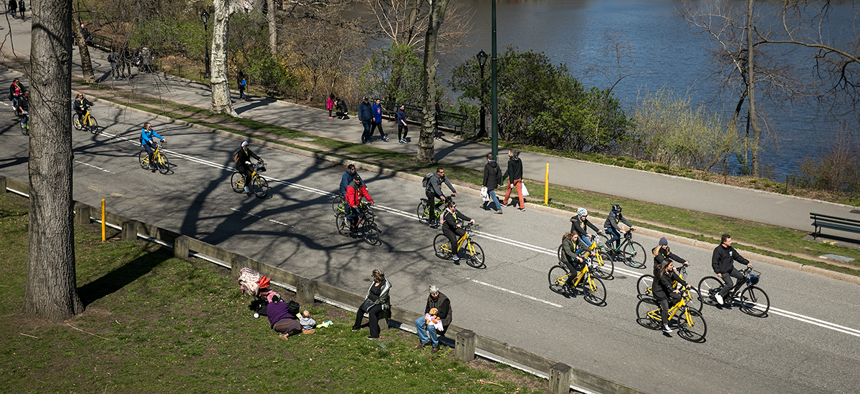
People ride bikes on West Drive in Central Park on April 20, 2018. Drew Angerer/Getty Images


Every year, some 40 million people pass through the gates of Central Park – that’s more visitors than Disney World. They come from all five boroughs and every corner of the globe, seeking exactly what Frederick Law Olmsted and Calvert Vaux envisioned in their awe-inspiring design: a democratic refuge from the city's noise and speed, open to anyone willing to share it in peace.
With so many people flocking to the Park, that promise is under real strain. After years of relative tranquility, in the past three weeks, two Park-goers lost their lives on the Drives – one while walking, and one while riding his bike. Earlier this year, an 18-year-old fell from a horse carriage and died.
We are heartbroken and horrified. It's time for an honest conversation about safety – one that doesn't stop at horse carriages.
Last Thursday, the City Council voted to pass Romanch’s Law, banning horse carriages from Central Park, a measure the Conservancy supported because the facts are impossible to ignore. These are 2,000-pound animals, hardwired by instinct to spook and bolt when startled, pulling vehicles along crowded drives for the benefit of tourists. That combination proved dangerous, and even deadly, and Park-goers will be safer without horse carriages.
But the mobility problem does not end there. Private cars have been banned from the park’s Drives since 2018, demonstrating that how we use these shared spaces must evolve to protect the people who enjoy them. Increasingly, we hear from visitors that people can feel anxious about their safety in the Park because speeding bikes, e-bikes and a fast-growing fleet of other e-mobility devices are moving with too much velocity and too little regard for anyone else.
This isn't unique to Central Park; it's a phenomenon that seems to be on the rise across our city. The Park, however, can serve as a proving ground for new strategies and ideas that can be applied far beyond our 843 acres.
It’s initially tempting to say that e-bikes should simply be banned. But that fails to recognize that bikes and e-bikes have become a legitimate mode of clean, efficient transit for hundreds of thousands of New Yorkers every day.
Instead, government should lead the way in resetting how we all share space and protect one another’s safety and serenity in our precious green spaces:
- Stop illegal and unsafe wheels before they hit the road. The City Council and the Mayor’s Office are each making efforts to deter the sale of faster e-bikes and prohibited unicycles and other devices. Additional Council bills would address unregistered mopeds and pedicab safety. All of City Hall should throw their full weight behind these bills and reforms.
- Show zero tolerance for speeders. Heavy-duty e-scooters, e-unicycles and unregistered mopeds regularly exceed 40 miles per hour. They are already illegal in New York and have no business on our roads, much less the Park, where the speed limit on the Drives is lower than the vast majority of other City streets. NYPD should double down on real, routine enforcement against illegal devices and legal ones exceeding posted speed limits.
- Get crossing guards at highest-conflict intersections. The city already employs thousands of crossing guards. Deploying even a modest number of these or other agency personnel at the Park’s busiest crossings would go a long way toward getting bikes to yield to pedestrians and help to drive home the “rules of the road.”
- Better bike infrastructure on the streets around the Park. We need a renewed push to build bike lanes on the transverses that run through the Park and on all roads around the Park, which would take pressure off the Park's interior drives and paths. And DOT should consider new design interventions to slow the most aggressive riders.
For more than 45 years, the City has entrusted the Conservancy with the hands-on management of Central Park – maintaining its landscapes and infrastructure, working closely with government partners and helping millions of people share the Park every day.
That experience has taught us that extraordinary public spaces don’t happen on their own. Creating and maintaining a safe, welcoming public space requires sophisticated management, sustained partnership with government, effective enforcement and a shared commitment to civility.
The Conservancy can and often does advocate for reforms, as we have on horse carriages, e-bikes, new plans to improve the pedicab industry and numerous other challenges over our 50 years of existence. But real change only comes when government takes a hands-on, multi-agency approach – in this case bringing together the Central Park Conservancy, the NYC Parks Department, the Department of Transportation and the NYPD – and turns the rules on paper into rules people actually follow.
Central Park has long served as a model of what a great urban park can be, and a proxy for how the rest of the world sees the city as a whole. Part of that heritage is honoring history – but it also means grappling with modern-day challenges and finding new solutions aimed at creating a better, safer future for all.
That effort should start in Central Park.
Betsy Smith is president and CEO of the Central Park Conservancy, the non-profit that manages Central Park on behalf of the City of New York.
NEXT STORY: Opinion: NYCHA residents’ lives are not for sale