

Opinion
Opinion: Bring the ‘People’s Yacht’ to Upper Manhattan and the West Bronx
Our rivers should connect us, not divide us.
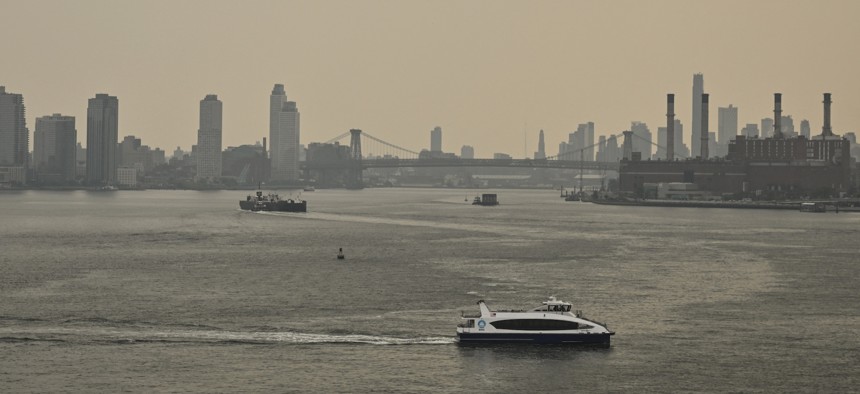
A New York City ferry crosses the East River on Aug. 5, 2025. ANGELA WEISS / AFP via Getty Images


Visit the West Harlem Piers, La Marina or Roberto Clemente Park on a sunny day, and you will find families enjoying the outdoors and beautiful views of a Hudson River teeming with activity. The water is part of our landscape, but for residents of Upper Manhattan and the West Bronx, it remains largely disconnected from our daily lives.
Not one NYC Ferry landing serves our neighborhoods, with a large, visible gap in the map. Except for the lucky few who can afford to go out on a private craft, the river is just something to admire while the ferry system passes us by.
NYC Ferry has steadily become one of the city’s great transit success stories over the past decade. The system logged just over 7.3 million boardings between July 2025 and July 2026 and set its all-time record this August with nearly 57,000 on a single day. At the same time, the city has cut the per-rider subsidy to the lowest levels in the system’s history.
In late 2025, NYC Ferry added routes connecting Brooklyn, Staten Island and Manhattan’s East Side, and linked the Rockaways with Soundview and Throgs Neck.
We are delighted that the ferry is growing while simultaneously getting more efficient. Yet none of those new lines reach Harlem, Washington Heights, Inwood or any neighborhood along the Harlem River. Despite its progress, the ferry has decidedly skipped over our communities and left us stranded on the shore.
The city has also been working to make the ferry affordable for the riders who need it most. Under the new fare structure, which went into effect this week, the 10-trip pass works out to $3 a ride, the same as the subway and the bus. Seniors, people with disabilities, low-income New Yorkers and middle and high school students can enjoy fully ADA-accessible rides for just $1.50.
But accessible fares mean little if the boat never stops in your waterfront neighborhood. If the goal is to serve working-class New Yorkers who need more options for their commute, our neighborhoods should be at the top of the list. This inequity is particularly evident at the Yankee Stadium Ferry Dock, where private ferry operators charge baseball fans as much as $55 for a one-way trip between the Bronx and Manhattan. At the same time, Bronx residents remain without comparable public ferry service or meaningful access to their own Harlem River waterfront.
In environmental justice communities in our districts, where air quality concerns and climate vulnerability are acute, diversifying transportation options is a public health, safety and resiliency strategy. New Yorkers have already seen what a flooded transit system looks like, and the next heavy rain is a matter of when, not if. The people of Upper Manhattan and the West Bronx deserve a transit network that bends instead of breaking, and a waterfront that connects them to the city rather than separating them from it.
Activating the landing at 125th Street would plug ferry passengers directly into the rest of our transit system, connecting riders to subway lines and crosstown buses. A landing at Dyckman would give Inwood and Washington Heights’ growing population a new route to jobs, schools and opportunities. Ferry service to Morris Heights would activate the Harlem River waterfront and improve access to Manhattan and beyond. And all three stops would bring new customers to the restaurants and small businesses that line these corridors, linking our neighborhoods to areas of the city that are otherwise difficult to reach.
Transportation equity means ensuring that where a person lives does not determine which opportunities they can reach. For working families, young people, older adults and immigrant communities, every reliable connection matters. Ferry service would not replace the subway or the bus, but would complement these other modes, offer another way to reach destinations and ensure our neighborhoods are included in the city's transportation future.
Ultimately, this is a question of whether our rivers serve as barriers or assets for our residents. Our neighborhoods are home to working families and immigrant communities who depend on public transit. They have watched the ferry transform other neighborhoods across the city for the better. We are simply asking to join in on that success and have our waterfronts become gateways to the city, rather than its edge.
Shaun Abreu is the majority leader of the New York City Council and a council member representing District 7 in Manhattan. Carmen De La Rosa is a council member representing District 10 in the Bronx. Althea Stevens is a council member representing District 16 in the Bronx.
NEXT STORY: Opinion: The World Cup was a test for city government. How did we do?