

Opinion
Opinion: The horse heroine
In the battle of the speaker vs. the union boss, Julie Menin emerged victorious.
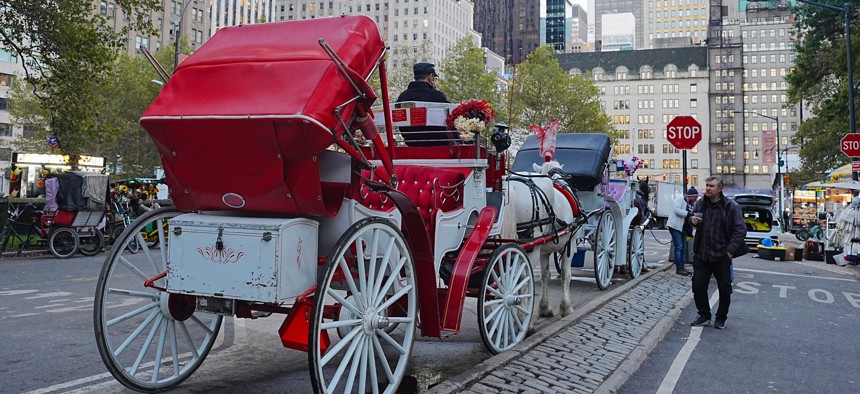
Horse-drawn carriages wait for customers near Central Park on Oct. 22, 2026. Selcuk Acar/Anadolu via Getty Images


Bill de Blasio promised to ban carriage horses on day one of his mayoralty.
He didn’t do it.
Thirteen years later, someone in power finally showed the courage to end this archaic, dangerous and inhumane industry.
City Council Speaker Julie Menin had to stare down an old-fashioned union boss, Transport Workers Union international president John Samuelsen, whose bare-knuckle style of politics had scared countless elected leaders into stasis for many years.
Last week, the Council voted 40-7 (with a few abstentions) to phase out carriage horses by June 2028 – in just 20 months. Romanch’s Law, named for the 18-year-old tourist who lost his life in a tragic carriage accident last summer, is a controversial bill that the TWU and carriage drivers still plan to contest in court.
But Menin and her colleagues did a stellar job representing their constituents and this action to phase out the industry reflects the will of a large majority of New Yorkers. Polls show that 70% of New Yorkers want New York City to join the dozens of other cities around the world who have already banned this inhumane and dangerous form of transportation.
This two-decade battle – led by well organized animal rights groups like NYCLASS, Voters for Animal Rights and PETA – looked at times to be futile because of the power of a bellicose union representing the interests of 60 carriage medallion owners.
Yes, carriage owners. There’s been a lot of talk about the 200 carriage-driving jobs that will be lost once the industry is phased out – and no one wants to see people displaced from their jobs — but the part-time carriage drivers aren’t the ones who are protected by the union. The union actually represents the medallion owners, the ones who make real money off naive and unsuspecting tourists like Romanch’s bereaved family.
Now that the bill has passed, it will be important to monitor whether the City Council and Mamdani administration live up to the promises made to the three constituencies most affected by this phase-out: the medallion owners, the drivers and the horses themselves.
The owners paid tens of thousands of dollars for the medallions that give them the right to operate their business – and the city needs to remunerate them in full for the value of their medallions.
The carriage drivers need to be retrained for new jobs, and the city’s workforce development office must offer them job coaching and placement to make them whole, too.
And the carriage horses must be given better homes – the city vowed to help them find horse farms and pastures around the country where they can roam and thrive, a stark contrast to their current sad lives, where they sleep in tiny stalls by night and trudge along with 1000-pound carriages strapped to their backs by day.
In fact, NYCLASS is working with the Coalition for Responsible Carriage Horse Retirement, which was created for exactly this reason – to have a huge network of sanctuary and rescue farms, ready to take every horse. NYCLASS Executive Director Edita Birnkrant said large, well-funded organizations like the ASPCA and Humane World have also pledged to help with the transition to sanctuaries.
The end date for this industry is 20 months away, which should be more than ample time to accomplish these three obligations. But we will need to monitor progress on these fronts and hold the administration and council accountable for follow through.
As someone who has been part of this battle for almost 15 years, it is exhilarating to see our government finally do the right thing, instead of allowing the strong-arm tactics of a few overwhelm the humanity of the many.
Let’s make sure to record and disseminate the reactions of the horses as they are set free in their new pastures. That will surely make us all want to gallop for joy.