

Opinion
Opinion: NYCHA residents’ lives are not for sale
Public land, held for the public good, should continue to serve the people who depend on it, not be transformed into a vehicle for private real estate development.
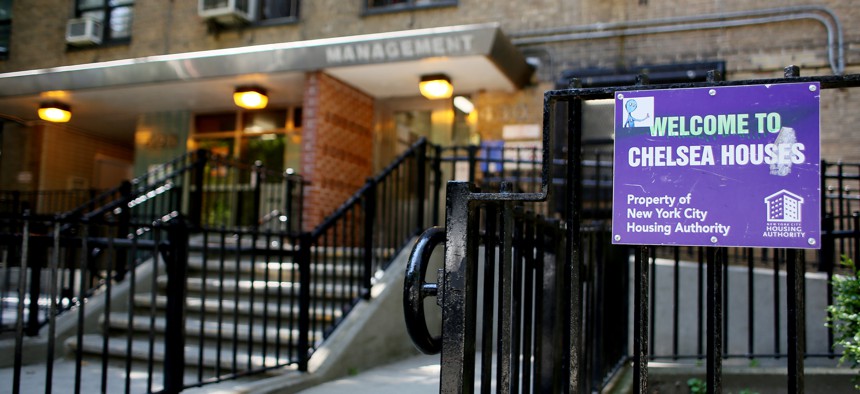
NYCHA plans to work with private developers to demolish and rebuild the Chelsea Houses, which would then be transferred to private management. John Smith/VIEWPress


The question is: who benefits when public land becomes a real estate opportunity? Let's be honest about what is perceived to make Fulton and Elliott-Chelsea Houses valuable. We live in Manhattan, in a neighborhood surrounded by extraordinary wealth, expensive apartments, luxury developments and some of the most valuable real estate in the country. Chelsea is not lacking in luxury housing. Related Companies is already a major presence in the neighborhood's luxury real estate market.
And yet, the land occupied by public housing is being presented as an opportunity for redevelopment. Our NYCHA developments are being considered for demolition because they are in a high opportunity area. That should make us ask a fundamental question: Would our homes be facing the same fate if this land were not so valuable?
Supporters of the plan say residents voted for it. But after months of resident pushback and pressure from the local community, Simon Kawitsky, NYCHA's vice president of portfolio planning, acknowledged that what NYCHA had called a “vote” was, in fact, a “temperature check.”
That distinction matters. A vote suggests that residents have a meaningful role in deciding their future. A temperature check suggests something far less binding. If the process was not a vote, then why was it presented in a way that could leave people believing they had been given a decisive say? And why did it take approximately eleven months for NYCHA to release the survey results? These questions deserve answers. Residents deserve transparency, not carefully managed language that shifts when the original framing becomes difficult to defend.
If the survey was never a binding vote, what role did it actually play in the decision-making process? Had demolition already become the preferred outcome? Were residents being asked to shape a plan, or were they being asked to lend legitimacy to a direction already chosen?
The issue is not simply whether buildings can be repaired, modernized or made more energy efficient. It is whether public land, held for the public good, will continue to serve the people who depend on it or be transformed into a vehicle for private real estate development. Who gets to benefit from the value of this land, who bears the costs of demolition?
When public officials, developers and other representatives repeatedly use the same language to describe a controversial proposal, residents are entitled to ask whether that language reflects genuine independent judgment or a coordinated communications strategy. A public relations campaign is not a substitute for public accountability
Residents should not have to prove that their lives matter more than the market value of the land beneath their homes. Demolition is a choice. So is disinvestment.
We are repeatedly told to confront the question of who will pay for the buildings if demolition does not happen. Framing the discussion this way makes a dangerous assumption: that demolition is the only viable solution. It is not.
For decades, public housing has suffered from chronic underfunding, deferred maintenance, and failures at the federal, state and city levels to provide the resources necessary to preserve it. Those failures have consequences. Buildings deteriorate when maintenance is deferred. Infrastructure ages when repairs are postponed. Residents live with the results of policy decisions they did not make.
Now we are being asked to accept demolition as the answer to a crisis that public policy helped create. The starvation of public housing is a choice. The failure to adequately fund repairs is a choice. The decision to treat demolition as inevitable is also a choice.
Why should residents accept a future designed around someone else's priorities? The burden of proof belongs to those proposing to demolish our homes. They must demonstrate why demolition is necessary, not demand that residents prove they deserve to stay.
We want comprehensive modernization. We want the resources to remain in Section 9, preserving Fulton and Elliott-Chelsea Houses as public housing. We want the agencies responsible for our housing to explain their decisions and answer our questions.
A promise of new housing is not a promise of a home. We have heard the language of improvement and opportunity before. We know how easily the promise of a better future can obscure the losses people are being asked to accept in the present. NYCHA has stated in correspondence to Community Board 4 that our current buildings are structurally sound. We have repeatedly asked for the assessment of the buildings done by Related Companies, and they have failed to produce it.
New construction does not automatically mean better housing for the people who already live here. New apartments can be smaller. Their layouts may not accommodate the same family sizes or household compositions. A development can be rebuilt in a way that makes it harder for existing residents to remain, even when assurances are given that they will have a place in the new plan.
We hear the same scripted assurances from the administration and elected officials that the redevelopment will preserve the same number of apartments, while conveniently omitting that Phase 1 would eliminate 250 bedrooms. Maintaining the apartment count while reducing the number of bedrooms is not preserving our community; it is another way of eroding its ability to house families and quietly erasing the family-sized housing that makes our community what it is.
Imagine being told that you can remain in your neighborhood, but only if you accept less space, fewer choices and a reduced claim to the land your community has occupied for generations. Imagine being told that three buildings are enough for you, while the majority of the land becomes an opportunity for housing that many working-class New Yorkers cannot afford.
Is that what progress is supposed to look like? A promise that residents will not be scattered does not resolve the question of whether they will be able to live with dignity. Remaining in the neighborhood is not the same as preserving a home. A smaller apartment is not necessarily an adequate replacement. A new building is not necessarily a stronger community. We should not have to surrender space, stability, and control over our future in exchange for the privilege of remaining where we belong.
Privatization is not a guarantee of security. The proposed path also raises concerns about the conversion of public housing to the Project-Based Section 8 model through NYCHA's Permanent Affordability Commitment Together, or PACT, program. PACT has been presented as a way to bring private financing and management into the effort to address NYCHA's capital needs. Residents and advocates have raised concerns about accountability, oversight, tenant protections, and what happens when private entities take on responsibilities traditionally held by a public housing authority.
Most importantly, we must ask why residents should have to accept privatization when we are demanding something entirely different: the resources to preserve and modernize their homes as public housing. This is about people, not a portfolio. There is something profoundly dehumanizing about hearing people discuss your home as if it were a line on a balance sheet.
To a developer, a parcel of land may represent an opportunity. To an agency, it may represent a financial strategy. To a planner, it may be a site on a map. To us, it is home. It is where children grow up. Where neighbors look out for one another. Where families gather. Where people build friendships, establish roots, and survive difficult times. It is where a community becomes more than the sum of its buildings.
Our contributions do not appear on a developer's spreadsheet. They cannot be measured by the projected value of a new luxury apartment. They do not disappear simply because a redevelopment plan treats the land as an underused asset.
We are not assets to be monetized. Our homes are worth fighting for because our lives are worth fighting for. The children growing up here are worth fighting for. The memories we have made, the relationships we have built, and the future we hope to share are worth fighting for. That is self-determination.
Renee Keitt is the president of the Elliott-Chelsea Tenant Association.
NEXT STORY: Opinion: The election isn’t over on Nov 3rd, stay ready