

Opinion
Opinion: Privately owned public spaces should actually benefit the public
Property owners agreed to create public plazas and lobbies in exchange for zoning concessions, but many of these spaces remain uninviting or inaccessible.
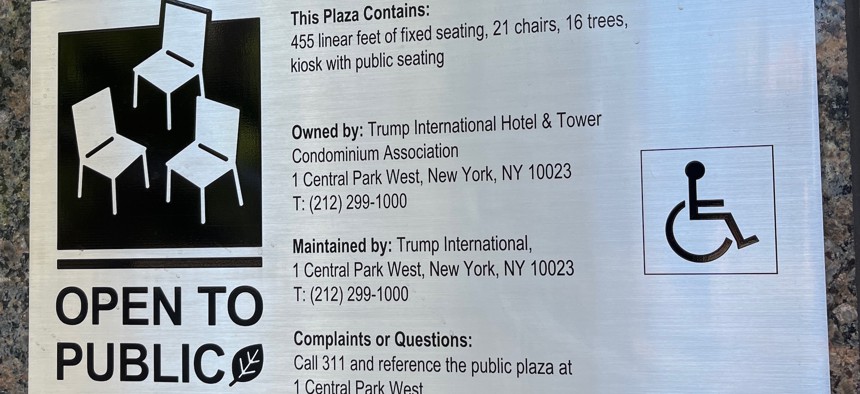
A sign outside the Trump International Hotel & Tower identifies the property’s privately owned public plaza. Asher Garodnick


A recent confrontation at Guastavino’s, the Manhattan luxury private event venue, highlights the problem of privatizing public space in New York City. Guastavino’s treated city-owned land at its entrance as its own private front yard, posting a sign that read “Private Property” and using aggressive security and barricades to restrict access to the public space. Only advocacy and litigation forced Guastavino’s to acknowledge the truth and allow public access.
Two summers ago, as an eighth grader, I visited most of the city’s privately owned public spaces (or “POPS”), which are plazas, arcades, and indoor spaces located at office and residential towers. New York City has over 590 POPS, most in Manhattan. They are legally required to remain open to the public and provide specific amenities.
My visits revealed both a problem and an opportunity: while some well-designed POPS are widely used, many others remain uninviting or inaccessible. Others are perpetually privatized. Trump International Hotel & Tower on Columbus Circle kept its POPS plaza off-limits to the public for over three years. To remove any doubt, a sign read “Plaza Closed, Controlled Access Zone, Authorized Personnel Only.” At the time, some work was being done on the building’s glass façade, but in the meantime, the public was deprived of a public space to which it was entitled for far too long.
I don’t mean to pick on a Trump building. There are other owners who, through a variety of strategies, discourage the public from using their ostensibly public spaces. But owners are not doing the public a favor by providing POPS. By creating these spaces, developers gained permission to build millions of square feet of rentable space otherwise prohibited by zoning. Cumulatively, as part of these deals, building owners have made approximately $10 billion in added revenue from about 20 million additional square feet.
Today’s POPS rules are serious and demanding – which is how they should be. In contrast, the rules of the 1970s allowed developers to earn bonuses for drop-off driveways or sidewalk widenings, without even signs or amenities identifying these spaces as public. Without clear signage or meaningful public function, I found that I often could not distinguish these older POPS from private property. These poorly designed, uninviting spaces can become effectively private, making enforcement more difficult.
To his credit, Buildings Commissioner Ahmed Tigani has reminded owners that these spaces must comply with legal obligations and remain open. That said, for a better future for POPS, the city should consider two changes to the law. First, fines should increase beyond the current $5,000, especially for repeat POPS offenders. Second, owners of POPS that have always been useless to the public should be allowed to pay to remove their legal obligations. Although owners benefited from zoning bonuses, useless spaces provide little public value.
In my visits to POPS two summers ago, I counted over 50 spaces that are POPS in name only, which in reality function as private spaces. Money from the owners could be used to fund publicity campaigns to make the public aware of POPS throughout the city, as well as to improve those spaces that actually deliver.
As a New York City high school student, I rely on parks and other public places where I can spend time with friends for free, away from the structured environment of school and home. I cannot imagine the city without them. New Yorkers do not need public spaces that only exist on paper, but rather spaces where people feel welcome to enter and use freely. It’s time to foster public spaces that are clearly designed for the public, and which are truly meaningful to the people that use them.
Asher Garodnick is a high school student who served as a research assistant to Harvard Professor Jerrod Kayden, the author of the book “Privately Owned Public Space: The New York City Experience.”
NEXT STORY: Editor’s note: Finding – and teaching – America’s Next Top City Council Member