

Opinion
Opinion: We need transformative responses to sexual violence
New York must pass the Healthy and Safe Students Act.
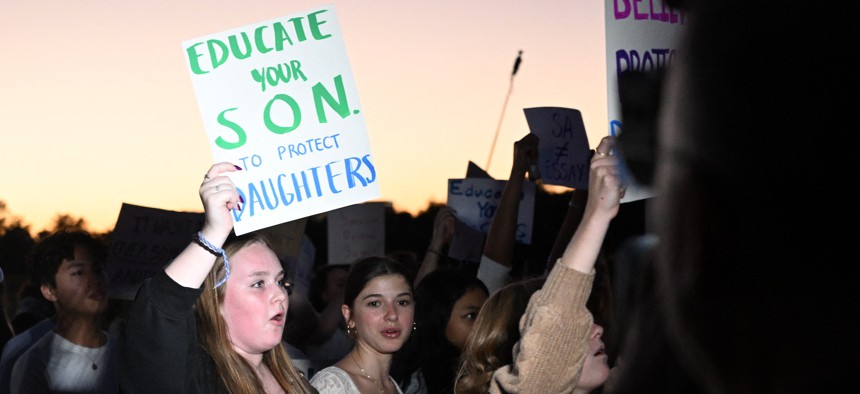
Demonstrators holds signs at a Women’s March protest on Oct. 8, 2026. Alex Wroblewski / AFP via Getty Images


The horrific assault at Cornell reminds us that rape culture and victim blaming remain pervasive on our college campuses and in our society. Yes, we must demand real accountability from the attackers, the university and the legal system. But accountability is not enough. We must also change the cultural norms and lack of consent education that perpetuate violence. That change can start with the Healthy and Safe Students Act, which would finally require our state's public schools to teach medically accurate and inclusive sex and consent education.
The reality is that our culture condones sexual violence. Starting even before we are literate, we interact with forms of popular culture (advertisements, music, television, film and video games, to say nothing of pornography) that depict abusive relationships as though they are romantic or charming. When we consume these harmful portrayals of intimate relationships, we internalize those messages on a subconscious level – it shapes what we expect of ourselves, our partners, our peers and our relationships.
According to the Centers for Disease Control and Prevention, 30.2% of women and 12.8% of men in New York will experience some form of sexual violence or stalking by an intimate partner. These numbers are even higher in Black, Latine, indigenous and queer communities, with trans New Yorkers experiencing some of the highest recorded rates of sexual violence.
The problem is simply too enormous to think about in terms of isolated bad actors. Sexual violence is embedded in our society; it is pervasive, structural, and cyclical. As such, there is no single solution that will eradicate violence; however, it is clear that systemic problems require systemic solutions. That’s where the Healthy and Safe Students Act comes in.
The bill was introduced in 2021 by one of us, Assembly Member Jessica González-Rojas, and state Sen. Julia Salazar. It would require all public schools in New York state to provide age-appropriate and medically accurate sex and consent education, aligned to the National Sex Education Standards.
Age-appropriate and medically accurate sex and consent education gives young people the tools they need to navigate sexual relationships respectfully. Curricula teach core concepts of respect and empathy, while creating space for young people to practice the communication that healthy relationships require.
Importantly, providing school-based education does not mean teaching young children about sex. Instead, children are taught how to engage with consent in an age-appropriate manner as a part of playtime and peer socialization. Learning how to ask for permission and navigate rejection are foundational building blocks that start early.
There is longstanding evidence of the effectiveness of school-based sex and consent education. Over thirty years of research on school-based sex education found that these programs reduce violence and also improve attitudes about assault (i.e., reduced victim blaming). More targeted estimates here in New York suggest that education alone can reduce violence by as much as 60%.
This demonstrated effectiveness has motivated states across the country to take action. California, Colorado, Illinois, Oregon and Washington all require schools to provide comprehensive school-based education. New York, on the other hand, continues to lag behind without any comprehensive education requirement whatsoever, leaving individual school districts to decide for themselves what to teach.
In a recent report, the New York Civil Liberties Union sampled school districts across the state and found that 52% of them provide inadequate discussion of consent. The Sexuality Information and Education Council of the United States currently ranks New York among the ten worst states for sex education. Without proper education, young people are not given the tools they need to navigate relationships safely. This includes understanding boundaries, communicating effectively and recognizing coercive and abusive behavior.
School-based education on these topics is critically important. Neglecting to engage young people on sex, consent and healthy relationships does not prevent them from developing assumptions and expectations; it only leaves them to learn from less constructive influences.
That’s why we need to pass the Healthy and Safe Students Act. By finally passing this bill, we have the opportunity to meaningfully shift how young people in our state engage in consent and accountability.
If we are serious about ending the cycles of sexual violence that our culture perpetuates, then we have to move beyond surface-level condemnation and embrace transformative solutions that create new cultural norms. We cannot afford to wait.
Jessica González-Rojas is an Assembly member and the Democratic nominee for state Senate District 13 in Queens. Christian Celeste Tate is the Democratic nominee for Assembly District 54 in Brooklyn.
NEXT STORY: Opinion: The best response to measles is action before crisis