

Opinion
Opinion: It is time for NY to disclose its high school data
The state’s refusal to release aggregated, depersonalized AP score data is making it harder for families to choose the right high school.
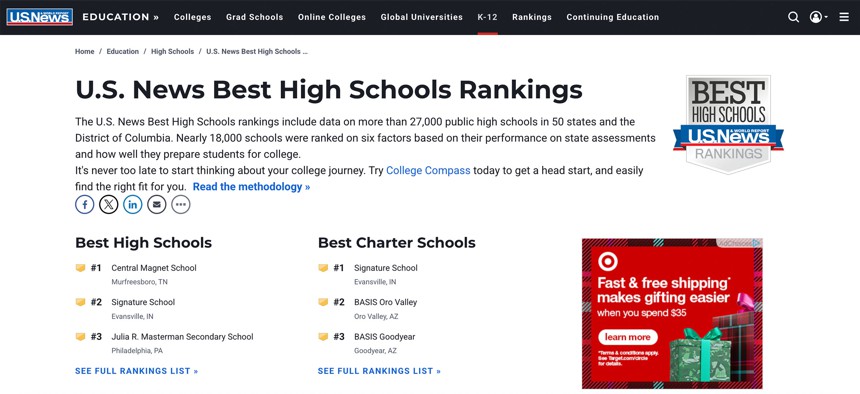
A screengrab of U.S. News & World Report’s ranking of the best high schools in the nation. U.S. News & World Report


In a recent campaign ad, Gov. Kathy Hochul tells voters, “if you really want to know what is going on in a school, talk to a lunch lady.”
No doubt, lunch ladies are hardworking people who care about the students they serve each day. And they may even support some of the governor’s positive school initiatives, including a ban on cell phones, free lunches and universal pre-K.
But lunch ladies don’t measure high school performance. U.S. News & World Report does, with our annual Best High Schools rankings, the 20th edition of which we published in August. Until this year, New York state participated in these rankings by authorizing the release of aggregated, depersonalized information showing how New York high school students performed on AP tests. AP scores are an important indicator of teaching quality and academic performance at high schools, which is why U.S. News uses that data as one factor when producing our high schools rankings.
This year, however, New York state education policymakers withheld that data, depriving U.S. News – and more importantly, parents and educators – of information relevant to important education choices, which can include choosing between public schools and charter schools, selecting the school district in which to live and evaluating whether their state and local governments are delivering a quality education. More data is better, especially when families are trying to figure out which schools are excellent, which ones are adequate and which ones are just plain failing our kids.
Meanwhile, New York’s decision to withhold data is also affecting universities struggling to determine whether their accepted students are prepared to learn at the college level. Already, college professors nationwide complain that too many first-year students arrive missing basic math and reasoning skills, forcing them to spend time teaching middle school concepts. U.S. News presents its data and produces its rankings in a way which allows colleges to compare the relative performance of high schools on a national level.
For more than 40 years, U.S. News has collected data and presented information in a manner which has enabled us to become the gold standard for measuring schools ranging from high schools to colleges to graduate schools. We do it as part of our journalistic mission to provide the public with useful information and to hold state and local governments accountable.
Measuring the quality of the nation’s 27,000 high schools is a big undertaking. We consult experts, and we formulate what we believe is the best way to measure high school quality. A great high school educates all of its students, from different social and economic backgrounds, exposing them to challenging coursework on the path to graduation. We do not favor wealthy school districts; rather, we favor performance. We particularly favor schools that exceed expectations. A high-poverty school with strong test scores is a winner in our book. And some wealthy schools are better than others.
Until this year, our high school rankings allowed parents across New York state to fully compare schools – from Stuyvesant High School or Success Academy down in New York City to Bethlehem Central or Niskayuna High School up in Albany – and to choose a high school or a school district that was best for them. This year, 46 other states gave us this information.
But not New York, for reasons that mystify my colleagues and me – and should rile high school parents. The state claimed they were protecting student privacy – even though we requested only aggregated data that does not expose individual student performance. Once this explanation was debunked, a state spokesperson then offered a word salad no lunch lady would serve, claiming that somehow our news organization was not qualified to assess schools because we are a business – like most news organizations.
One explanation for the state’s recalcitrance may lie in the performance of its schools when compared with other states: A recent Citizens Budget Commission analysis found that in 2025, New York state paid more than any other state for a student’s education while delivering mediocre returns.
Lunch ladies have families, too, and they no doubt want to send their kids to the best schools. New York state should provide them – and all other New York families – with the data that will help them to achieve their goals.
Eric J. Gertler is the executive chairman and CEO of U.S. News & World Report
NEXT STORY: Opinion: A Lone Star lesson