

Opinion
Opinion: A Lone Star lesson
Democrats’ Texas sweep could have huge implications for 2028 and beyond.
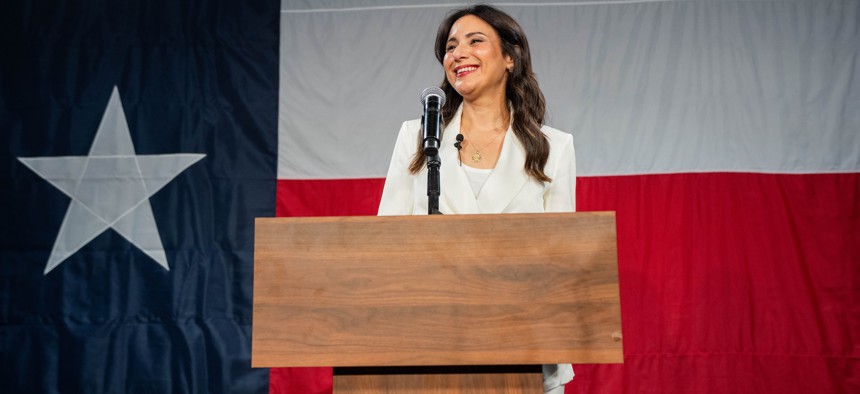
Texas Gov.-elect Gina Hinojosa addresses supporters after winning the gubernatorial election. Mikala Compton/The Austin American-Statesman via Getty Images


It’s just three days after the Blue Hurricane election, and I can’t stop reading the endless commentary in both traditional and social media.
I’m a political junkie and a data guy. I’ve been running the numbers in my head – just like the hard-working editors and reporters at City & State have been doing day and night on the local and state level.
There is one numerical measure that keeps gnawing at me. The deadlocked electoral map could be experiencing a seismic change.
Now that the hurricane-force winds of change are dying down, we can peer into the wreckage of the ship that’s called the Republican Party (which should really be called The Trump Party).
First and foremost, the Republicans lost the equivalent of the Battle of the Alamo: Democrats now occupy Texas, the state with the second-largest amount of electoral votes, led by a faith-driven Millennial, Sen.-elect James Talarico, and a confident, hard-charging Latina, Gov.-elect Gina Hinojosa.
My favorite line from election night: “A Mexican took Greg Abbott’s job.”
That and the near sweep of Texas’ statewide elections by Democrats, should strike terror in the hearts of J.D. Vance, Marco Rubio, Ted Cruz, Tom Cotton, Nikki Haley, Ron Desantis and the rest of the Republican presidential hopefuls.
Let’s go to the electoral college map, as Steve Kornaki at MS NOW would say: California (54), New York (28), Pennsylvania (19) – where Democratic Gov. Josh Shapiro just reelection won by 22 points – combined represent 101 pretty safe electoral votes for Democrats.
If you add in all the Northeast states that are traditional Democratic strongholds (from Maine to Maryland), you’ll get 60 more votes, taking you to 161.
Then add other Democratic near locks around the country: Illinois (19), Virginia (13), Washington (12), Colorado (10), Minnesota (10), Oregon (8), New Mexico (5), Hawaii (4) and D.C. (3).
Those 84 additional electoral votes push the Democratic tally to 245.
Then add in Texas (40), and voilà! You’re at 285 votes, above the magic number of 270. Checkmate!
No longer will Democrats have to stay up all night, sweating results from Ohio (17), Michigan (15), Wisconsin (10) and Iowa (6) – all purple swing states that, by the way, voted resoundingly for Democrats on Tuesday.
Watch Senate Majority Leader Chuck Schumer and House Speaker Hakeem Jeffries – Brooklyn literally rules! – lavish lots of attention and pork on Texas the next two years.
They will do everything to make sure Hinojosa and Talarico are successful in delivering for their state. They know an investment in Texas can pay huge dividends in 2028 and for generations to come.
Of course, Texas’ 40 electoral votes have been safely in the GOP presidential column for five decades. The last time a Democrat won Texas was in 1976 when Jimmy Carter eked out a 3% (129,000 votes) win over Republican incumbent Gerald Ford.
To illustrate how much Texas has grown in population the last 50 years, that win resulted in just 26 electoral votes – 35% less than the 40 it’ll yield in 2028. And in 2032, after reapportionment, Texas is likely to carry 44 electoral votes.
All roads on America’s electoral map should run through Texas now. If the Democrats can win the hearts and minds of Texans in the medium term, they should be able to secure the White House in 2028 and beyond.
Tom Allon is the founder and publisher of City & State. He wrote this column from Puerto Rico, at the Somos conference.
NEXT STORY: Opinion: Time for a change in Southeast Queens