

Interviews & Profiles
“Significant progress” made with Tier 6 reforms in state budget
In a Q&A, United Federation of Teachers President Michael Mulgrew talks about the new, lower retirement age for educators.
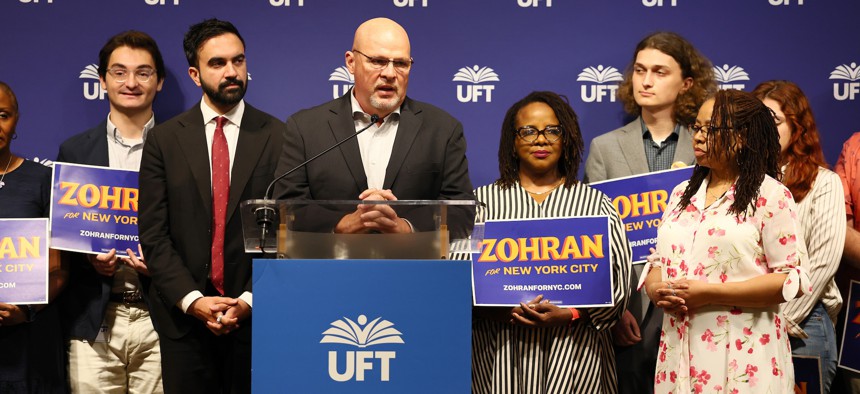
United Federation of Teachers President Michael Mulgrew has been on the front lines of Tier 6 reforms. Michael M. Santiago/Getty Images



State, local and other public sector workers walked away from this year’s state budget with some significant wins after Gov. Kathy Hochul and lawmakers agreed to a number of changes to the controversial Tier 6 public pension plan. Tier 6 offered public sector union workers hired on or after April 1, 2012, far worse benefits compared to older, more generous pension tiers. It included higher rates of contributions from one’s salary and an older retirement age, pitched as a cost-saving measure by former Gov. Andrew Cuomo after previous tiers hit state and local government coffers hard.
Labor unions have pushed for changes to Tier 6 since it was enacted, but this year marks the most success in the endeavour following smaller previous tweaks. Teachers specifically won a five-year reduction in retirement age, permitting educators across the state to retire at age 58 without penalty after 30 years instead of the current 63.
United Federation of Teachers President Michael Mulgrew has been on the front lines of Tier 6 reform for years, and he helped get the changes included in the very late state budget. City & State caught up with him about the hard-won victories for his members, and his take on concerns over a hefty estimated price tag for state and local governments.
The conversation took place after widespread reporting on the details of the agreed deal, which were proven accurate, but before the relevant budget bill was printed. This interview has been edited for length and clarity.
How do you feel about where things landed? It’s not 100% of what you and others were asking for, but it is a pretty solid chunk of it.
Yeah, it’s significant progress, which we’re happy with. We knew we weren’t going to get everything in this done that we are all committed to getting done, but it’s significant progress, so we’re happy for that. Different unions have different priorities, but in the end we all have the same exact thing, which is to undo all of the nastiness of Tier 6.
Teachers were able to lower the retirement age from 63 to 58. How do you think that will improve recruitment and retention?
It definitely is going to help, because, for us – our unions – the overwhelming majority of our members start under the age of 25. Most of them start 21, 22, right out of college. So this was something that was a complete focus for us, was the age. Because our members, by and large, we’re going to have to work 41 or 42 years, which was having a major impact on both recruitment and retention. And it’s a big deal, five years, to our folks. It’s a very big deal, especially in Tier 6. Because in Tier 6, every year you work, even if you have 30 years, you’re still required to pay contributions. If the teacher had to work to 63, that would require them to pay another $45,000 in contributions, which now they don’t have to. And the other thing is they can retire at 58 with no penalty, where right now if they needed to retire at the age of 58, 30% of their pension would be gone.
What made this year the year to get Tier 6 reform done?
The economy at the state level is quite well. A lot of the cost is incurred by individual workers and by local government. But I think it was really about everyone just saying, “Enough is enough with this, we have to start making some progress.” Remember, when Tier 4 came out in 1982, it was not completely fixed until 2006. It took that long to fix Tier 4. This one’s much worse. I think it’s because this one is so much worse. We’ve never had a pension tier like this, with this amount of money going into it, with individual members contributing so much, with local governments paying so much, with people having to work so long. And none of it was necessary. If you go back to 2012, both (the New York City and state) comptrollers at that time were writing editorials saying, “We do not need to do this, this is a mistake.”
In terms of costs, original estimates were around $1.5 billion and the final budget plan was estimated at $577 million. Do you think those are accurate and was this a good compromise between reform and costs?
Of course, I never believe any estimated costs out of Albany, or New York City, or any government-based entity. I’m sorry, I’ve just been doing this for too long. You have this position known as an actuary, right? Their job is very simple. Once the tier is created, they want to make sure they get all the revenue that the tier is supposed to create for them, all the payments of local government, state government, city government. When they’re estimating the costs, if you ask them, “Is the money necessary?” They’ll just tell you: “That’s irrelevant. Our job is to calculate what we’re supposed to get, and it doesn’t matter if we need it or not.” That’s the problem, because we have to look at that side of the equation right now.
A lot of the pushback around these reforms was around the cost, especially with a focus on affordability. Are you saying that’s not a relevant concern?
No, it is a relevant concern. Because we know, and we are very confident when we argue and say there’s too much money being put into this pension tier. When you start seeing pension systems going at 105%, 108%, 110%, that means there’s a lot of money being paid into those systems that should not be going into it. But when they calculate the cost, that doesn’t matter to them. To the actuary, it’s, “We’re supposed to get all this money. Period.”
So you’re saying the fixes being put into place will also fix some of the overpayments happening now?
Yes.
And in your estimation, some of the cost concerns have been overblown?
Yes.
Looking at this from a political angle of the governor’s reelection, do you think that this is going to put her in a good position with the unions to really come out strong for her?
When you’re an elected official and you’re talking about affordability, about workers, the majority of the people who are the workers of your state, and you do something significant? Yeah, it’s going to have a profound impact.
Correction: This story has been updated to reflect that teachers benefiting from a reduction in retirement age will not also benefit from a reduction in pension contribution rates.
NEXT STORY: Empire AI is already making rapid progress in drug discovery