

20th Anniversary
Hakeem Jeffries & Letitia James: Rising through the ranks, together
Over the past 20 years, the two have led a generation from Central Brooklyn.
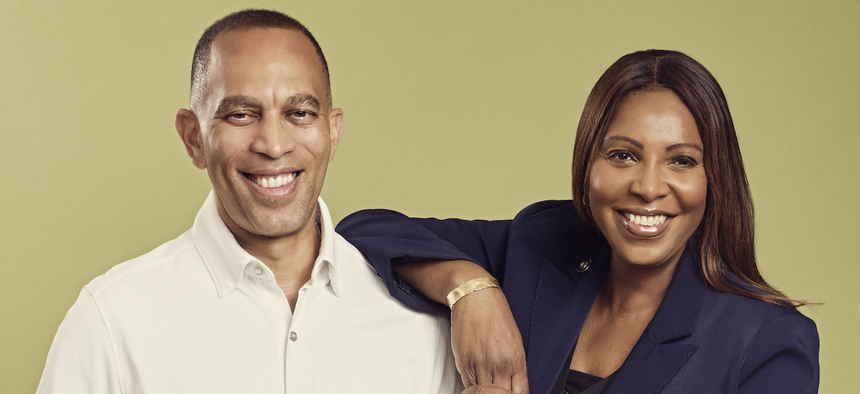
House Minority Leader Hakeem Jeffries and state Attorney General Letitia James talk about their ascent up the political ranks. Emily Assiran



Letitia James and Hakeem Jeffries are two of New York’s 20 most influential politicians of the past 20 years. See the full list.
Twenty years ago, the names Hakeem Jeffries and Letitia James would’ve only meant something to the kind of people who were excited about the launch of a new outlet, City Hall, covering New York City politics. And even then, they might not have known an aspiring Assembly member and a second-term New York City Council member.
Now, Jeffries and James are household names, as House minority leader who may be on the cusp of becoming the first Black speaker of the House, and state attorney general and anti-Trump resistance hero. But their names have long meant something to each other, as they rose together in politics from the same Central Brooklyn turf.
So we got the pair together on Sept. 12 at a hotel in Downtown Brooklyn to look back and talk about their careers, the races that put them on opposing sides, what they say democratic socialists just don’t understand and the job that James really wants. This interview has been edited for length and clarity.
You’re both Brooklyn-born and raised. James got into politics first. Do you remember the first time that you heard the name Letitia James?
Jeffries: The first time I heard the name Tish James was probably in the early 2000s as we were all getting started. And I think in terms of the order of all of our generation being elected, it would have been (Rep.) Yvette Clark getting elected in 2001 to the City Council, then Tish getting elected in 2003, then myself and Eric Adams getting elected in 2006 –
James: Mmm. Forgot about that.
Jeffries: (Laughs.) And then (New York City Public Advocate) Jumaane (Williams), I think, would have been the final one of our generation from Central Brooklyn –
James: The outlier! (Laughs.)
Jeffries: – Being elected in 2009 to the City Council.
But the first time you ran –
Jeffries: 2000.
Against (former Assembly Member) Roger Green. AG, were you on the other side of that one? Because he was previously your boss.
James: My job was to protect incumbents. Nothing personal. In fact, so many people – (former Assembly Member) Al Vann, Roger, (former Rep. Ed) Towns – they were all enthralled with this young man. But my job was to protect incumbents and not really have an opinion.
So do you remember the first time you heard the name Hakeem Jeffries?
Jeffries: That had to have been 2000, right?
James: I met his wife before I met him. We used to go to the same hairdresser. She was very, very nice, and I really admired her. They lived in Prospect Heights. I lived in Prospect Heights. I remember her being pregnant, and she would walk down Vanderbilt (Avenue), and I just said, “You look so beautiful.” Girl talk.
Really coming up in the same neighborhood. Congressman, you lost in 2000 and 2002. AG, you also ran in 2001 and weren’t successful. You’ve now ascended in politics, but you both started with electoral losses. What did you learn from that? Is it better that you lost?
Jeffries: It’s very interesting when you actually look at the trajectory of a lot of elected officials, including many who’ve been incredibly successful, including Barack Obama and (former Rep.) Charlie Rangel, there’ve been losses before there were wins. And once someone understands that, and that it takes a certain degree of perseverance and resilience, it does strengthen your ability to lead when you pick yourself up off the ground, learn from the adversity and keep moving forward.
James: There’s a saying that a setback is a setup for a comeback. And my loss was due to two reasons. I mean, there were a lot of reasons, but primarily two. One was 9/11, and the respect for first responders, and as you know, the late James Davis (who won the City Council race) was a police officer. And two, the power of women. (Then-City Council Member) Mary Pinkett endorsed James Davis, I think, days before the (primary). And all the incumbents that I was responsible for protecting were mostly men. And Mary Pinkett was not part of that crew.
You ended up getting elected a couple years later, and Jeffries was first elected to the Assembly in 2006. Then for six years, you were just local elected officials representing some of the same territory: Prospect Heights, Fort Greene. What do you remember from that time? Was there a lot of coordination, or were you guys rivals?
Jeffries: There was definitely a lot of coordination. In fact, it was an intentional decision that both Tish and I made to break the cycle of distance between the council member and the Assembly member. For a long period of time – though both are tremendous elected officials, and in many ways, Mary Pinkett was a mentor of mine on my way into office – there was a chilly relationship, if it’s fair to say –
James: Yes. It’s a good word.
Jeffries: – between Councilwoman Pinkett and Assemblyman Green.
James: Yeah. Assembly Member Green, Assembly Member Vann, and the list goes on. (Pinkett) called me out of respect when I sought her endorsement. And I’ll always remember, she fell asleep on me while she was interviewing me. And that sort of settles a lot. She took a nap. She closed her eyes. She rested.
So a better relationship. What do you remember working on together?
James: Quite a bit. From public housing –
Jeffries: Public housing. Pushing back against stop and frisk. Some challenges that existed at Medgar Evers College that we were able to overcome together. It was a transition of leadership following (former Medgar Evers College President) Edison Jackson. And it was an out-of-town gentleman whose name escapes me that was brought in, but it caused all sorts of problems.
James: A couple of presidents – wasn’t it a couple?
Jeffries: Yeah, it was a couple of presidents before we got it right with CUNY. It was a challenge.
James: It was very much a challenge. It was very much a challenge.
Jeffries: And it became sort of a state of emergency situation that brought all of the local elected officials together. We also supported Medgar Evers historically in terms of providing resources from the city and state level, and always worked on that together. Medgar Evers is like a jewel in the community that was started, really, by the Vann, Roger Green, (former state Sen.) Velmanette Montgomery movement.
James: Right, and we were aligned on Fort Greene Senior Center, which has gone through a couple of challenges. And also Mitchell-Lama developments, as well as representing Ebbets Field Houses together.
James: And Ebbets Field, which continues to be an issue. And in fact, to this day, people still reach out to the Congress member and myself on local issues.
Right, you never lose that connection to the constituents. Now, Eric Adams was also the state senator for that whole time, also overlapping with your districts. With him included, but just you two also, it’s remarkable that local elected officials have now ascended to statewide, nationwide positions. Is that a coincidence, or is there something in the water in Central Brooklyn?
James: Hard work. (Laughs.)
Jeffries: It was an interesting period of time, if you think about it, that there was a moment when Tish was the councilwoman, I was the Assembly member, Eric was the senator. And then he went on to become, eventually, the mayor, Tish the attorney general, and myself in Congress and ascend to the position of House Democratic leader, which is an extraordinary development in terms of the trajectory in that regard.
It’s like Vienna in 1913, when all the future world leaders were living in one place. But you guys also came up as progressive challengers – backed by the Working Families Party, taking on the incumbent. It seems like you came in as outsiders and then were able to shape the party around you.
James: So I don’t like labels. I can just say that I think our ascension is primarily responsible to the fact that we have been outspoken on a wide range of issues. And Brooklyn has always been the center of the universe. And in my role as attorney general, what I see now is so many states look to New York as models of progressive politics and policies and promise. I think just that alone, because we have been involved in so many issues, particularly as it relates to ensuring that individuals whose voices have been ignored for far too long have now been heard. I think that has resulted in improving our standing in the state and in the nation.
Jeffries: And it’s actually been incredible to me. Because if you think about the role that Brooklyn has played in making history with respect to strong, talented, brilliant, principled African American women elected officials, Shirley Chisholm became the first African American congresswoman ever elected to the House of Representatives in 1968 in Brooklyn. In 1973, Mary Pinkett became the first African American woman ever elected to the City Council, from a Central Brooklyn district. And of course Tish made history twice in both the city and the state in 2013, becoming the first African American woman elected citywide, and then in 2018, becoming the first African American woman as attorney general ever elected in the state of New York. That’s incredible history. All made from the same neighborhoods.
When you talk to people from Harlem, do you tell them that?
Jeffries: (Laughs.) They have their own history! Which is extraordinary. But I’m proud to be associated with that history: Shirley Chisholm, Mary Pinkett and Tish James.
James: It is history. And there was tension, Harlem, Central Brooklyn. And they’ve had their moment. And now this is our moment, our crowning moment.
You’re both strong fighters for all Democrats. But attorney general, you’ve seemed to maintain a warmer relationship with the progressive wing of the party. Is that because of a difference in your personal politics, or is that just because you’re a New York official, and Jeffries, you have more of a national constituency as House minority leader?
James: So, given the leader’s history – he was an insurgent. And I think part of it is that (the Democratic Socialists of America) and others just don’t know our history and the history of the struggle that we’ve been through, and how we have both ascended. He was an outsider. He was an insurgent. He was someone who was not going to wait his turn, and obviously wanted to be respected, and had a vision for the district, as well as for the city and the state at the moment. And DSA needs to understand that and respect that. And if they knew all of that, then, you know, all of this noise about him not being progressive is foreign to me, as someone who has known him up close and personal.
And for me, I think it’s just a result of all of the litigation that we’ve filed and all the success that we have had. My complaints speak for me.
Would you agree with the flattery?
Jeffries: Well, Tish has been a great colleague and a great friend, and it’s been wonderful to travel along this journey together with her since I was first elected in 2006. And we’ve been through a lot of different electoral and policy struggles together, and I’m proud of that fact. It’s interesting because there is something to some folks not fully understanding the history as it relates to different races, for instance, that I’ve been involved in beyond my own, including being the first elected official to endorse both Jumaane Williams and Brad Lander when they ran for the City Council in 2009. In that same race, I recall supporting both Bill de Blasio for public advocate, as well as John Liu for comptroller, who were running against candidates supported by the Brooklyn Democratic machine at the time. Of course, in 2013, I supported Tish James for public advocate, and Ken Thompson, who was running against then-Brooklyn District Attorney Charles Hynes. And I was on the other side of that race, where many elected officials, including those who now more closely associate themselves, I guess, with the progressive establishment.
James: Me!
Jeffries: Not necessarily Tish, I remember where Tish was –
James: I was on the other side. I was playing it safe. (Laughs.)
Jeffries: It’s interesting, because in that race, it was really myself, (Reps.) Jerry Nadler, Nydia Velázquez and Yvette Clarke. And everyone else was on the other side. It’s also interesting, in 2007, there were just a handful of us that supported then-Sen. Barack Obama against Hillary Clinton.
The New York senator.
James: And I again was on the other side.
Jeffries: It may have been the fact that I was new enough that I didn’t know enough.
James: (Laughs.) You and Al Vann!
Jeffries: I was with Al Vann. It was basically Al Vann, who was the senior elected official, myself, Adams, (former Assembly Member Karim) Camara, maybe (state Sen.) Kevin Parker, and (then-state Sen.) Bill Perkins and (former City Council Member) Helen Foster. And that was it – less than 10 elected officials in the whole state.
You must have had a chip on your shoulder. Deservedly.
Jeffries: It was interesting. I remember Al Vann convening us –
James: And him calling me, over and over again, and me not answering. Trying to get me over, to convince me.
Crazy thinking back to that. We’re celebrating City & State’s 20th anniversary, 2006 to 2026. What’s a big change in politics that you’ve experienced since then?
James: The changing demographics of Central Brooklyn and Harlem, but the stability of Southeast Queens. It’s all tied to real estate.
Jeffries: The intensity of the gentrification that traditionally African American communities have experienced in both Central Brooklyn – primarily Fort Greene, Clinton Hill, Bedford-Stuyvesant and Crown Heights – as well as in Harlem, has been significant in changing the nature and character of many of these neighborhoods.
So in 2006, looking back, where were you guys hanging out? Was there a go-to diner, or bar for the local politicians? What was the spot?
Jeffries: Well, Junior’s has been pretty consistent for me, to this point. And I know we talked about the possibility of going to Junior’s (for this interview), but Tish is such a celebrity, we would have never been able to get through the interview –
James: (Laughs.) Please, please. No, Tish would’ve stopped to get some cheesecake.
You’ve come up on parallel paths, intertwining, working together for so long. What are you working on now? What does the future hold?
James: The focus right now is on our elections, ensuring that they are free and fair. We are concerned, obviously, as we approach the midterms, about the possibility that the SAVE Act might pass. The fact is that we’ve been sued, not only in New York but other states, (by) this administration trying to obtain our voter data. We are at the Supreme Court, what they will decide with regard to mail-in ballots. The possibility that ICE may be at our poll sites. The fact that there is going to be voter suppression, intimidation. The lawsuit that was just filed by Common Cause two days ago, the outcome of that, whether or not that’s premature.
So I can’t sleep at night because I think of all the possibilities. And the Democratic AGs have been engaging in tabletop exercises and preparing possible briefs and complaints in anticipation of certain scenarios, which threaten a right to free and fair elections, in addition to misinformation and disinformation. The last time we had an election, as you know, there were some influencers, individuals out there who were surgically targeting Black communities in upstate New York and part of Michigan and Illinois. Working with those Democratic AGs, we were able to shut it down through civil enforcement as well as criminal enforcement. But it will only increase as the days go on, there’s 54 days to go, and I count each and every one of them.
Jeffries: We’ve worked together to push for the creation and preservation of affordable housing, and that’s an ongoing fight in terms of pushing back against the gentrification machine. And now we’re working together to end this national nightmare that Donald Trump and MAGA extremists have been visiting upon the people of New York City, New York state and America.
What would you like to see in his future?
James: He will be speaker. In 54 days. He will win a significant number of states. There will be a blue wave. Because there’s so much enthusiasm right now. Because people basically want to return to normalcy. And Democrats will provide that way. And I look forward to working with him as we rebuild government, as we ensure that there’s a rule of law in this country, and that our democracy is protected, and that this never happens again.
What would you like to see in her future?
James: Rest. (Laughs.)
Jeffries: Well, she’s been an incredible statewide elected official who’s been on the front lines of pushing back against Donald Trump. And wherever Tish wants to go in terms of continuing to do her thing in an incredible way as attorney general, or serve in other positions – whether that’s statewide, or for an enlightened administration in the future, because I think she’d be an amazing attorney general of the United States of America.
James: (Whispers:) Jesus.
Jeffries: When it comes to Tish James, as Biggie once said, the sky’s the limit.
I knew you would get a Biggie reference in. Took 30 minutes.
James: You know what I want to do? I told Hakeem this. I want to be the, I guess it’s the sergeant at arms? As you march down the aisle, and then I say as they open up the door: “Here comes mister speaker!” There’s never been a woman.
Jeffries: Chuck (Schumer) and I can work that out. When Tish is in retirement.
NEXT STORY: This week’s biggest Winners & Losers