

New York State
Lisa Kaul looks to oust Rolinson from state Senate
The Dutchess County legislator is aiming to win a seat many thought would favor Democrats when it was drawn during redistricting.
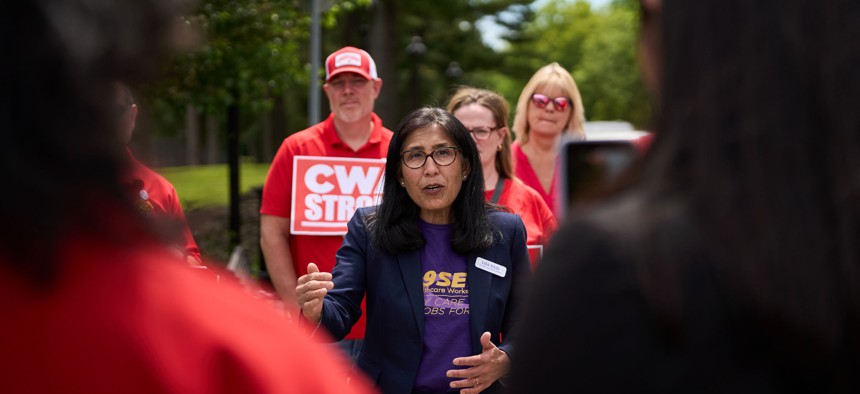
Dutchess County Legislator Lisa Kaul is trying to flip state Senate District 39 to the Democratic majority. ucas Pollet Photography

For the past four years, Democrats have attempted to win state Senate District 39, a Democratic-leaning seat centered around Poughkeepsie. Now, Dutchess County Legislator Lisa Kaul is trying her hand at unseating Republican state Sen. Rob Rolison, the moderate former mayor of Poughkeepsie who has held the seat since its creation in the last redistricting cycle .
After winning a three-way primary in June, Kaul advanced to take on Rolison in November. Although Democrats initially lost the open seat in 2022 by 6 points, they came closer to besting Rolison in 2024, losing by just 1.4 points. Now, with headwinds favoring Democrats in the midterms, Kaul feels confident that her life experiences and record of serving her community will result in a victory over the well-liked Republican.
Kaul spoke with City & State about her campaign, her immigrant background and priorities should she win. This interview has been edited for length and clarity.
What brought you into this state Senate race against Republican Rob Rolison?
I’m a new American. I became a citizen in 2008, came here in 2004, joined the (Dutchess County) Legislature in 2023. And at that point in time, I entered electoral politics because I really wanted to do something about climate change. Having been in office and having now knocked on thousands of doors, I realized that our climate crisis is really intertwined with our affordability crisis. At the doors – and what I’m personally experiencing too at many levels – is, I see that the cost of living is crushing us. And that we are facing enormous challenges when it comes to our future, the uncertainty of our future – not just in terms of whether we have clean air and clean water, but also in terms of a functional democracy and having simple things like autonomy over our bodies.
So having served in the legislature, I have begun to recognize how important it is for us to have strong representation at the state level. We don’t have that at this particular moment in time. It’s a real hole in (state) Senate District 39. … And I think somebody with my background as an educator, immigrant, mother, legislator is better equipped to address those challenges as opposed to somebody who has a background in law enforcement – which is a wonderful, noble service. But we need a much broader approach and orientation to the issues at hand now.
This district was drawn fairly Democratic in the previous redistricting cycle, but Rolison has won the last two elections. Other Democrats have tried and failed to win this seat. What do you think will make your candidacy successful?
I have a record of running and winning. When I first ran in 2023, I ran against somebody who was a beloved Republican, very similar to Rolison, and I won with 58% of the vote. And that was sheer hard work in building coalitions. I’ve lived here for over 22 years, and I’ve really built strong coalitions, relationships with people. I’ve been a community activist for a long time, and I think I’m one of the few people who kind of straddles the world of activism and being an elected. I think that really gives me sort of an upper hand, as it were, in terms of just having connections in the district.
Having a Democratic primary has certainly helped me with name recognition. It certainly helped me get out there and learn this district. I understand that there’s all these winds behind our back, etc. But I'm not relying on those. The people here are independent people. I’ve built a reputation for myself in the legislature (not just) as somebody who gets stuff done, but as somebody who gets stuff done by bringing people along. In my first term in the minority, I was able to get a budget amendment for a waste management issue that had been held up for several years, and the and the way I did that was just sitting down with the Republicans, sitting down with other administrative bodies that needed to be consulted, and figuring out why we couldn't move ahead. So I think having built that reputation for myself, being seen as somebody who does solve problems (and) wants to move ahead. At the end of the day, I think everybody knows I’m in this to get stuff done for all of us. I’m not a career politician, as it were. I’m running for this seat so much to be a senator, but to do the work that a senator can do, and I think people see that. And that's why I think we’re going to win this year.
You said the Democratic primary helped with your name recognition. What was the primary fight like for you, and have you or do you plan to reach out to your opponents to work with or get ideas from them?
We’re all on the same team. We all want the same things. Our platforms were not that different. We’re all working in the same space. We want the same outcomes. I think the primary was wonderful. I think it’s really good for people to see how even people within the same party can differ, and people can have a chance to choose who they want their candidate to be. It levels the playing field a little bit. The night off the primary onwards it’s been: this is the one team that’s going to go ahead to win this race. If somebody asks me whether there should be primaries or not, I would say primaries are fantastic. They’re really, really good for the candidates, and I think the Democratic Party should have more of them.
For me, it was a little bit hard during the primary because I have always been endorsed by the Working Families Party, and I wasn’t during the primary. But our issues are completely aligned, and now we’re all on the same side. I think that’s what matters at the end of the day. (It) made me work a little bit harder to show people what they needed to see, to prove to people that I was the viable candidate. These elections, we have to work to win them, and that’s what I did.
What are your top priorities if you win in November?
The top priorities are addressing the cost of living. In terms of the cost of living, what I hear from folks are utility bills through the roof, housing that’s impossible and healthcare. Those are sort of the three top priorities. There’s already really good policy in the state that I would be supporting in my area. In terms of utilities, we have a corporate monopoly, Central Hudson, who has been fleecing us. I’m proposing that we replace it with a nonprofit utility, the Hudson Valley Power Authority. … Nonprofit power authorities do pay less than others, and their rate increases actually are lower than the cost of inflation because they’re able to borrow municipal bonds, which are significantly cheaper, and they’re not guaranteed the rate of return that Central Hudson currently is guaranteed. It’s absolutely unsustainable.
The second thing has to do with housing, thinking about what policies we can put in place to make sure that renters are protected. I am supporting the (Rent Emergency Stabilization for Tenants) Act. I do think municipalities should have the ability to decide when they’re in a housing emergency. I appreciate the fact that the REST Act has a pool of money for small landlords, so they can continue to provide maintenance on buildings because the last thing we want is to take away a source of income from small landlords and to take away required maintenance from renters. I also think we should be putting more money towards building more housing that’s affordable. There is a Social Housing Development Act which I’m supporting. There are ways to provide for housing that will not feel like there’s overdevelopment, and I think the state could be pushing other policies on that.
To me, housing is also an issue that is aligned with transportation. In the district that I live in, everybody wants more housing, but nobody wants an additional unit to be built because they’re concerned about more roads and more cars on the roads. So, addressing housing also means addressing public transit. I would really want to see us look at (State Operating Assistance) funding and change some of the parameters and bring back much more funding to the district, so we can have transportation which is reliable, accessible to people and frequent, which we don’t have.
And the third big piece is healthcare costs. I hear far too many people struggling. We’ve seen these huge cuts coming from the federal government. We have insurance companies who hold people ransom. I am a supporter of the New York Health Act. I think this is the year for us to seriously address all the concerns unions and other groups have about it, and to pass it. We cannot afford to tarry on this. This will also help us reduce our property taxes, hopefully, because it will reduce the burden on municipalities and school districts, and that would reduce their expenses and maybe help for us to all have lower property taxes. I know people talk about it not being affordable; it's too expensive. But it’s interesting to me that every developing country – I lived in England for several years (and) I grew up in India – that they’re able to provide a public health offering, and we somehow can’t do it over here. We have some of the worst healthcare outcomes, and we spend the most on healthcare.
The other big focus that I have personally has to do with thinking of ways to reduce our dependence on fossil fuels, promoting the use of solar. Especially reducing the number of administrative hurdles we have currently in place for solar permitting to make it cheaper, and also for the state to provide some investment in upfront costs that are associated with solar to move to (electric vehicles) and to have HVAC systems. Right now, those are very expensive. Long term, they are cheaper, but we do need to be providing more incentives for people to be able to transition and to also provide the right apprenticeships so that we can transition our labor force as well.
You’re a new American, grew up in India, lived in England for a while, served on the county legislature. How do you see the breadth of your background informing the kind of race that you're running and the kind of state legislator you’d like to be?
I’ve experienced what it is like to not have access to infrastructure – so clean air, clean water, reliable electricity – and I can see us coming very close to that over here. That’s just basic stuff. But an important part of my biography is that when I moved to this country in my 30s, I took a long career sabbatical to give care to my son and my father who was ailing in India. So I was going back and forth. I was very involved with my son’s school, served on the school board, and I think what really informs me today is having occupied those spaces of being on the outside. To really deeply experience what it means to be somebody who does not have the power to influence what's going on around them. Somebody who’s had to give care, and just seeing the lack of understanding of the importance of care in the way our policies are shaped. And I have volunteered extensively with various organizations locally, understanding the reality on the ground. Then also having the advantage of having a broader world experience of seeing how things are done in other countries, of seeing other possibilities, of being able to imagine what it’s like to problem solve and just to just be a little more entrepreneurial, as it were. It’s interesting. This is the word I associate with America, but I think Americans increasingly are increasingly acting from places of fear and not from curiosity. And I’m open to iteration because I’ve seen that in other places and I’ve seen how policies change over the years and you respond differently to circumstances and having that agility.
NEXT STORY: This week’s biggest Winners & Losers