

Politics
With progressive momentum on their side, tenant advocates see hope for the REST Act next session
On the heels of the primaries, is there more of an appetite upstate for rent stabilization?
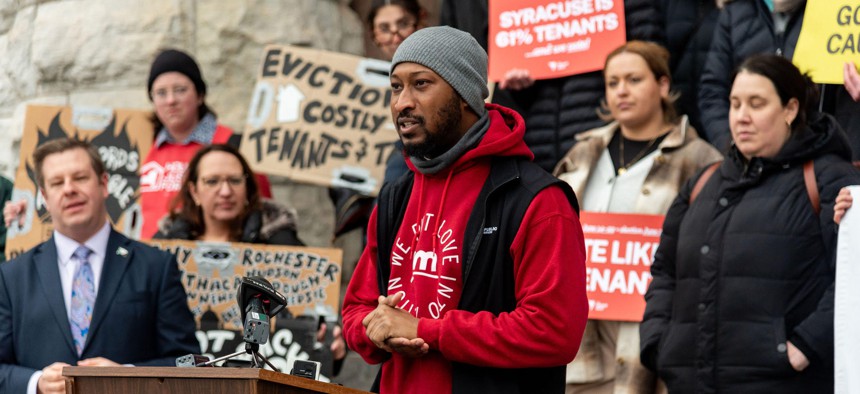
Maurice “Mo” Brown just won a Democratic primary for Assembly in Syracuse, making tenants’ rights a key part of his platform. Ciara Feltham of Ciara Studios


Tenants’ rights groups see a clearer path to pass key pieces of their agenda, like statewide rent control, next year after progressive candidates they backed won recent primary races outside New York City and housing affordability stays top-of-mind for voters.
Housing advocates like Xaver Kandler, political director with For the Many, are working to build on the momentum currently giving progressive and democratic socialist candidates an edge – momentum only further aided by the New York City Rent Guidelines Board’s approval of a one-year rent freeze last month. “The No. 1 thing stopping gentrification right now in New York City is rent stabilization – it’s the No. 1 thing keeping people in their homes,” Kandler, told City & State.
Current law allows localities outside New York City to adopt rent stabilization, or place an annual limit on rent hikes, if they declare a state of housing emergency, or demonstrate a housing vacancy rate of 5% or less, through a vacancy study.
Several Democrats in the Legislature this past session had their sights set on the Rent Emergency Stabilization for Tenants, or REST Act, that would allow localities to use more public data and tools to declare a housing emergency, like rates of homelessness or eviction rates, rather than a costly study.
Democratic socialist candidates Maurice “Mo” Brown, who narrowly defeated incumbent Assembly Member Bill Magnarelli in Syracuse, and Adam Bojak, who was victorious in a Democratic Assembly primary in Western New York, both back the REST Act. The two Democratic nominees, who were endorsed by a coalition of tenant activists known as the New York State Tenant Bloc, argue the issue could sway voters struggling to make rent payments. Kandler said housing advocates called on Magnarelli to sign onto the REST Act, but never did.
“Fundamentally, our tenants need help, and I want to bring that help,” Brown said. “The REST Act is one of the ways our state government can intervene in the conversation.”
Kingston, where Kandler lives, is the only upstate municipality to have rent stabilization, but litigation challenging the policy threatens to upend it. “The REST Act would actually allow all these municipalities to enact rent stabilization and keep tenants in their homes and stabilize communities, especially in the Hudson Valley,” he said.
There could be an appetite for tenant protections in Syracuse beyond the REST Act, though. The Syracuse Common Council failed to pass the “good cause” eviction law earlier this spring, but with recent election victories for progressives in the Central New York city, Brown said the council now has a clearer path to expand tenant protections through good cause.
Dutchess County Legislator Lisa Kaul just won the Democratic primary to challenge state Sen. Rob Rolison in November, a race where housing affordability is expected to be a top issue,Kaul supports the REST Act, but sees it as a piece of a larger puzzle to solve the housing crisis. “We have to literally throw every single thing that we have and use every tool in our toolbox to make sure that people stay in their homes,” said Kaul, a self-described progressive Democrat. “Once people are forced to leave their homes, that’s the first domino to fall that makes it much more expensive for county government and the state to provide for people.”
Rolison could not immediately be reached for comment.
But Housing Providers of New York State Executive Director Rich Lanzarone said the REST Act wasn’t as close to crossing the finish line this past session as some housing advocates might have the public to believe.
“I’m not going to name legislators, but I had Democrats – influential Democratic legislators – tell me that they’re not on board with this,” Lanzarone told City & State. “It didn’t have the support in either chamber and it won’t have the support going forward, either.”
Landlords and opposing groups were successful in killing the bill in the last days of session, even though Assembly Speaker Carl Heastie indicated that legislative leaders were on board with bringing the measure to the floor. Landlords have worked hard to sway moderate Democrats to not believe the hype, and to convince them that rent stabilization will deter investors in upstate communities and will make maintaining existing buildings not financially viable. Lanzarone cited new data that shows New York City landlords are keeping about 57,000 rent-stabilized apartments off the market, and counting, which ultimately made an existing housing crisis even worse.
“Capping rents without capping costs, it doesn't work,” he said. “It doesn't work for anyone.”
Correction: This story previously misstated what parts of the state have rent control. Kingston is the only upstate municipality to have rent control.
NEXT STORY: What’s NOT in the New York City budget?