

Health Care
Hochul explains her support for Medical Aid in Dying
“We're not talking about ending life early, but about ending dying early,” the governor said.
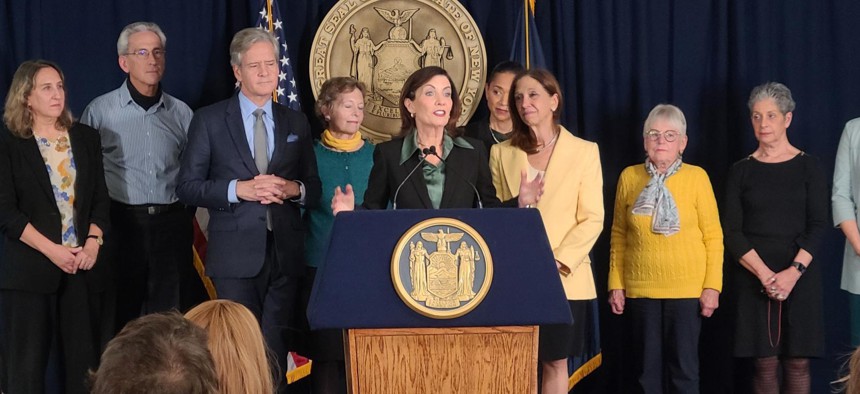
Gov. Kathy Hochul announces a deal to sign a modified version of the Medical Aid in Dying Act. Rebecca C. Lewis


Gov. Kathy Hochul announced New York will join about a dozen jurisdictions that permit doctors to assist certain terminally ill patients in ending their own lives, after she came to an agreement with state legislators. On Wednesday, the governor said that she plans to sign the Medical Aid in Dying Act early next year, now that lawmakers have agreed to add a number of additional guardrails she proposed.
Hochul said she listened to many people and dedicated significant thought to the issue before making her final decision. “Know that I did not come to this lightly,” she said, calling her support of the measure “one of the toughest decisions I have made as governor.” A devout Catholic, Hochul said she recognized that some members of the faith community may not understand her choice, but she made it not for herself, but for the millions of New Yorkers she represents. “If a New Yorker chooses to have that under the circumstances we predesignated, who am I to stand in their way?” she asked.
Hochul framed her decision as one of personal freedom and giving New Yorkers a choice in how their lives end. “We're not talking about ending life early, but about ending dying early,” she said, adding that this revelation came to her at a recent church service.
City & State first reported Hochul’s decision to support the bill Tuesday night.
The version of the Medical Aid in Dying Act passed by the state Legislature earlier this year would allow terminally ill people with fewer than six months to live to request a doctor prescribe them a cocktail of drugs that they could take to end their lives. The measure included a series of requirements that patients must meet before receiving the drugs, including approval from two doctors, and other guardrails meant to prevent abuse. Hochul proposed additional safeguards, many of which legislators agreed to as part of the deal. “I believe we’ve crafted an elegant solution to a problem that people have fought for, but also wrestled with, for a long time,” she said, acknowledging conversations about coercion and among disability rights groups.
One addition the governor made will require patients to record their request for life-ending medication. Another change will limit the law to New York residents only, as a means to prevent an influx of patients from other states hoping to end their lives. Hochul also succeeded in adding a five-day waiting period between when someone receives a prescription and when it can be filled. The law will not go into effect until six months after she signs it, ensuring the state Department of Health has enough time to enact all necessary regulations.
Both legislative sponsors said they were satisfied with the changes. “I think some of the additions that we put in are not going to be insurmountable barriers – and that was very important to me,” Assembly Member Amy Paulin told City & State. She expressed some disappointment that patients in neighboring states receiving treatment in New York will not be able to access through option, but was overall pleased the bill is set to become law.
For state Sen. Brad Hoylman-Sigal, the deal for Medical Aid in Dying comes as one of his final acts as a member of the Legislature. “The applicability of this legislation is probably the most far reaching of my Senate career,” he told City & State. Although he won't be the sponsor of the amended version passing next year, negotiating its approval served as a capstone to his time in Albany.
Legislators passed the controversial measure for the first time during this year’s legislative session, and Hochul had months to consider how she would act. Some religious groups, including the Catholic Church, and disability rights organizations lobbied the governor to veto the measure on moral and ethical grounds. Patient advocates, some physician groups, terminally ill people and surviving loved ones implored Hochul to sign it as a measure of compassion for those dying in pain.
Supporters celebrated the deal on Wednesday. “This law will represent the culmination of more than 10 years of determined, consistent effort by hundreds, no, thousands, of New Yorkers who advocated for this law,” Corinne Carey, senior campaign director for Compassion & Choices NY/NJ, said in a statement. “Many did not live to see this day.”
But Hochul’s changes were not enough to sway opponents, who quickly denounced the agreement. “This new law signals our government’s abandonment of its most vulnerable citizens, telling people who are sick or disabled that suicide in their case is not only acceptable, but is encouraged by our elected leaders,” said Cardinal Timothy Dolan and the Bishops of New York State in a statement. “While physician-assisted suicide will soon be legal here in New York, we must clearly reiterate that it is in direct conflict with Catholic teaching on the sacredness and dignity of all human life from conception until natural death and is a grave moral evil on par with other direct attacks on human life.”
At Hochul’s insistence, the new version of the law will permit religiously-affiliated home hospice providers to refrain from offering medical assistance in dying.
NEXT STORY: Hochul agrees to sign Medical Aid in Dying bill