

New York State
What will be the biggest 2026 policy fights in Albany?
Raising taxes and enacting the Mamdani agenda are likely to be major points of conflict.
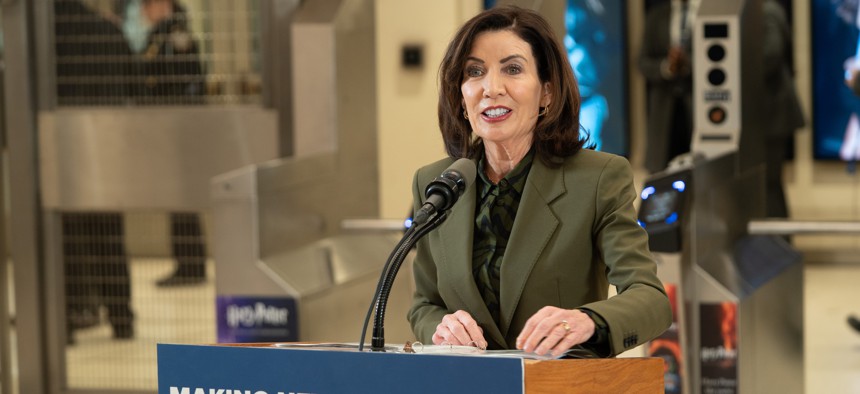
Gov. Kathy Hochul has said she won’t raise income taxes but has hinted at an openness to raise corporate taxes. Gov. Kathy Hochul’s Office



With a polarizing new mayor in New York City, countless high-profile elections and an ever-unpredictable (and often hostile) federal regime, 2026 certainly won’t be a boring year in Albany. Gov. Kathy Hochul’s own reelection will loom large as she attempts to win a more resounding victory compared to 2022. Facing both a progressive primary challenger and a Trump-aligned conservative in the general election, she must walk a thin line between appeasing her party’s left wing without alienating moderate voters in November. Legislative leaders will also have to be mindful of left-wing primary challenges to their members while shoring up vulnerable incumbents against Republican attacks. Officials tend to play it safe in election years, but the past few years have proven that long shots are in vogue.
While Mayor-elect Zohran Mamdani may push for broad new investments with fresh grassroots support, state leaders will still need to contend with fiscal insecurity caused by the president.
The new year will bring plenty of new problems – more than can possibly be predicted – but here are some of the big issues to keep an eye out for starting in January.
It’s the economy, stupid
Top of mind for both the governor and lawmakers in the upcoming legislative session will be dealing with federal funding cuts. In the current fiscal year, the state already needed to account for a $750 million hole created by President Donald Trump’s One Big Beautiful Bill Act, and New York was bracing for another $3 billion in losses in the upcoming fiscal year thanks to Medicaid cuts kicking in. Hochul has already taken steps to address a $7.5 billion cut to the Essential Plan, the state’s basic health care program that provides zero-premium insurance to low-income residents who don’t qualify for Medicaid. In addition to the cut, the federal funding law restricts the use of federal dollars to insure many legal resident noncitizens.
The state is required by a 2001 court ruling to insure about 500,000 noncitizens who can’t receive Medicaid, and the federal change would have put New York on the hook again for funding. But Hochul has sought to revoke an expansion of the Essential Plan to cover people making between 200% and 250% the federal poverty line. Due to a legal technicality, that move should allow the state to continue using federal dollars to cover some noncitizens, but at the cost of roughly 450,000 New Yorkers who were part of that previous expansion and would lose their insurance.
But newly uninsured people means more costs for safety net hospitals, which already struggle to stay afloat. Those hospitals would likely turn to the state for more funding to cover those new costs. And new Medicaid eligibility requirements that kick in at the start of 2027 – in the last quarter of the next fiscal year – are expected to impact 1.3 million recipients in the state. All the health care cuts don’t even account for slashed federal support for food assistance, which will put the state on the hook for a larger share of the funding near the end of 2027 and could result in hundreds of thousands of New Yorkers losing their benefits even sooner. Hochul and legislative leaders have repeatedly said the state cannot backfill all the cuts, but even plugging some of the holes can get costly.
The Mamdani moment
New York City Mayor-elect Zohran Mamdani won’t be heading back to Albany in the new year as a member of the Assembly, but he’ll still spend plenty of time trying to get his agenda passed by his former colleagues. One of Mamdani’s major requests will likely be tax increases on wealthy New Yorkers and corporations to fund his top policy priorities, like free buses and universal child care.
On the income tax front, Mamdani wants to create a new tax bracket for city residents who make over $1 million, with income over that amount to be taxed at a proposed rate of 5.9%. That would be on top of the state income taxes that already have tax brackets at $1 million, $5 million and $25 million. Mamdani also wants to increase the state’s highest corporate tax rate by 4.25 percentage points to 11.5%.
Legislative leaders have long supported tax increases to some degree, and both chambers have previously included this specific proposal to raise the corporate tax rate in their one-house budgets. Hochul has consistently opposed any increase to income taxes, even on the state’s highest earners. Since Mamdani’s election, though, the governor has appeared more open to possible increases to corporate tax rates. She already has raised taxes on big businesses in the city to help fund the Metropolitan Transportation Authority, so such a move would not be unprecedented.
On the free bus front, Mamdani previously managed to win a pilot program during his time in the Assembly, with one free route in each of the five boroughs for several months, though the pilot did not get renewed or expanded. Mamdani has allies in the Legislature who support his free bus vision, which relies heavily on adequate state funding to account for lost fare revenue. But neither Hochul nor MTA Chair and CEO Janno Lieber are fully onboard with Mamdani’s idea, with both expressing concerns and reservations about the pricey plan.
Think of the kids
Although Mamdani and Hochul don’t see eye to eye on taxes, both are committed to achieving universal child care. In her 2025 State of the State agenda, the governor included a pitch to “identify a responsible and sustainable path toward funding Universal Child Care” – though she has not thrown her support behind any specific legislation meant to achieve it yet. Hochul favors a gradual approach; speaking with City & State in November, Hochul said, “we don’t have the infrastructure in place” to immediately implement universal child care. More than simply raising enough money to fund such a program, the state first needs to build out the capacity to handle the influx of kids, both in terms of physical space and child care professionals.
State Sen. Jabari Brisport, a close ally of Mamdani, is a longtime advocate for universal child care. He sponsors the Universal Child Care Act and has estimated it could cost $5 billion. State Sen. Jessica Ramos, who has also fought for universal child care, has introduced the Early Learning Child Care Act, which would ensure free child care up to age 5 for families who make four times the federal poverty line or less. Brisport’s bill does not include a means test and would also include after-school programs for school-age children.
The Empire State Campaign for Child Care released a report that envisions a six-year rollout to achieve full universal child care, starting with investments in next year’s budget. The report includes a few main budget requests for the upcoming year, like a $1.2 billion workforce compensation program already recommended by a gubernatorial task force and sufficient funding for the Child Care Assistance Program, which is estimated to cost $1.8 billion for New York City and $500 million for the rest of the state.
Still trying to go green
As the federal government eliminates subsidies for building renewable energy and cancels green energy projects, actions by individual states are now more important than ever. Hochul has recently adopted an “all of the above” approach to the state’s energy needs, supporting investments in both fossil fuel and renewable energy projects as outlined in the newly approved state Energy Plan. In December, the governor celebrated a ruling that found the president’s halt on new offshore wind approvals was illegal, which was good news for stalled projects in the state. But her Department of Environmental Conservation also recently greenlit a controversial pipeline extension it had previously rejected. In the upcoming year, Hochul will likely advance her plans to build a new nuclear power plant upstate – a lengthy and costly process that will take years to complete.
Climate advocates have been less than pleased with the governor’s other recent environmental moves beyond the pipeline permit approval. The governor has delayed the release of necessary regulations to enact a cap-and-invest program, putting the state years behind the deadlines for emissions reductions and electrification laid out in the 2019 Climate Leadership and Community Protection Act. The state finalized reporting rules for greenhouse gas emissions, but the cap-and-invest legal battle remains ongoing.
Lawmakers have made little progress in recent years in passing climate-related bills, much to the chagrin of activists. The NY HEAT Act will likely be a priority again after legislators managed to pass only a very watered-down version of one of its provisions in 2025. (At the time of publishing, Hochul had not yet acted on the bill, which was on her desk.) Climate advocates have criticized the New York Power Authority for planning to build less than 15 gigawatts of green energy, which is likely the mark the state would need to hit to reach its climate goals. Some lawmakers have proposed expanding NYPA’s board of trustees to push the authority to move faster. And legislators also recently kicked off a push for the new Solar Up New York Act, or SUNNY Act, to make it easier for renters and low-income New Yorkers to install balcony solar panels. Observers should also keep an eye out for efforts to amend the state’s environmental review process, whose onerous requirements have been a major obstacle to new green energy projects.
Pushing for and rolling back criminal justice reforms
It’s an election year, and criminal justice reform is sure to emerge as a high-profile issue for lawmakers, activists and the governor. For the past several years, Hochul has tried to deflect Republican attacks that she is “soft on crime” by insisting on rollbacks to bail and discovery reform during budget negotiations, often pushing the spending plan well past the deadline for passage. For 2026, district attorneys have suggested revisiting New York’s 2017 Raise the Age law, which raises the age of criminal liability from 16 to 18. Prosecutors played a significant role in the fight over discovery reform this past year, and Hochul has hinted that she may be open to making changes to the Raise the Age law. State legislators, meanwhile, are preparing for it to be the latest criminal justice reform battle with the governor.
But criminal justice reformers won’t just be playing defense. Activists have already launched campaigns for the new year to pass new prison reform legislation, which has failed to pass in previous years. The ongoing turmoil in the state prison system remains top of mind for many legislators, and many proposed reform measures were left out of the omnibus prison reform bill that the governor recently signed. In particular, the influential Black, Hispanic, Puerto Rican and Asian Legislative Caucus released a comprehensive prison reform plan in June, but many of its proposals were left off the table. Advocates are planning a renewed push for bills like Elder Parole, which is meant to give older inmates a shot at parole, and Fair and Timely Parole, which aims to make it easier for those eligible to be granted parole. On the sentencing side, advocates and lawmakers will again try to pass the Second Look Act and Earned Time Act to help reduce original sentences and make it easier for incarcerated people to get time off their sentences through good behavior.
Protections for immigrants
Lawmakers began talking about passing new immigrant protections before Trump even returned to the White House, but a year into his new term, they’ve made little progress. In New York City and around the state, the presence of federal immigration officials has increased, as the administration makes good on the president’s mass deportation agenda and targeting of major Democratic cities. U.S. Immigration and Customs Enforcement has also signed formal agreements to work with several local law enforcement agencies in conservative areas like Nassau County, which was heralded by gubernatorial candidate and County Executive Bruce Blakeman.
The state currently has a patchwork of regulations through executive action, state law and case law, so immigrant advocates and legislators have focused much of their attention on trying to pass the New York for All Act, which would codify and expand sanctuary city regulations statewide, banning the kinds of agreements that Nassau law enforcement entered into that allow them to work with ICE. Immigrant advocates are also pushing for the Dignity Not Detention Act, which would prohibit local governments from entering agreements with ICE to operate immigrant detention centers, like in local jails or prisons. According to New York Focus, seven county jails throughout the state currently detain immigrants for ICE, for which they receive compensation.