

New York City
Who’s going to pay for AC in New York City?
Air conditioning could soon be required, but questions remain about how it’ll be implemented.
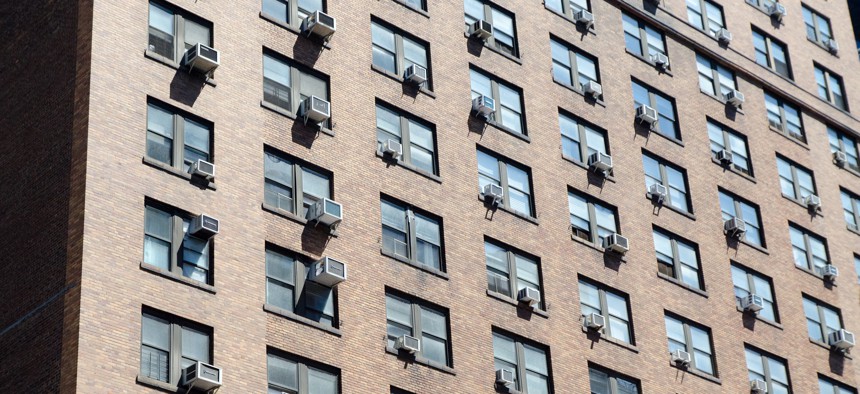
An air conditioning requirement would likely be addressed by more window units. Marc Dufresne/Getty Images


Summers in New York City are getting hotter and hotter. There were 14 days with temperatures over 90 degrees last year, and the state’s climate assessment projected that number will go up throughout this century. On average, more than 500 people die prematurely in New York City each summer due to extreme heat, according to a 2025 city report. And the most common place of death was homes without air conditioning.
But about 10% of New York households don’t have AC, according to city health statistics. And in lower-income neighborhoods like East Flatbush, Brooklyn, it’s closer to 30%.
The New York City Council just passed a bill meant to help them, but critics say it doesn’t do enough to address the major reason why New Yorkers don’t have air conditioning in their homes: the cost.
The legislation would effectively give renters a right to air conditioning. The bill requires landlords to provide air conditioning capable of keeping bedrooms 78 degrees or lower, if the tenant asks. And in buildings where the owner controls the temperature, landlords would be required to maintain temperatures at 78 or lower from June 15 through Sept. 15.
While former Mayor Eric Adams vetoed several other housing-related bills that passed on the same day, he didn’t touch this one, and it’s set to become law in late January.
“We need New Yorkers to be able to have access to the cooling devices they need to stay alive in extreme heat. Generations ago, we as a city, as a state and a nation required landlords to provide heat in the way that we need to in winter,” said City Council Member Lincoln Restler, the sponsor of this bill. “With climate change evolving as it has, we need landlords to take that same responsibility to keep their tenants safe during extreme heat. And that is what this bold legislation will accomplish.”
New York City enacted a heating code after a major coal shortage in 1918. It’s still in force today, requiring not only that radiators be installed but that they need to operate through the winter months. The new maximum temperature law is less sweeping, just requiring landlords to provide an air conditioning unit. Anti-poverty advocates are concerned about landlords simply passing along the cost to low-income tenants. And while heat is typically controlled by landlords, running the AC will in many cases be controlled by the tenant, leaving them to deal with the additional energy costs. As a result, some critics of the legislation are worried renters might choose not to cool their homes.
“There are affordability concerns that I think still need to be addressed and it’s not enough to provide the physical hardware. We also need to provide the financial backing for people to actually use the air conditioning units when they need it the most,” said Diana Hernandez, associate professor of sociomedical sciences at Columbia University’s Mailman School of Public Health.
The cost is a major barrier for a lot of New Yorkers. Almost 21% of New York City residents had difficulty paying their utility bills, according to a recent study Hernandez published in the journal Health Affairs.
With the affordability question up in the air, green advocacy groups like the New York City Environmental Justice Alliance and WE ACT for Environmental Justice are conditionally supporting the legislation because it helps address the disparities in how New Yorkers experience extreme heat. But they’re calling on city leaders to offer more financial support to tenants before the law goes into effect in four years.
“If people still have the same fear in 2030 that they do now around the cost of their utility bills, the bill won’t be nearly as strong as it could be,” said Caleb Smith, the New York City policy manager for WE ACT for Environmental Justice.
Restler previously told news outlet City Limits that he was interested in pursuing “significant city and state subsidies,” but that didn’t make it into the final bill.
Mayor Zohran Mamdani took office in January and won the election on an affordability agenda, but Hernandez noted how the discussion of affordability hasn’t really focused on the issue of energy insecurity: “It is indeed a big issue. And a growing one too.”
City Hall declined to comment on the bill, but Mamdani sponsored an Assembly bill that would prohibit companies and local governments from shutting off utilities for nonpayment throughout the summer months.
The council doesn’t require air conditioning to be provided until June 1, 2030, but even with the four-year-delay, it allows landlords who might experience financial hardship from this legislation to request more time to comply. The legislation doesn’t provide any new funding to support them. New York Apartment Association CEO Kenny Burgos, who represents property owners and managers of multifamily housing, said that’s a problem.
“It’s incredibly difficult to retrofit some of these older buildings, particularly with some of the newest air conditioning and central air technology,” Burgos said. The legislation doesn’t specify what cooling units would need to be installed but Burgos said it would most likely be window units, especially for older rent-stabilized buildings.
He also noted the city is concurrently requiring buildings to reduce their greenhouse gas emissions, often by switching to electric heating systems such as heat pumps.
“We also have been concerned that it runs in complete conflict with Local Law 97, which has a goal of reducing greenhouse gas emissions, but now, pushing for more air conditioners, which are a huge greenhouse gas contributor,” Burgos said.
Restler said the AC law’s 2030 timeframe is deliberately aligned with the Local Law 97’s major deadline. “And so as buildings are making energy efficiency upgrades, potentially including heat pumps, centralized air and other improvements, they would come into compliance with this law as well,” Restler said. The bill, Restler said, also directs the city’s housing department to set rules about the types of air conditioners that would be acceptable, weighing factors including electricity costs and energy efficiency.
If energy affordability is not adequately addressed by the time this law is implemented, many tenants may still end up suffering through sweltering heat waves.
“In the summertime, it may mean that people are completely forgoing the use of an air conditioning unit because of affordability issues. So they’re being exposed to these extreme indoor temperatures in a way to kind of cope with the financial stress,” Hernandez said. “And there’s a way in which they can’t really occupy and enjoy their home in comfort. At some point this is not just about human dignity. It really kind of lands in the realm of health and survival.”
Niamh McAuliffe is a student at the Craig Newmark Graduate School of Journalism at CUNY.
NEXT STORY: Gowanus faces a hidden threat beneath its neighborhood boom