

Criminal Justice
Legislature considering funding reforms for Raise the Age, not rollbacks
Tweaks could come to the 2017 law increasing meant to keep teens from getting criminally charged as adults.
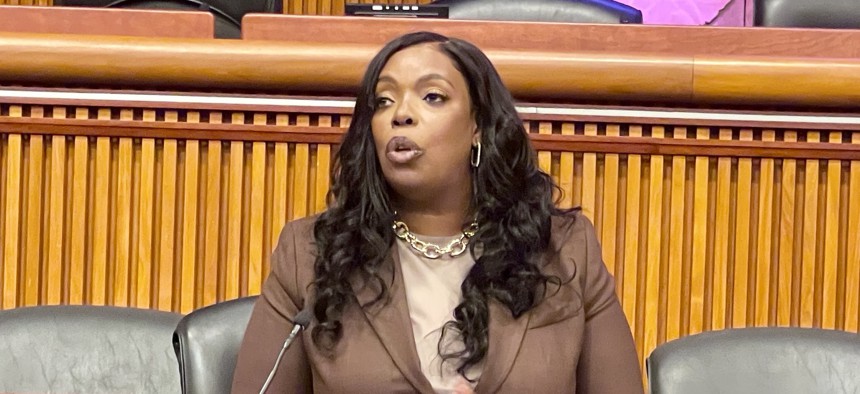
Assembly Member Latrice Walker speaks on a Raise the Age panel at Caucus Weekend in Albany on Feb. 14, 2026. Kate Lisa/City & State


New York government leaders have no intentions this year of rolling back the law that increased the state’s age of criminal responsibility to 18, but changes to its funding rules aren’t off the table.
A 2017 law known as Raise the Age moved 16- and 17-year-olds to family court, preventing youth offenders from being tried as adults.
Gov. Kathy Hochul did not include changes to policy, or the much-criticized funding mechanism for counties in her executive spending plan. But lawmakers at Caucus Weekend in Albany told City & State they want the Assembly and state Senate to propose new funding rules in their counter spending plans to be released in mid-March.
“We’re still having the funding conversation,” said Assembly Member Michaelle Solages, who chairs the state’s Black, Puerto Rican, Hispanic, and Asian Legislative Caucus. “I think we need to do this in the budget. We’re having active conversations.”
Assembly Member Latrice Walker, who chairs the caucus association, said the funding to counties for Raise the Age programs shouldn’t be provided through reimbursements, but rather made in direct grants.
“That’s something that we should take a look at,” she told City & State after speaking at a Saturday panel about the law.
Walker, a Brooklyn Democrat, carries a bill to create a new young adult offender status for people ages 19 to 25 – something she argued would expand discretion for judges while keeping records sealed.
“Based on the neuroscience, the brain development stages that we apply to 16- and 17-year-olds still exist in that particular age group,” Walker said.
Raise the Age also included funding for local governments meant to reduce crime committed by 16- and 17-year-olds. The New York Association of Counties is pressuring the Legislature to decouple a county’s reimbursement eligibility from the 2% property tax cap and to transition Raise the Age funding to grants. County leaders argue the current structure has led to unreliable funding that has made it difficult to satisfy the state mandate – and many have sat on millions of dollars in aid intended for the programs.
Solages said she expects legislative leaders to have a larger conversation with district attorneys and police departments about changes to the policy next year.
District attorneys around the state have been pushing Hochul to adjust the statute, arguing judges should have access to a youth offender’s history from family court, and that sealed records impact continuity for services and treatment.
“It starts all over as if the judge or the courts or other parties involved never knew anything about this kid, and that’s a loss for the child,” Bronx District Attorney Darcel Clark said at the Raise the Age panel on Saturday in Albany. “We need that information sharing so we can see what the treatable need is.”
Clark has been calling for changes to the law since 2021. But not all district attorneys think the statute must be changed. Brooklyn District Attorney Eric Gonzalez said Raise the Age funding issues must be addressed, but the policy should be left alone.
"I think it's premature to say that Raise the Age is responsible for any kind of increase in youth violence. In my county, we saw numbers went down,” Gonzalez said. “But I still think the right approach is to treat kids like kids.”
Likewise, state Chief Administrative Judge Joseph Zayas said he does not think the statute needs to be changed.
“The numbers don’t support the idea that Raise the Age is failing, I think it’s doing a wonderful job,” he told City & State after a budget hearing in Albany earlier this week. “Judges in (state) Supreme Court are sending the right cases back to family court and the stats don’t prove that otherwise.”
NEXT STORY: Back in Albany, Mamdani says ‘tax the rich’