

Policy
Mamdani to Hochul: Raise taxes or else…
… New York City will raise its own property taxes while also raiding budget reserves.
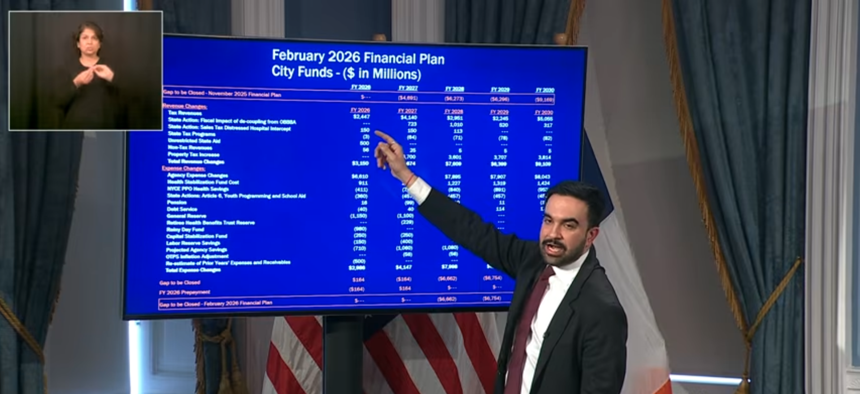
Mamdani isn’t giving up on taxing the rich. Screengrab/New York City Mayor’s Office


In his first budget proposal, New York City Mayor Zohran Mamdani delivered a nervy ultimatum to his partner in government, Gov. Kathy Hochul: Raise taxes on the wealthy and kick in more money to the city or be indirectly blamed for a property tax hike and drawing down city budget reserves.
That message, delivered prominently in Mamdani’s presentation of a $127 billion proposed budget for fiscal year 2027, could land with a thud in Albany, where Hochul has drawn a line against raising taxes on high-earning individuals and corporations – as Mamdani has requested. And it comes just a day after the governor announced the state would kick in an additional $1.5 billion – including $500 million in recurring funding – to help close the city’s $7 billion gap over the next two years to where it stands now, at $5.4 billion.
“There are two paths to bridge this gap. The first is the most sustainable and the fairest path,” Mamdani said on Tuesday, referring to his preferred option of taxing the rich and getting additional funding from the state. The latter option – raising property taxes and pulling from reserves – he called the option of “last resort.”
The $127 billion budget for next fiscal year is a roughly $9 billion increase from the $118 billion budget for the current fiscal year. (The budget for fiscal year 2026 was revised up to $122 billion in Mamdani’s presentation on Tuesday.) The bulk of that increase is funding to resolve underbudgeting under the last administration, including for a rental assistance program. It includes just $576 million in new spending on programs, including the hiring of 300 new employees at the Law Department and $100 million in extra snow clearing costs this winter.
Hochul’s resistance to raising personal income and corporate taxes would leave Mamdani with the path he has presented as “much more damaging”: raising property taxes and pulling from reserves to fill the remaining gap. The proposal includes a 9.5% property tax increase, which would need to be approved by the City Council. It would also include drawing down $980 million from the Rainy Day Fund this fiscal year and $229 million from the Retiree Health Benefits Trust in fiscal year 2027, a move budget watchdogs frown upon.
“The Rainy Day Fund is intended to be used in the case of a recession, which is not the current situation. So using those resources is not prudent,” said Ana Champeny, vice president for research at the fiscal watchdog group the Citizens Budget Commission.
Without pursuing either of those options, the city would be left with a $5.4 billion gap in fiscal year 2027, Mamdani said.
As City Hall knew it would, the prospect of raising property taxes raised some eyebrows on Tuesday too. The property tax system has long been decried as an unfair, broken system that favors single-family homes and higher-income homeowners in co-ops and condos. Comptroller Mark Levine called it a “pretty extreme option” – and noted it also relied on “pretty aggressive revenue projections.” At an unrelated appearance in New York City, Hochul said she didn’t think a property tax increase was necessary.
Raising property taxes is a political third rail, unpopular with both Democrats and Republicans. “It’s hard to buy a home now, so you’re really setting back generational wealth,” Queens Borough President Donovan Richards told reporters Tuesday, adding, “You’re going to force people out of their homes.”
“Raising property taxes has got to be among the worst ideas imaginable to make our budget gap smaller,” Council Member and Republican Minority Leader David Carr told City & State. “The reality is, it’s among the most regressive taxes that the city levies on New Yorkers. And to say that we have a progressive administration that actually thinks that's something they may need to do is ridiculous.”
Faced with multiple questions about what raising property taxes would actually look like – the political fallout, a City Council speaker that quickly staked out her opposition to the prospect – Mamdani only repeated that it’s an option he doesn’t want to have to pursue. He didn’t weigh in on the question of whether it would be politically or technically possible.
The appetite for reforming the property tax system – a task that would fall to Albany – is greater. It’s often been a bipartisan interest, and Carr, for example, has advocated for reform. Mamdani campaigned on reforming the property tax system.
Though the preliminary budget is the mayor’s first official step in the city budget cycle, it is the third glimpse of the city’s finances Mamdani has presented in the past month. He held a budget address in late January forecasting a $12 billion budget gap over two years, before announcing in Albany last week that the city had lowered that gap to $7 billion thanks to updated tax revenue forecasts, projected savings and dipping into in-year reserves.
Detailed savings plans are expected to come by March 20, compiled by “Chief Savings Officers” at each city agency, per an executive order signed last month. Some of those savings will include reducing some vacancies across city agencies, while also opening up hiring for remaining vacant positions. Mamdani announced on Tuesday that the city is ending a “2-for-1” hiring policy that for the most part restricted agencies to hiring for a position only after two employees had left.
Now that the mayor has submitted his preliminary budget, the City Council, borough presidents and Independent Budget Office will review it. The City Council’s response to the proposed budget is due April 1.
This story was updated with additional budget details at 5:15 p.m. on Feb. 17.
NEXT STORY: More money, still problems for Mamdani’s first budget