

Events
70K older New Yorkers on waitlists for basic services
Advocates spoke at an AARP panel are seeking more funding to implement the state’s Master Plan for Aging.
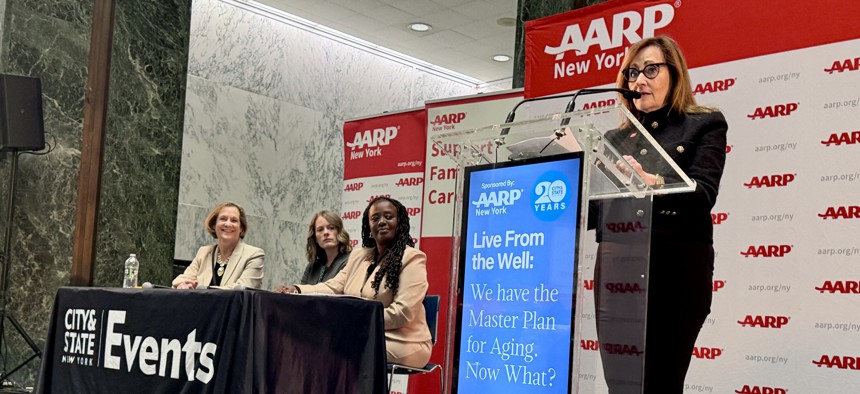
AARP New York's Beth Finkel speaks at the Live from the well event Kate Lisa/City & State


Thousands of older New Yorkers are languishing on waitlists for basic services like housing, caregivers, transportation and more – and increased closures of licensed, skilled nursing facilities are forcing older New Yorkers hours from home, or even out-of-state.
Six panelists, including state Sen. Cordell Cleare and Assembly Member Rebecca Seawright, discussed the future of aging in New York and what’s needed in the upcoming budget to fully implement the state’s Master Plan for Aging. The Albany event on the future of aging in New York was hosted by AARP and City & State in the Legislative Office Building as state leaders begin serious budget talks.
Multiple panelists said 70,000 New Yorkers on waitlists will grow much worse if the Legislature doesn’t act this session.
“People are going to die waiting for the most basic health and human services that are available, but that’s already happening,” said Becky Preve, executive director of the Association on Aging in New York. "The 70,000 services that are currently waitlisted, those are only for people that can afford to wait."
“That is not an individual that reaches out to our network to say, ‘My mom just came home from the hospital, I desperately need a home health aide to come in and help me,’” Preve added. “If you tell that client you're going to be placed on a waiting list, guess what's going to happen? That caregiver is going to either spend down to Medicaid or have to look at alternative living arrangements.”
All panelists said the budget needs millions of dollars to fully implement the Master Plan on Aging – particularly full funding for services to ease the backlog of older adults in need of housing and case management, to address a surge of fraud targeted at the elderly, and other programs that help keep vulnerable seniors out of nursing homes.
Preve said the state has just over 100,000 licensed skilled nursing facility beds with a population of about 5 million residents age 60 or older and 4.1 million family caregivers. The closure of those facilities often forces people to be far from their loved ones, or to go out of state to Massachusetts or Pennsylvania.
“We’re sending people hours from home, which is essentially giving them a death sentence,” she said. “And we have to do better.”
A previous version of this story was erroneously labeled as sponsored content. Due to a transcription error, this story has also been updated to clarify Preve’s comment.
NEXT STORY: State legislators gear up for budget fight with one-house proposals