

Policy
What happened to New York’s climate goals?
Gov. Kathy Hochul’s new play to roll back parts of the climate law is only the latest chapter in the state’s nonlinear path toward climate victories.
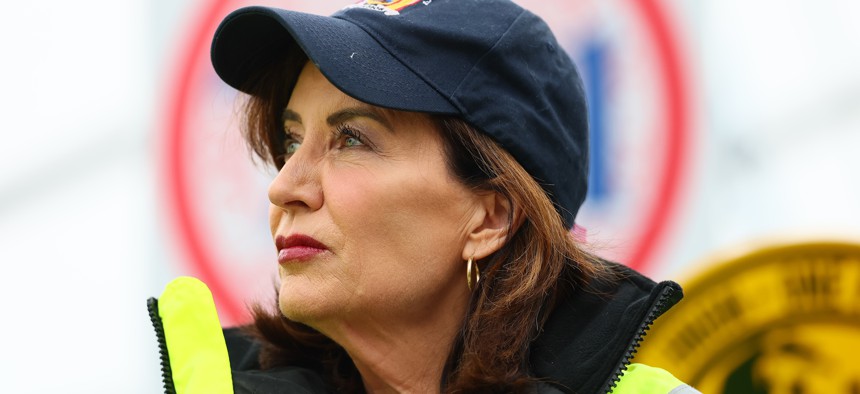
Gov. Kathy Hochul meets with Gateway tunnel project workers on Feb. 17, 2026. Michael M. Santiago/Getty Images



It’s 2026, do you know where your climate goals are?
Seven years have passed since New York enacted the landmark Climate Leadership and Community Protection Act, which set ambitious deadlines and benchmarks to tackle the climate crisis. But for as much effort has gone into trying to meet those goals, fossil fuel and business interests have spent perhaps just as much time trying to delay the full implementation. Gov. Kathy Hochul’s new play to roll back parts of the climate law in this year’s state budget is only the latest, and most high-profile, chapter in the state’s nonlinear path toward climate victories.
To understand Hochul’s most recent actions, it’s crucial to have an accounting of the law’s statutory requirements and the state’s progress so far. The law’s most well-known mandates are an 85% reduction in greenhouse gas emissions from 1990 levels by 2050, with a 40% interim goal by 2030, and having 70% of the state’s electricity to come from renewable sources by 2030, with the state’s power sector achieving net-zero emissions by 2040. On all counts, the state is well behind.
Reneging on renewables
By the numbers alone, the state might appear to be making real progress. New York currently gets 23% of its electricity from renewable sources, led by upstate hydroelectric power production. Once you factor in projects in the pipeline, such as offshore wind and utility-scale solar, the state is on track to have 45% of its electricity come from renewable sources by 2030. That’s nearly double the current share, but it’s still not the 70% required by law.
State officials have long admitted New York cannot hit that 70% goal by 2030, imperiling the state’s 2040 net-zero aspirations as well. Hochul and her administration have blamed a number of factors – including global supply chain disruptions caused by the COVID-19 pandemic, economic turmoil caused by federal tariffs and President Donald Trump’s ongoing attacks on offshore wind – for the stalled and canceled projects that would’ve been needed for the state to hit its goals. In turn, climate activists blame foot-dragging by Hochul and inaction by the New York Power Authority.
The two sides may disagree on the path ahead, but an inescapable truth has created a different ticking clock for the state. New York faces an imminent energy crisis. The New York Independent System Operator, the nonprofit that runs the state’s grid, has warned for several years that energy production won’t meet growing demand, and aging and insufficient transmission infrastructure won’t be able to carry that energy reliably even when produced. The most dire warning came in a Short-Term Assessment of Reliability report released in October that said the New York City region will face critical energy shortages starting as soon as this year.
“This is not a call to abandon our state’s climate goals,” NYISO Executive Vice President and Chief Operating Officer Emilie Nelson wrote in a December Daily News op-ed. “It is a call to balance them with the urgent need for reliability, certainty and resilience.”
Climate activists have pointed out that the NYISO’s estimates don’t account for incomplete renewable projects that will add production power, like the Champlain Hudson Power Express transmission line set to go online later this year. But officials with the nonprofit said even those projects won’t close the predicted gap and advocated – like Hochul – for an “all-of-the-above” approach.
The most recent example came as for-profit companies threatened to pull the plug on 3 gigawatts’ worth of projects unless the state renegotiated the contract terms to reflect current economic pressures and receive greater state subsidies. Public Power New York took that as an opportunity to once again push the state-owned New York Power Authority to build out 15 gigawatts of renewable energy under the Build Public Renewables Act to ensure the state meets its clean power needs without relying on private developers. New York Power Authority officials in December approved an updated plan to develop 5.5 gigawatts of renewable energy, which was a decrease from the original draft.
Time left for fossil fuels?
Hochul has touted her commitment to environmental ideals since taking office, and Time magazine recognized her last year as one of the 100 most influential climate leaders around the world. But that hasn’t stopped her from opening the door again to fossil fuel production. For years, regulators had repeatedly rejected bids for new and expanded natural gas pipelines, but Hochul’s Department of Environmental Conservation made a significant shift late last year when it approved permits for the Northeast Supply Enhancement project. Trump administration officials just broke ground on that project last week. But the Hochul administration skipped the event in Brooklyn, apparently wary of the optics of a Democrat celebrating new fossil fuel infrastructure alongside her old Republican rival Lee Zeldin, who now serves as the administrator of the U.S. Environmental Protection Agency.
A coalition representing fossil fuel companies and business groups also petitioned the state Public Service Commission in January to utilize its authority to pause the CLCPA’s renewable energy requirements in light of pressing energy needs. State law allows the regulatory commission to put the 2030 and 2040 benchmarks on hold in the name of affordability and reliability. Like the state’s grid, much of the fossil fuel infrastructure in New York is old and inefficient. The coalition argued in its petition that phasing out fossil fuels in less than 15 years prevents them from investing in newer, more efficient infrastructure that would reduce emissions in the short-term with greater reliability. They also sought to repower decommissioned power plants, which they said would be cleaner than building new ones. The catch – which climate activists have pointed out – is that investing in those updates, rather than doubling down on renewables, would keep New York reliant on fossil fuels for decades longer.
The comment period for the petition case closes on May 1, so the commission still has time before it makes a final decision. It could significantly amend the state’s climate goals without the Legislature or governor needing to lift a finger. That would solve the governor’s headache on renewables, leaving Hochul to deal with emissions on her more traditional battlefield: the state budget.
Ebbing emissions
As of January 2025, the state had managed to reduce greenhouse gas emissions by just 9% compared to 1990 levels, which only gets the state about a quarter of the way to its 2030 goal. Meeting that goal may sound improbable, if not impossible, because the state has barely made a dent in reducing emissions since the CLCPA passed in 2019.
The New York State Energy Research and Development Authority and the state Department of Environmental Conservation were required to issue regulations by 2024 to enable the state to hit its emissions benchmarks. Two years later, the most significant rules have yet to be finalized. The climate law didn’t stipulate the specifics of what kind of program the state must enact, but a panel tasked with making recommendations advised implementing a cap-and-invest program that would gradually require major polluters to release less emissions, or else pay for allowances with money reinvested into climate mitigation efforts by the state.
Hochul signed a law in 2023 enabling the creation of such a program, but the statute left the details up to state agencies and regulators to determine. In the lead-up to 2025, regulators and Hochul signaled they would have rules ready to go when the governor unveiled her agenda for the year. And according to Politico New York, they did – but those rules never got released.
Instead, Hochul punted for at least another year, barely mentioning the cap-and-invest program in her 2025 State of the State policy book. NYSERDA and the DEC took a small step forward last year with the release of draft reporting rules, but those proposed regulations only account for a portion of those needed to implement the program. The real meat of the rules – prices and timing for emissions allowances – remain elusive.
The start of this year offered no meaningful updates, aside from the expectation that Hochul would attempt to gut the CLCPA. In 2023, she had attempted a wonky amendment that would have changed how the state measured emissions – replacing a more stringent methodology with a more commonly used one that would make New York appear closer to its reduction goals. That attempt to change the law failed.
But Hochul is now facing unprecedented pressure to enact a cap-and-invest program thanks to a state court ruling. Tired of waiting for the state to act, environmental advocates sued the state. Late last year, a state judge determined New York officials violated the CLCPA by failing to enact its proposed cap-and-invest program by 2024 and gave the Hochul administration until the start of February to release the rules.
NYSERDA instead released something else: a now-infamous memo. The memo projected exorbitant energy costs for average consumers by 2031 if the state implemented a cap-and-invest program that was sufficiently aggressive to meet its 2030 emissions goals, while describing the necessary renewable energy deployment as “infeasible.” Environmental groups immediately trashed the memo, disputing its cost predictions with their own analyses that accounted for the types of investments that a cap-and-invest program would make possible beyond direct rebates. The memo itself even offered an assessment that households that convert to “high efficient electrification” would have sizable net savings.
“Let’s be clear, this is a completely manufactured crisis that is founded through an incoherent narrative in an attempt to pressure the Legislature to give in to punting on our climate law,” Eric Walker, energy justice senior policy manager at We Act for Environmental Justice, said at a large March rally in Albany.
Even before the release of the memo, Hochul and her surrogates had already laid the groundwork for why the current version of the climate law doesn’t fit with her affordability agenda for New Yorkers – even as she acknowledged that changing the climate law won’t bring down costs right now. So after weeks of waiting, the governor finally released the first concrete details of the changes she wants to make. She proposed a new 2030 deadline for the state to implement necessary regulations like a cap-and-invest program. That would rid her of the climate activists’ lawsuit, which she has directly blamed for the proposed rollbacks. “I’m not excited about having to do this,” Hochul said at a recent unrelated press conference. “We are forced to because of advocates who took us to court not satisfied with the pace that we were on.”
Hochul is also taking another crack at changing the law’s emissions accounting methodology. Her proposal would change how the state measures what’s called the “global warming potential” of greenhouse gases from using a 20-year period to using a 100-year period. While she has defended this as aligning New York with the most commonly used standard, the change would no longer accurately account for the harmful impacts of methane gas, which does not stay in the atmosphere as long as carbon dioxide does. And it would immediately make the state’s emissions reduction numbers look better.
With the state budget now more than two weeks late, Hochul and lawmakers have reached a stalemate over the proposal. Some legislators seem willing to find a compromise – such as a 2027 deadline for cap-and-invest regulations – as long as it doesn’t change the emissions accounting methods. But Hochul has offered no indication she is willing to budge on negotiations over the climate law and has yet to offer language for legislative leaders to consider.
Tensions in Albany are high – but the pressure on Hochul to come out on top with budget victories is elevated in a crucial election year. The governor has said she needs to overperform at the top of the ticket as Democrats fight to win back the House – after her 2022 campaign drew the ire of Rep. Nancy Pelosi. This year, Hochul won’t let the state’s climate woes impede her.