

Campaigns & Elections
Claire Valdez calls for a rent freeze – and universal rent control
The DSA-backed congressional candidate is going a step further than Mayor Zohran Mamdani.
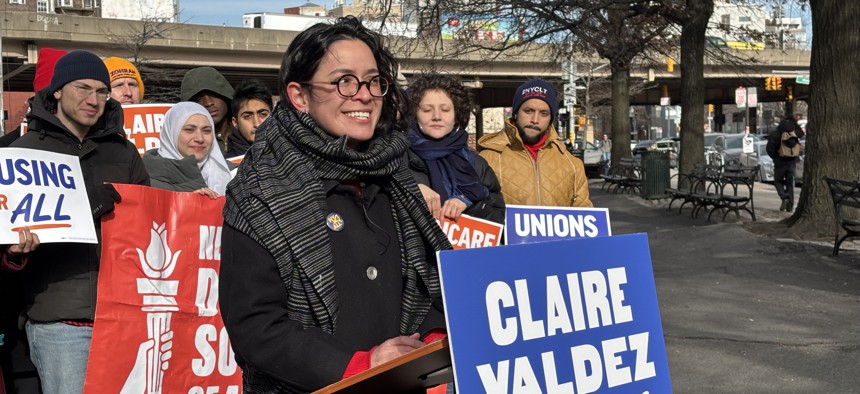
Congressional candidate Claire Valdez announced the endorsement of NYC-DSA soon after launching her campaign. Jeff Coltin/City & State NY



As New York City mayor, Zohran Mamdani can no longer call on the Rent Guidelines Board to “freeze the rent.” But his comrade, Assembly Member Claire Valdez, sure can!
“There are things that, as a candidate and as an Assembly member, that I can talk about now, that our mayor cannot, because it is an impartial process, and he needs to remain impartial in this moment,” she told City & State. “That's why we have a tenant movement. … Because one person can't do all of this by themselves. And so I'm proud to call for a rent freeze alongside many, many tenants all over the city.”
Valdez’s campaign said she is the first candidate this cycle to call for a rent freeze. A close ally and endorsee of Mamdani, she’s running for a congressional seat in Queens and Brooklyn currently held by the retiring Rep. Nydia Velázquez. Her two main opponents in that race are Brooklyn Borough President Antonio Reynoso, who’s backed by Velázquez and the New York Working Families Party, and New York City Council Member Julie Won. Both said they’re also in favor of a rent freeze.
“While rent freezes and rent laws are decided at the state and city level, not in Congress, Antonio has long called for rent freezes to support rent-burdened New Yorkers,” Reynoso campaign spokesperson Kirstin Horn said.
“We can and should freeze the rent for the two million New Yorkers living in rent-stabilized apartments right now,” Won said in a statement. “The Rent Guidelines Board has the authority to do so and should act immediately.” As a City Council member, Won has advocated for rent freezes and more recently has called for reducing the rents on rent-stabilized by 12%, which would effectively reverse the previous four years of rent increases.
Valdez doesn’t just support a rent freeze. She’s also going a step further than the mayor and calling for universal rent control.
Roughly 40 to 50% of rental units in New York City are rent-stabilized, which means landlords cannot legally increase the rent by more than the RGB authorizes each year. Most other rental units in the city are unregulated “market rate” units, which have no legal cap on rent increases. Tenants in market rate units – like Valdez – could theoretically have their annual rent raised by any amount.
“I live in market rate housing, my landlord could raise my rent as much as he wanted to, and I would have 90 days, basically, as the only cushion to make sure that I could afford to pay that,” she said. “And if he chose to double it, that would be a completely insurmountable change in my rent.”
In practice, rent increases in market rate units are limited by what the market will bear. Valdez’s landlord might legally be able to double her rent, but he hasn’t actually done so; her monthly rent in Ridgewood, Queens, only increased by $100 this year to $2,350. That’s about a 4.4% increase, which is only slightly higher than the 3% increase that the RGB authorized for this year.
Still, tenant advocates say the lack of rent regulation on market rate units allows landlords to price out existing tenants and bring in new tenants who are willing to pay more, contributing to gentrification and displacement. To prevent that, Valdez would like to see some form of rent stabilization extended to market rate units.
“Rent stabilization only affects a relatively small number of tenants,” she said. “So I think making sure that as many people as possible are able to stay in their neighborhoods, are able to put down roots and raise families, is really important. And I think expanding rent stabilization is definitely one way that we can expand tenant power and keep people in their homes.”
If Valdez is elected to Congress, she wants to push for federal rent control laws. Rep. Alexandria Ocasio-Cortez proposed legislation including a cap on rent increases back in 2019, but hasn’t prioritized the issue since. And while the idea is unpopular in Washington, it’s not unprecedented. During World War II, a majority of rental stock in the United States was subject to rent control and the Nixon administration briefly froze rents nationwide to combat inflation in the 1970s. Valdez plans to release a full housing platform in the coming weeks, which will include more details on her universal rent control proposal.
Won said she shares Valdez’s goal of increasing rent stabilization, though she didn’t commit to supporting specific policies. “Cities that have tried to do this without getting the details right have seen their policies struck down in court, leaving tenants worse off than before,” she said. “I'm committed to ensuring affordable housing in a way that actually holds.”
For now, Valdez’s focus is on the rent freeze. The RGB will vote on May 7 to determine the range of potential rent increases on rent-stabilized units and will vote again in June to determine the final allowable rent increase. Valdez and many of Mamdani’s supporters are calling the board to approve only 0% increases to both one and two-year leases, keeping rents frozen at their current levels.
Groups that represent owners of rent-stabilized units oppose a rent freeze and have tried to get the state government to allow them to raise rents in some cases beyond the maximum set by the board, arguing that limiting rent increases has made it unsustainable to own and maintain rent-stabilized housing.
“Housing has costs and NY has forced affordability on the rent regulated housing without accounting for it,” New York Apartment Association CEO Kenny Burgos wrote on X in March. “Now thousands of buildings are in distress and a rent freeze will threaten that very housing lawmakers want to protect. When 100,000+ apartments have expenses that exceed revenue, it’s a recipe for disaster.”
Valdez is not swayed by these arguments, citing data from the RGB showing that landlords’ profits on rent-stabilized housing have increased in recent years. In cases where owners feel that it is unprofitable to continue to maintain rental units, she’d like to see the city step in by buying out buildings for tenants.
“If landlords feel that they are no longer able to upkeep buildings, then I absolutely think that the city has a role to play in stepping in and helping tenants buy their building, helping to support tenants (to) take ownership of those buildings,” she said.
In addition to supporting a rent freeze and universal rent control, Valdez is also calling for the repeal of the Faircloth Amendment – which prohibits the creation of new public housing units – and increased federal funding for NYCHA. (Reynoso’s campaign said he also supports the repeal of the Faircloth Amendment.) In the Assembly, Valdez cosponsors a bill to create the Social Housing Development Authority, a publicly-owned housing developer that can build and finance the construction of new affordable housing.
Valdez’s approach to housing policy reflects her democratic socialist politics – and recalls the approach once favored by Mamdani. Back in 2020, Mamdani called for the decommodification of housing and the expansion of publicly-owned housing at the expense of the private housing market. By the time he ran for mayor, though, he had embraced a more YIMBY mindset; he told The New York Times in 2025 that he had come to recognize the private market played an important role in housing construction. Since taking office, he has adopted an “all of the above” approach to the housing crisis, pushing to accelerate both private and public housing development.
For now, Valdez isn’t following that same path. She remains skeptical of the private market’s ability to produce affordable housing and wants the state to take the lead on housing development.
“What passes for affordable often, in New York City, is simply not affordable, and the state can play a real and active role in making sure that our housing is deeply and permanently affordable, that it's insulated from the kind of market forces that drive our rents up, and that's exactly what social housing provides us the opportunity to do,” she said.
This article has been updated to reflect that Julie Won has called for a 12% decrease on rents in rent-stabilized units.
NEXT STORY: Childcare providers and lawmakers want $500M to eliminate waitlists