

Policy
Mamdani, Menin shake on $126B NYC budget
After a whirlwind weekend of last-minute haggling.
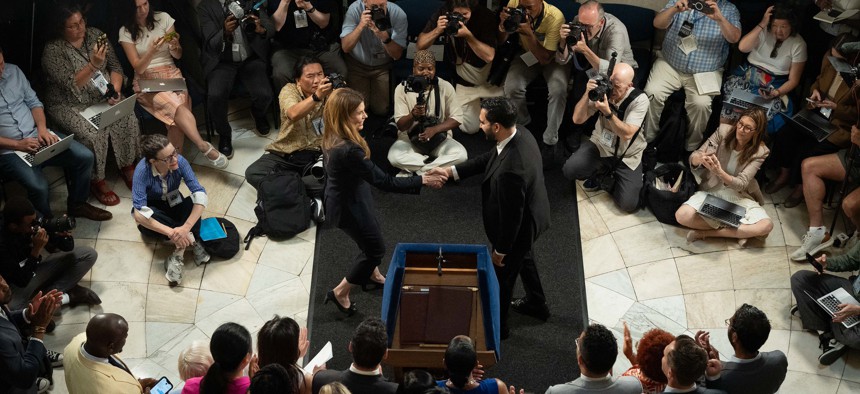
A $126 billion budget, sealed by a handshake Michael Appleton/Mayoral Photography Office


New York City Mayor Zohran Mamdani and City Council Speaker Julie Menin shook hands on a $125.8 billion budget for the upcoming fiscal year Tuesday, bringing a blitz of contentious final hour negotiations to a close mere hours before the July 1 deadline.
“This budget offers a road map, though it is only the first budget of our administration, and more will follow,” Mamdani said, joining Menin and the council members in the City Hall rotunda. “(But) every budget that follows will build on the principles established here: honest budgeting, fiscal discipline, transparent government and an unwavering belief that working people deserve a City Hall that delivers for them.”
The budget passed the City Council at 8:07 p.m. Tuesday evening by a vote of 45-6, with the council’s five Republican members voting against it, citing, among other things, a plan to increase the police department’s headcount falling out of the final deal. Council Member Althea Stevens was the lone Democrat to vote against the budget, citing a lack of investment in her Bronx district. “It saddens me that I cannot tell my constituents that this budget fully meets the urgency of their needs,” she said.
Work to hash out a budget deal ran into the 11th hour with both sides fighting well into Monday to finalize an agreement around a popular rental assistance voucher program known as CityFHEPS. Despite not initially prioritizing funding to expand the program, the City Council mounted an all-out last-minute push to get Mamdani to expand CityFHEPS in next year’s budget.
Still at an impasse on Friday, Menin canceled the ceremonial handshake that had been planned five days before the deadline. Tensions flared over the weekend and into Monday as a broad swath of council members fired off tweets pressuring the mayor to increase funding for the program. The advocacy was the latest development in a protracted legal fight that began when the City Council voted to significantly expand the program in 2023. The Eric Adams administration refused to implement the expansion due to the high cost, prompting a lawsuit from The Legal Aid Society and the City Council that continued until Tuesday. While Mamdani initially promised as a candidate to stop the legal fight and expand the program, he pivoted upon taking office.
The City Council dug its heels in for a legal settlement that would more modestly expand the program in the final stretch of budget negotiations, putting Mamdani in a tough position. The lefty mayor suddenly looked like he was standing in the way of expanding the kind of social welfare program he should theoretically support, while the more moderate Menin pushed for expansion. (Council Member Pierina Sanchez and the council’s Progressive Caucus were also leading the charge in the final negotiations, with some members saying they’d vote against the budget barring a satisfactory expansion.)
In the end, the budget deal includes $175 million in new funding for the rental vouchers in fiscal year 2027, with $125 million baselined in future years, and $50 million of it coming from the City Council this year. That’s short of the at least $200 million council leadership was pushing for, but it includes a deal for the Mamdani administration to drop their legal fight over the council's 2023 laws to expand CityFHEPS, and support a new bill in their place – to be passed Tuesday. The bill creates a new program expanding rental vouchers to some New Yorkers who were excluded from the existing program because they didn’t meet income requirements or because of the kind of shelter they reside in, Sanchez said.
“This agreement delivers a humane and fiscally responsible path forward by expanding access to rental assistance, establishing cost controls, and ending years of litigation,” Menin said in a statement.
Mamdani’s first budget has not been without drama. Just a few weeks into office, the new mayor laid the narrative groundwork for his first budget with a press conference recapping how the city came to face a $12 billion budget gap. (It was Adams and Andrew Cuomo’s fault, he said.)
Then in presenting his preliminary budget, Mamdani set out a controversial ultimatum for Gov. Kathy Hochul: tax the rich or force the city to raise property taxes and drain budget reserves. The pitch, meant to bolster Mamdani’s negotiating position and pressure Hochul to assent to his proposed tax hikes on the wealthy and major corporations, never really caught on. Most involved in the budget process never expected that Mamdani would actually touch property taxes, a political third rail.
Mamdani did, however, succeed in getting a substantial amount of funding from Hochul to help close the budget gap, presenting a $124.7 billion executive budget in May that didn’t resort to his threatened property tax hike or raided reserves.
Outside of CityFHEPS, the adopted budget agreement also includes an additional $54 million in baselined funding for Fair Fares, the discounted transit program, increasing income eligibility to those earning 200% of the federal poverty level up from 150%.
An increase to the New York City Police Department’s headcount was one of the things not included in the final budget agreement – a pivot from Mamdani’s initial proposal to grow the force by 580 police officers. While the prospect garnered a wave of criticism from the mayor’s base, even invoking a rare rebuke from the New York City chapter of the Democratic Socialists of America, Mamdani attributed the reversal to him and Police Commissioner Jessica Tisch finding ways to keep the NYPD’s original headcount “while also meeting all of our crimefighting needs.” News of the reversal was first reported by the New York Post. Menin said at a later press conference that she disagreed with the decision to not raise NYPD headcount.
“I believe we need to be adding police officers. We now have a police force that is less than on 9/11 yet the city has grown substantially,” Menin said. “The NYPD has successfully thwarted over 50 terrorist attacks … We are also seeing an increase in rapes and felony assaults and subway crimes, so this is of concern to me.”
In voting against the budget, Republican council members slammed the exclusion of the police headcount increase. Council Member Frank Morano said members learned on Monday night that the additional 580 officers wouldn’t be included, slamming the Mamdani administration for backtracking on the expansion at the 11th hour. “It’s a slap in the face to this body and an insult to the public trust,” he said in an impassioned speech in chambers. A spokesperson for Mamdani referred City & State to his explanation of the decision cited above.
While the budget plan isn’t an all out spending spree, it still drew some criticism from city budget watchdogs for not being conservative enough. “Yes, next year is balanced, but the gap is closed mainly with one shots, short-term savings, and cost shifts to future taxpayers, leaving the city to face a gaping hole next year and undue stress in the years after,” Citizens Budget Commission President Andrew Rein said in a statement.
The City Council approved the budget Tuesday evening, an unusually tight turnaround from the ceremonial handshake that left members – and the public – little time to review the finer details.
Here’s how all the council members voted on the budget:
YES
Julie Menin
Shaun Abreu
Shirley Aldebol
Alexa Avilés
Chris Banks
Gale Brewer
Selvena Brooks-Powers
Tiffany Cabán
Carmen De La Rosa
Eric Dinowitz
Elsie Encarnacion
Harvey Epstein
Amanda Farías
Simcha Felder
Oswald Feliz
Jim Gennaro
Jen Gutiérrez
Shahana Hanif
Ty Hankerson
Kamillah Hanks
Crystal Hudson
Rita Joseph
Shekar Krishnan
Linda Lee
Farah Louis
Virginia Maloney
Chris Marte
Darlene Mealy
Mercedes Narcisse
Sandy Nurse
Chi Ossé
Lincoln Restler
Kevin Riley
Yusef Salaam
Pierina Sanchez
Justin Sanchez
Kayla Santosuosso
Lynn Schulman
Shanel Thomas-Henry
Sandra Ung
Nantasha Williams
Carl Wilson
Julie Won
Phil Wong
Susan Zhuang
NO
Joann Ariola
David Carr
Frank Morano
Vickie Paladino
Althea Stevens
Inna Vernikov
This developing story has been updated with details of the budget vote.
NEXT STORY: Menin delays budget handshake, pressing Mamdani on rental voucher expansion