

Budget
Menin wants to boost funding for food pantries – but quiet on city-owned grocery stores
The New York City Council speaker addressed City & State’s Food Access and Affordability Event, weeks before the city budget is due.
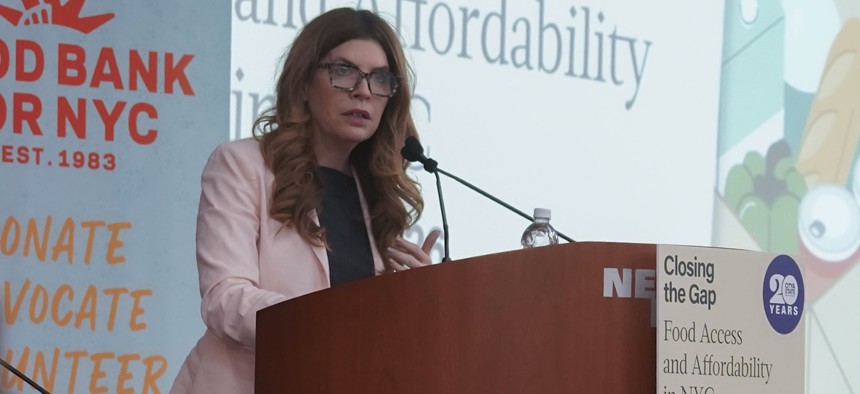
Speaker Julie Menin returned to New York Law School Thursday morning, after getting an honorary degree last month. Gerardo Romo / NYC Council Media Unit


As New Yorkers face an ever-increasing affordability crisis, compounded by the Trump administration’s reduced SNAP and EBT funding, the New York City Council and mayor’s office may be at odds over the best way for the city to improve food access.
Council Speaker Julie Menin announced in her keynote address at City & State’s legislative breakfast and panel focusing on food access and affordability Thursday morning that the council is pushing to increase funding for Community Foods Connection, or CFC,by $25 million, up to a total of $100 million for fiscal year 2027. Menin did not mention Mayor Zohran Mamdani’s plan to create city-owned grocery stores during her address.
“We are striving to eradicate food insecurity and make sure that every New Yorker can afford a meal. And if we are a city where every New Yorker can afford a meal and not have to worry about their next one, then we can begin to believe that we are a city where every New Yorker can afford to thrive,” Menin said. “The challenges are very clear, even if the solutions at first are not, and that's why we are drawing on every ounce of creativity and drop of innovation to ensure that we are addressing this urgent crisis.”
The CFC program provides funding to over 700 community kitchens and food pantries citywide. Menin said the boost in funding would allow the CFC to increase food distribution across its network and expand access to healthy and culturally competent food.
Mamdani’s office didn’t immediately respond to a request for comment.
Menin also mentioned bills recently introduced by the council that would ban so-called dynamic pricing and surveillance pricing. Dynamic pricing allows stores to change prices based on item demand in real time, while surveillance pricing uses consumer data to create profiles of customers and adjust prices accordingly to their individual shopping habits.
She also mentioned a bill to establish the nation’s first Office of Insurance Accountability, which she pitched as a way to assist bodega and small grocery store owners with rising insurance costs that carry over into consumer shopping carts. Menin said that bodega and deli owners pay between four to five times the national average for liability insurance.
Menin’s proposed Office of Insurance Accountability comes as bodega and small grocery store owners raise growing concerns about the negative impacts of Mamdani's plan for city-owned grocery stores. The Mamdani administration pledged $70 million in capital funding to build out one city-owned grocery store in each borough, but the funding has yet to be approved by the City Council in the final budget, which is due by July 1.
Emily Marcus, a senior vice president at the New York City Economic Development Corporation, spoke at the event to represent the Mamdani administration’s city owned grocery store initiative.
“Mayor Mamdani has been clear: the working people of this city should be able to afford the basic needs and services the city has to offer, and that includes healthy food and groceries,” Marcus said. “That is why public grocery stores are a key part of this administration’s affordability agenda.”
At the May 29 executive budget hearing for the EDC, Menin questioned interim president and CEO Jeanny Pak about the operating structure for the grocery stores and how the stores will be able to afford to offer consistent discounts over time.
The grocery stores will be run by third party operators, with a core basket of goods – including bread, milk, meat, chicken and eggs – that are discounted, according to Pak. The city will pay the tenant fit-out fee, give landlords free rent and not charge property tax for the sites to reduce overhead costs in order to fund the discounts. Pak also assured council members at the hearing that site selection criteria means that only areas that do not have enough grocery stores per capita will be considered, and the administration was communicating with bodega associations and the National Supermarket Association.
Council Member Eric Dinowitz told City & State that he is in full support of increasing the CFC budget for the fiscal year, but worries about the potential cost to city budget and unfair market competition that city-owned grocery stores might pose.
“The question is, is the cost to the city budget actually an investment?,” Dinowitz said. “Will it result in more people who don't have food access being able to access that food in a way that doesn't impact the small businesses, but does what we want it to do, which is to get more food in people's refrigerators?”
This story has been updated to clarify the relation of Menin’s proposed Office of Insurance Accountability to Mamdani's plan for city-owned grocery stores.
NEXT STORY: State leaders stand ready for a redistricting rumble