

New York City
New York City is freezing the rent
The Rent Guidelines Board approved a one-year rent freeze for the city’s rent-stabilized housing stock.
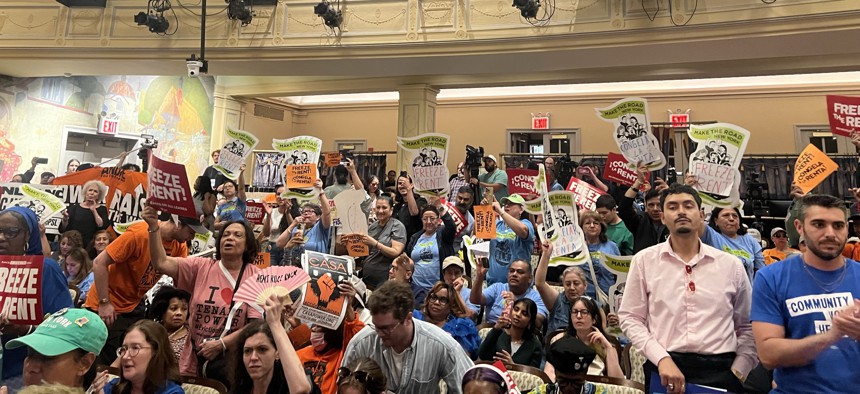
A room packed with housing advocates. Sahalie Donaldson


Make that two for three. A little over halfway into his first year in office, New York City Mayor Zohran Mamdani has made real progress on two of his three central campaign promises.
On Thursday, the city’s Rent Guidelines Board approved a rent freeze for both one- and two-year leases for the city’s roughly 1 million rent-stabilized units by a 7-1 vote.
“This is a historic victory for New York City tenants,” Mamdani said in a statement following the vote. “After reviewing the data and hearing from New Yorkers across the city, the independent RGB has delivered a freeze on one-year leases, and the first-ever freeze on two- year leases in our city’s history. This is the relief that working people across our city deserve.”
Hundreds of New Yorkers packed into the El Museo del Barrio auditorium in East Harlem Thursday evening to hear the highly anticipated outcome. It was a raucous – albeit celebratory – occasion, punctuated with cheers, chanting and whistling. Organizers from New York State Tenant Bloc, CAAV Voice and other advocacy groups led the crowd in chants as the auditorium filled to capacity. Attendees held red signs reading “freeze the rent, which had been distributed by the city’s chapter of the Democratic Socialists of America.
The Rent Guidelines Board took a preliminary vote on the matter in May, setting a range of possible allowable increases for one-year leases – between 0-2% – and two-year leases – between 0-4%. While not definitive, tenant advocates rejoiced at the possibility that a rent freeze could actually be on the horizon. Mamdani championed the freeze on the campaign trail, galvanizing droves of New Yorkers around the prospect. Alongside universal child care (some progress made) and free buses (no tangible progress made), “freeze the rent” was one of Mamdani’s three central campaign planks.
Rent freezes aren’t entirely unprecedented. Under former Mayor Bill de Blasio, the board voted to freeze the rent for one-year leases three times, and another time for half a year. But during Mayor Eric Adams’ administration, the board raised the rent every year. Calls for a rent freeze grew louder each year. In 2024, shortly after announcing his candidacy for mayor, Mamdani ran the New York City Marathon in a shirt that said “Eric Adams Raised My Rent.”
On the campaign trail, Mamdani said that he would freeze the rent for every year of his first term. But the Rent Guidelines Board, while its members are appointed by the mayor, is an independent board that is meant to consider a range of data before deciding on rent increases, including landlord costs, cost of living, renter incomes and more. Both tenant and landlord advocates have argued in the past that mayors can and do exert influence over the board’s decision, however.
After being elected mayor and taking office, Mamdani backed off his explicit calls for a rent freeze, but appointed five new members and one returning member of the nine-person board, giving tenant advocates tangible hope in a freeze. That hope was fulfilled on Thursday night.
One of the board’s two members representing owners was notably absent for the vote. Christina Smyth, who also served on the RGB during the Adams administration, submitted her resignation to the board the morning of the vote. “This rebuilt board was required to deliver a rent freeze,” she wrote in her resignation letter. “Everything since has been theater. The hearings, the reports, the public comment, the data. None of it was ever going to change the result.” The other owner representative, Maksim Wynn, gave a speech calling for better tools to help landlords, but nonetheless voted in favor of a rent freeze.
Smyth’s dramatic departure has drawn speculation that the board’s decision could face legal challenges by landlord groups. Smyth told the Daily News that she would “do everything I can to assist” in challenges by landlords “aggrieved by the way this process has played out.”
In a prepared statement, Ann Korchak, board president of the landlord group Small Property Owners of New York, called the vote a “farce.” “The RGB may have technically met its quorum requirements, but proceeding with one of the most consequential rent votes in recent times with half of its owner representation undermined the balance and fairness of this process,” Korchak said. “On top of being an owner voice short, this is an egregious violation of the RGB’s legal mandate to set rent adjustments based on the math of its own research, not on political influence. There is no practical or legal justification for this outcome.”