

Artificial Intelligence
Mamdani’s government has started to embrace AI. Will he?
The personally AI-avoidant mayor faces calls to both expand use of cutting-edge technologies and put in guardrails to curb their usage.

Eric Adams was all in on AI. Zohran Mamdani could be a Big Tech spoiler Thomas Fuchs



In late January, when New York City Mayor Zohran Mamdani was laying out his case for why his predecessor was to blame for the city’s $12 billion budget gap, he reached for an evocative example of government waste. A line item that could be used to symbolize what he deemed the “Adams budget crisis.”
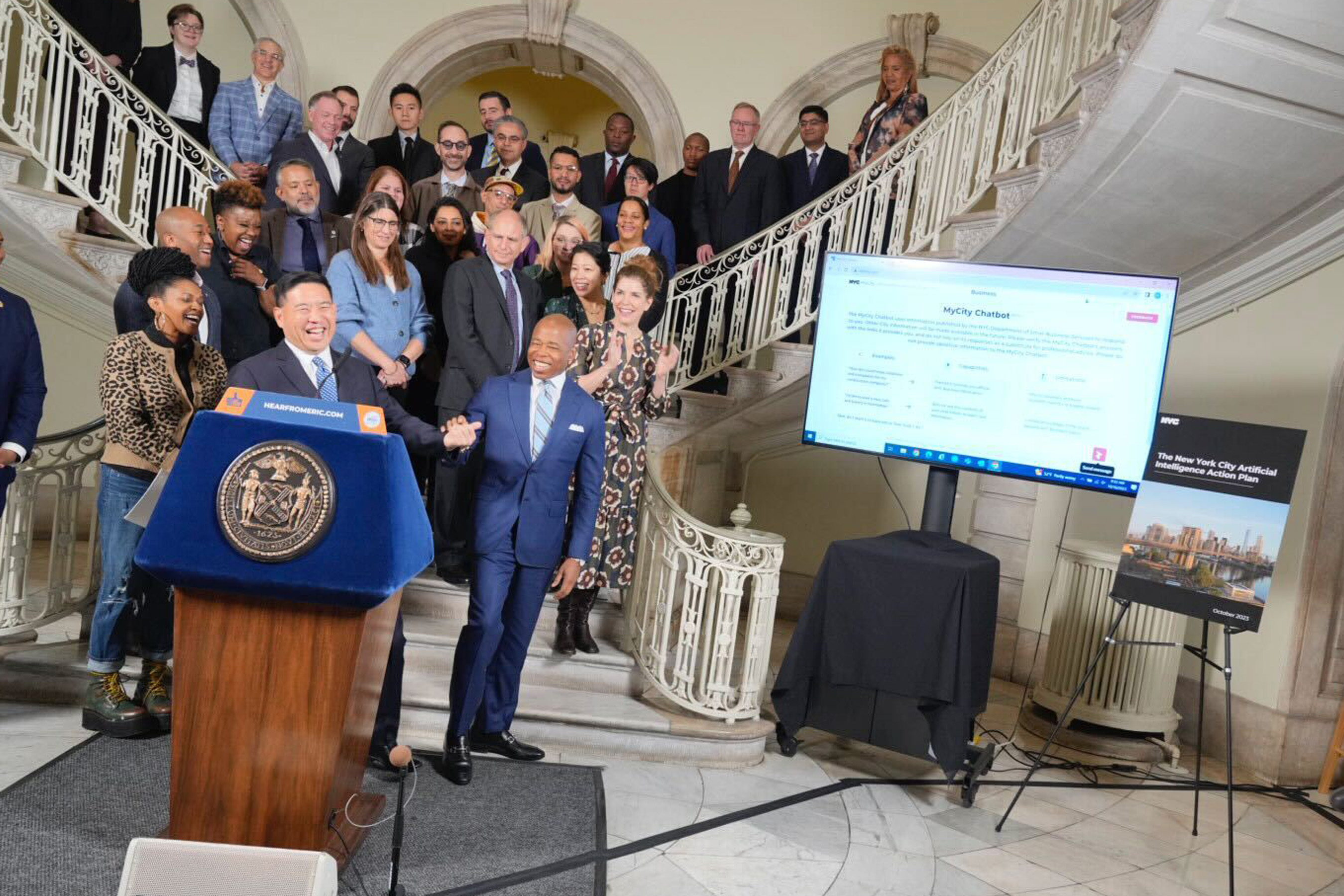
He landed on a $500,000 AI chatbot.
The MyCity chatbot, Mamdani said, was “functionally unusable.” (Among other problems, it advised business owners to break the law.) Mamdani vowed to get rid of it, and he did.
Axing the chatbot was an easy move. It was a relic from a bygone era of tech exceptionalism embraced by an avowed capitalist, crypto-enthusiast and self-declared “tech mayor,” Eric Adams. Adams publicly embraced tools like a robotic police dog (first deployed under then-Mayor Bill de Blasio) and championed a pilot for controversial weapons scanners in the subway.
Adams has continued to boost AI out of office. “AI is not going away folks,” Adams said in June, in a three-minute video that urged AI education and lambasted “some of the affluent voices on the far left” who he accused of having a “fear-driven” approach to the technology.
The 34-year-old Mamdani is a digital native who grew up in online chatrooms. But he belongs to that “far left” – and Mamdani’s democratic socialist brand of politics tends to be a bit more skeptical of technology. “Adoption of technology is not inherently a bad thing, but when New Yorkers interact with technology, it should not be mediated through a for-profit company that is enriching tech oligarchs further,” said Julie Swoope, a member of the New York City Democratic Socialists of America’s steering committee and a former member of its technology working group. “I think that applies to AI, I think that applies to lots of technologies.”
Mamdani said he doesn’t explore AI personally – at least to the extent he can help it – telling City & State in April that he doesn’t use Claude or ChatGPT. But the city government he inherited does, and with far wider scope than the highly publicized MyCity app.
There are the high-profile uses of AI tools by the New York City Police Department, like ShotSpotter and facial recognition. There are also new and more mundane uses of AI, and others aimed at making up for a lack of human resources. For the past six years, city agencies have been required to report any algorithmic tools they’ve used in the prior year to the city’s technology agency, which then publishes all of them in a report. They include algorithms that have been used for years – and that have come under scrutiny, like a tool that uses geographic and demographic data to help decide which child welfare cases to review.
More recently, the city has embraced large language models like chatbots. In the 2025 report, before Mamdani took office, at least one city agency and four mayoral offices used ChatGPT for tasks ranging from drafting emails to brainstorming interview questions to suggesting social media copy.
The 311 app offers New Yorkers the option to upload a photo and have Microsoft’s AI products match it to the relevant service request.
The Department of Environmental Protection acquired AI tools to help verify photos and videos of idling car complaints for potential enforcement, and analyze street camera footage to help identify potential muffler noise violations. Applications like these seem benign, but still stress out some lawmakers, advocates and unions about the changing nature of city work.
Mamdani’s administration has not reported any public meetings with major industry players like Open AI or Anthropic, but his interim economic development president cheered the recently announced expansion of Anthropic’s New York City office. Gov. Kathy Hochul – who has both embraced AI as a tool to make state government more efficient and signed a moratorium on new, large data centers used to power it – also celebrated the expansion.

If Adams’ embrace of AI bolstered his reputation as a tech evangelist, Mamdani is running the city at a time when AI’s use, across all workplaces, has become ubiquitous. Adoption is less about being at the cutting edge but what workers across many industries are being told they need to do to stay afloat.
“Artificial intelligence used to be thought of as something for the future or something about the future,” said John Paul Farmer, who served as the city’s chief technology officer in the de Blasio administration, which released its own AI strategy. “It’s not a future issue anymore. It’s here and it’s infrastructure and it’s going to stay.”
Mamdani is now leading a city government that has already bought into a not insignificant level of AI usage. And the decision on whether to further embrace the technology or close City Hall’s doors to it is arriving at his desk sooner than he might have thought.
Like-minded progressives – and other lawmakers – are currently urging Mamdani to implement a moratorium on the use of AI tools in New York City public schools. At the same time, the city is overdue to comply with a City Council law passed last year requiring the creation of a new Office of Algorithmic Accountability, tasked with analyzing algorithmic tools used by city agencies, evaluating their risks and setting up a process for public complaints and corrective action.
Council Member Jennifer Gutiérrez, who sponsored that law and who chaired the Committee on Technology during the Adams administration, is among those urging more caution about AI use by government. “I don’t think that we’ve had a good example of how AI technology can be unapologetically helpful,” she said. “A lot of these AI tools still have so much bias, and the algorithms are completely flawed.” AI should also not be used to replace city employees, but as a supplement, she added.
Mamdani has answered diplomatically when asked about his views on AI in government. He has said the city is working on guidelines for AI use, echoed broad concerns about the threat of automation on jobs, and, in an interview with City & State, acknowledging that “there are things that AI allows the administration to do that it couldn’t do prior.” But so far, he hasn’t said anything about what kinds of applications might fit that bill.
“Technology should serve people, not replace, exploit, disempower or discriminate against them,” City Hall spokesperson Jeremy Edwards said in a statement, in response to questions about how the Mamdani administration will use (and not use) AI. “The Mamdani administration will deploy artificial intelligence only where it demonstrably improves life for New Yorkers. We will not allow its adoption at the expense of workers, our environment or our civil rights.”
A new AI era?
If Mamdani himself has been AI-avoidant, there have been a few signs that his administration won’t be. The administration isn’t halting uses already underway at city agencies wholesale. In fact, it’s scaling some up. The Department of Transportation, for one, is expanding a pilot program that has deployed AI-powered sensors to analyze street traffic. Spokespeople for City Hall and the Office of Technology and Innovation didn’t respond to questions about whether they’ve identified any uses of AI by city agencies that they deemed inappropriate – apart from Adams’ doomed MyCity app.
The Charter Revision Commission convened by the mayor – also known as the Commission on Government Efficiency – referenced AI in its preliminary staff report published earlier this month as something that could help the city better deliver services. “The most capable tools in the history of computing, including a generation of artificial intelligence that can analyze data, automate tasks and process information at exceptional speed, are arriving in public life all at once,” the report reads. “If we can meet this moment, the city can use these emerging technologies to build the government that New Yorkers deserve – one that cuts through bureaucracy to deliver faster and better services and frees public servants to spend their time on the problems New Yorkers care about most.”
Mamdani, however, has not disclosed in detail what “meeting the moment” would look like in his administration. He faces immediate pressures that could test his strategy of measured distance when it comes to AI. Parent groups, teachers and a bipartisan majority of City Council members have called on schools Chancellor Kamar Samuels to implement a moratorium on the use of AI tools in schools, following backlash to a draft policy on AI guidance released by the Department of Education earlier this year. Mamdani and Samuels have not agreed to a full moratorium and have pushed back an initial June deadline for releasing updated guidelines.
But Mamdani has to think about another interest group: DSA. Swoope said NYC-DSA has not gone through a democratic process to establish a formal position on the topic of AI in schools but said, “The use of for-profit technological products around students in schools is something that I think we should be very careful about, because these products are not necessarily manufactured with the public interest in mind.”
Mamdani has brought on people to lead the administration’s AI work who have focused on the civil rights implications of technology and AI in particular – in line with the general skepticism toward technology and technology companies that carries through much of Mamdani’s political base. That includes Rashida Richardson, a civil rights attorney whose work has included researching the “social and civil rights implications of artificial intelligence and emerging technology policy interventions.” As senior adviser on technology and innovation under Deputy Mayor for Operations Julia Kerson, Richardson counsels on AI, among other technology topics.
City Hall and OTI denied requests for interviews with Richardson and the city’s Chief Technology Officer Lisa Gelobter. They also did not say in detail what kind of progress has been made in complying with the AI-related bills passed by the City Council last year, referred to as the GUARD Act. That includes Gutiérrez’s bill requiring the creation of an independent Office of Algorithmic Accountability, and a bill sponsored by Speaker Julie Menin that requires that office to set mandatory citywide standards on privacy, fairness and transparency for any algorithmic tools used by city agencies.
Per the law itself and OTI testimony to the City Council in March, the new office was supposed to be created by June. The city’s recently passed budget includes $1.4 million for six new employees for the office. But there’s no sign the office exists yet.
It’s unclear how much the new administration will rely on successive blueprints released by prior administrations for how to approach AI – including an AI Strategy released under de Blasio and a still in-progress AI Action Plan released under Adams – or whether it plans to write its own AI plan.
Despite unanswered questions, some of those hoping to see the new administration put up strong guardrails are optimistic. “I genuinely feel like we’re in a better position” with this administration, Gutiérrez said, noting that she’s encouraged by conversations she has had so far with Richardson and with Gelobter, who she said seems “genuinely excited about guardrails.”
But the mayor’s relative silence on AI has left room for those more excited about the technology to express cautious optimism. New York City Comptroller Mark Levine has been enthusiastic about AI – and insistent on preparing for its broader negative and positive impacts on the city – for years. “I think that he is looking to improve city government,” Levine said of Mamdani. “So I’ve got to believe that he will be open to technology as a vehicle for doing that.” Shortly after Levine said that, Mamdani announced a new initiative to hire public sector technologists to help build out its own tools and cut down on reliance on outside vendors.
As for Mamdani’s own curiosity about AI, Levine said he isn’t looking to lecture the mayor but suggested everyone should try to understand the capabilities and failures of the technology firsthand.
“We should all push ourselves beyond our comfort zone to learn, even when it’s tough,” Levine said. “I certainly have, and that does absolutely include understanding the weaknesses and shortcomings of these tools, which you’re better equipped to recognize when you have experience yourself.”