

Policy
What Mamdani’s Office of Community Safety does in the aftermath of tragedy
Some elected officials are still waiting to see the effects of the mayor’s gun violence prevention plans.
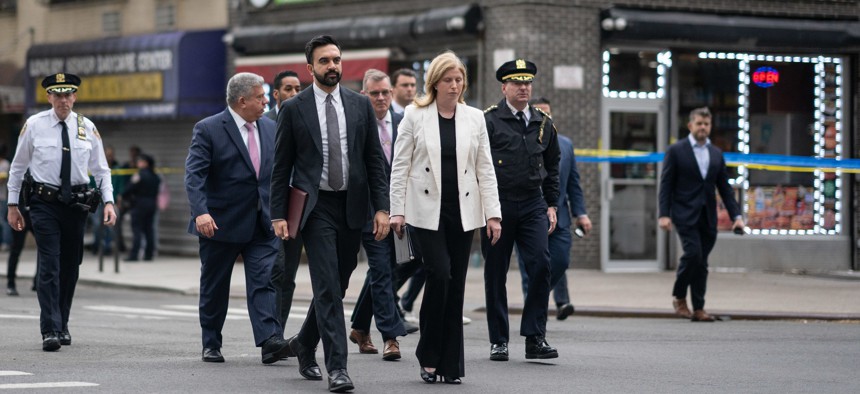
New York City Mayor Zohran Mamdani and Police Commissioner Jessica Tisch held a press conference after a 7-month-old baby was killed in a shooting in Brooklyn in April. Michael Appleton/Mayoral Photography Office


New York City Mayor Zohran Mamdani is known for his messaging. Catchy digital videos, attention-grabbing press conferences, and viral slogans all told New Yorkers what he would do if elected.
But in the four months since Mamdani launched a new Office of Community Safety, some supporters (and detractors) are still waiting to see his vision for fighting gun violence, and what new ideas the office will bring to the table.
As a mayoral candidate last year, Mamdani vowed to launch an ambitious Department of Community Safety. He largely focused on its goal of scaling up non-police responses to mental health crises when campaigning on the idea, but the blueprint for the department also laid out a vision for fighting gun violence. Instead of a full-fledged department, once elected, he launched a much smaller Office of Community Safety – something he could do on his own. He hired a deputy mayor and commissioner to lead it in March, and allocated $260 million to it in the budget.
The office, described as a stepping stone for a larger department, is led by Deputy Mayor Renita Francois and Commissioner Ayesha Delany-Brumsey. It houses multiple offices that already existed under previous administrations, including the Office for Neighborhood Safety and the Prevention of Gun Violence.
After receiving significant pushback for previously calling to defund the NYPD, critics were concerned Mamdani would push for police cutbacks in favor of his community safety initiatives. But in fact, most experts City & State spoke to said that the NYPD, led by Police Commissioner Jessica Tisch, is running similarly under Mamdani as it did when Tisch led it under former Mayor Eric Adams.
A major focus of the Office of Community Safety’s work on gun violence, meanwhile, appears to be supporting the existing Crisis Management System. Under former Mayor Bill de Blasio, Francois worked at the Mayor’s Office of Criminal Justice, which helped launch the CMS in 2014 as an answer to reducing violent crimes via conflict mediation and connecting residents to services in partnership with nonprofit providers. After the creation of OCS, CMS now falls under their leadership instead of under the Department of Youth and Community Development, as it did under Adams.
OCS has been involved in responding to recent shootings, including one in Coney Island earlier this month, and the killing of 12-year-old Jacob Freytes by a stray bullet in the Bronx last weekend, per City Hall. “Jacob was an innocent 12-year-old who loved to ride his bike. He rode his bike to the store. That’s what 12-year-olds do,” Bronx Borough President Vanessa Gibson told City & State. “He should have never died, never.”
According to City Hall, following the Bronx shooting, OCS organized multiple groups on the ground to canvas the neighborhood and help prevent retaliatory violence. CMS providers met with the victim’s family at the hospital, provided temporary housing assistance to the Freytes family and grief counseling. Another CMS organization is providing funeral and bereavement support. At the Dominican Day Parade, held in the Bronx the day after the shooting, OCS deployed multiple gun violence and interrupter groups, including one Spanish-language one, to be on hand in the aftermath.
“Any instance of gun violence in this city is too many, which is why the Mamdani administration is taking a whole-of-government approach to addressing the scourge of gun violence – including by taking thousands of illegal weapons off the street, expanding evidence-based crime prevention strategies through the Office of Community Safety, keeping young New Yorkers engaged in summer employment and extracurricular activities, and supporting survivors with wraparound services such as housing and mental health counseling,” City Hall spokesperson Lekha Sunder said in a statement.
Spokespeople for the mayor’s office and for NYPD confirmed there was coordination between OCS and the 44th precinct of the NYPD on the scene the night of the Bronx shooting.
“As the Police Commissioner stated, no arrest can ever ease the pain of this unimaginable loss, and the NYPD remains focused on taking guns off our streets and holding those who commit violence accountable,” NYPD spokesperson Bradley Weekes said in a statement. “Members of the NYPD removed 16 guns off our streets and made 16 gun-related arrests in the 44 Precinct in the Bronx, both during the Bronx Dominican Day Parade and the activities after. There were zero reported shootings within the precinct.”
The NYPD has taken over 2,000 guns off the streets of New York City so far this year, Tisch announced at a press conference earlier this month. She also touted a 12% decline in overall crime in the Bronx in the first half of 2026 compared to the same period last year, noting the Bronx is leading a citywide decline. Shootings are down 3.9% in that same period in the Bronx.
On July 13, OCS rolled out a “Summer Safety Strategy,” dedicated to victims of gun violence, which includes expanding enrollment in gun violence prevention programs, hosting “peacebuilding” activities for Gun Violence Awareness Month in June and increasing awareness of high-risk periods for violence.
The city is also now directing CMS providers to activate a 72-hour shooting response protocol to support victims in the aftermath of gun violence, which City Hall said is a new action. OCS has allocated $4.8 million to a CMS expansion across three precincts, $4.3 million to expand hospital-based violence intervention programs and $1.5 million dollars invested for new mobile response units, which cover ground where CMS doesn’t have providers.
Gibson told City & State that she was impressed by the efforts made by the Office of Neighborhood Safety and CMS – both now a part of OCS – to support the Freytes family in the aftermath of the shooting, and provide them resources like temporary housing.
She said under the new administration, the Office of Neighborhood Safety is taking more of a community engagement approach for the whole city, while she said they previously focused on violence around New York City Housing Authority complexes.
“When it comes to what is needed on the ground: the presence of the mayor’s office, the facilitation of partnerships, and what a family’s immediate needs are right after the aftermath of a shooting,” Gibson said. “Some of the short-term needs, long-term needs, a lot of counseling is necessary, and really triaging all of that and putting it together because it's a lot.”
Others are still waiting to see exactly what the new office has to offer. Queens Borough President Donovan Richards told City & State that he has not yet felt the weight of the new office as it is a “newborn baby.” He added that he has not seen a strategic plan put into place yet, and stressed that a multi-agency plan and interdisciplinary approach are needed.
“For a mayor who definitely ran on an equity framework and really talked like ‘We’re gonna do the rent freeze,’ Fine, that’s great. Universal childcare, great. But that’s not helping me with the 12-year-old who’s being lured by a gang. It’s absolutely not helping me at the moment because most of my gun violence incidents are now teens,” he said. In April, a 15-year old, Jaden Pierre, was shot and killed in a St. Albans park – a group of teens were charged with the shooting.
Some gun violence prevention advocates are hopeful about OCS. Multiple advocates in the space have said they have seen increased cooperation and willingness to listen and learn from Mamdani’s administration compared to Adams, particularly after he formed a transition committee with experts from the field. However, that increased cooperation and willingness to listen still did not come with any clearer messaging regarding the mayor’s vision for gun violence prevention.
“I think that they’re not seeing a difference now, and there’s still a little bit of a grace period because we’re in that first year,” said Obi Afriyie, an organizer for the NAACP Legal Defense Fund who is involved in police reform work. “I will say, grace periods can be over real quickly. There needs to be like one clear structure and plan set in place because you’re not going to fix gun violence in four years. This office is so amazing because they have provided so much hope. But sometimes it can feel like a laundry list. Like you can’t fix mental health crises, quality life offenses and this gun violence stuff in one go.”
If the mayor plans on expanding OCS into a full-fledged department, this first year of OCS will be crucial. At a June budget hearing for the NYPD, City Council Speaker Julie Menin expressed concern that the mayor had pledged $260 million to launch OCS, while Tisch could not provide her with any info regarding communications with the office.
“The most important thing that City Hall can do is show up,” Gibson said. Mamdani was not on the scene at last weekend’s shooting, but Gibson said City Hall was still represented. “I appreciate when City Hall shows up, and that’s what (the Office of Neighborhood Safety) did on Saturday, and that’s what I fully expect them to keep doing.”